Pakistan joins global AI body, the World Artificial Intelligence Cooperation Organization, as a founding member in a move that places Islamabad within a new China-backed initiative seeking wider international coordination on artificial intelligence.
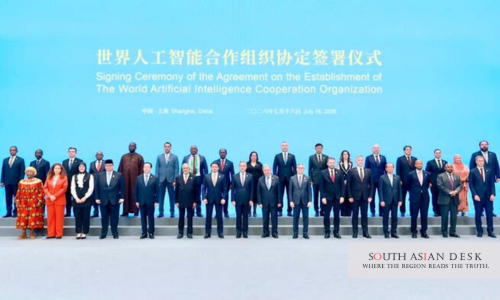
Deputy Prime Minister and Foreign Minister Ishaq Dar signed the agreement establishing the organisation on Pakistan’s behalf during a ceremony in Shanghai on 16 July.
The new intergovernmental body, commonly referred to as WAICO, has been established to promote international cooperation on the development, governance and use of artificial intelligence. Its formation follows growing international debate over how rapidly advancing AI systems should be regulated and how access to the technology can be widened beyond a small number of developed countries and multinational corporations.
Pakistan’s Foreign Office said the country would use its founding membership to support international AI cooperation from the perspective of the Global South. Islamabad also expressed its intention to work with other members to narrow the global AI divide and promote more equitable access to emerging technologies.
The decision gives Pakistan a formal place in a new international forum at a time when governments are competing to influence global standards for AI safety, data governance, technological development and access to computing infrastructure.
Pakistan joins global AI body amid governance debate
Pakistan joins global AI body WAICO as international institutions attempt to respond to the economic, political and security consequences of artificial intelligence.
AI governance has become an increasingly important area of diplomacy because the technology can affect employment, education, health care, public administration, cybersecurity, military systems and access to information. Governments are also considering how to address risks associated with algorithmic discrimination, misinformation, privacy violations and the concentration of computing resources.
China first proposed the establishment of the World Artificial Intelligence Cooperation Organization during the World Artificial Intelligence Conference in Shanghai in 2025. Chinese officials presented the initiative as a platform for cooperation on development strategies, governance rules, technological standards and AI capacity-building.
Beijing has repeatedly argued that AI should not become an exclusive field dominated by a small group of countries or technology companies. Its stated approach places particular emphasis on the needs of developing economies, many of which lack access to advanced computing capacity, specialist skills, investment and high-quality datasets.
The organisation’s establishment could create another centre of influence within an already complex global AI governance system. Existing initiatives include processes led by the United Nations, the Group of Seven, the Organisation for Economic Co-operation and Development and several regional organisations.
WAICO’s effectiveness will depend on the obligations accepted by its members, its institutional structure and whether it can translate broad commitments into practical cooperation. Detailed information about its decision-making arrangements, funding system, enforcement powers and technical programmes will be important in determining its long-term role.
Pakistan seeks Global South AI cooperation
Pakistan has presented its membership as an opportunity to ensure that developing countries have a stronger voice in decisions affecting the future of artificial intelligence.
Global South AI cooperation is becoming increasingly important because countries enter the AI economy with significantly different levels of infrastructure and technical capacity. Advanced AI development depends on powerful computing systems, reliable electricity, specialised data centres, skilled researchers and large volumes of usable data.
Countries without these resources risk becoming consumers of foreign AI systems rather than developers of their own technology. This could deepen dependence on external platforms and limit their ability to shape systems according to local languages, laws and social conditions.
For Pakistan, participation in WAICO could potentially support access to training, research partnerships, technical knowledge and international policy discussions. It may also provide opportunities for Pakistani universities, technology companies and public institutions to participate in collaborative AI programmes.
However, formal membership alone will not close Pakistan’s technological gaps. Benefits will depend on the development of domestic infrastructure, research institutions and regulatory capacity, as well as the government’s ability to convert diplomatic agreements into funded projects.
Pakistan will also need to ensure that international cooperation supports local innovation rather than increasing long-term dependence on imported technology.
Pakistan AI policy sets ambitious targets
Pakistan’s decision to join WAICO follows the approval of the National Artificial Intelligence Policy in July 2025.
The Pakistan AI policy sets out a national framework covering innovation, public awareness, workforce development, cybersecurity, infrastructure, regulation and international partnerships. It seeks to encourage the adoption of AI across the economy while creating safeguards for responsible use.
Among its major targets is the training of one million new and existing information technology graduates in AI and related technologies by 2027. The policy also envisages the preparation of 10,000 trainers to support the expansion of AI education.
The government plans to establish centres of excellence in major cities, including Islamabad, Lahore and Karachi, with auxiliary centres in other parts of the country. These institutions are intended to connect academic research with industry, support startups and expand access to computing infrastructure.
The policy also proposes a National AI Fund, regulatory testing arrangements, specialised training for public officials and stronger integration of data science and AI into the education system.
Other objectives include supporting AI research, promoting locally developed models and expanding cooperation with international technology institutions.
These targets demonstrate the scale of Pakistan’s ambitions, although implementation will require sustained funding, institutional coordination and measurable progress. The country continues to face challenges involving internet access, digital literacy, research funding, data availability and high-performance computing capacity.
Pakistan-China technology cooperation expands
Dar’s visit to Shanghai also included discussions with Chinese Foreign Minister Wang Yi, during which the two sides reviewed bilateral relations and agreed to deepen cooperation in technology-related fields.
The officials discussed trade, investment, science and technology, the digital economy and artificial intelligence as part of the next phase of the China-Pakistan Economic Corridor.
Pakistan-China technology cooperation has gradually expanded beyond the transport, energy and infrastructure projects traditionally associated with CPEC. Islamabad increasingly views digital connectivity, emerging technologies and innovation as important components of CPEC 2.0.
Closer cooperation with China could help Pakistan secure investment in data centres, cloud computing, telecommunications, digital payments and technology training. China has significant capabilities in AI research, surveillance systems, telecommunications equipment, e-commerce and digital infrastructure.
For Pakistan, the challenge will be to ensure that such cooperation strengthens domestic skills and productive capacity. Agreements that focus only on importing platforms or equipment may deliver short-term improvements without creating a sustainable local technology ecosystem.
Data protection, cybersecurity and procurement transparency will also require attention as digital cooperation expands. AI systems used in public services or critical infrastructure can process sensitive personal and institutional information, making strong legal safeguards essential.
Global AI governance remains divided
The creation of WAICO reflects a wider contest over the principles that should govern artificial intelligence.
Some international frameworks place greater emphasis on human rights, transparency, safety testing and restrictions on high-risk systems. Others focus more heavily on national sovereignty, economic development, technical cooperation and equal access to AI resources.
These approaches are not necessarily incompatible, but differences can emerge over issues such as cross-border data flows, government surveillance, intellectual property, military applications and the regulation of technology companies.
Pakistan will therefore have to balance its development goals with the need to protect individual rights and public safety. Participation in international AI forums can help the country learn from other regulatory systems, but domestic laws will remain central to determining how AI affects Pakistani citizens.
A comprehensive personal data protection framework will be particularly important. AI systems depend heavily on data, and weak safeguards can expose citizens to unauthorised surveillance, profiling, discrimination and misuse of personal information.
Independent oversight, transparent public procurement and clear accountability rules will also be required if AI is introduced into policing, taxation, health care, education or social protection programmes.
Membership creates opportunities and responsibilities
Pakistan’s founding membership of WAICO gives it an opportunity to participate in the early development of an institution that could become influential in global technology diplomacy.
The country could use the platform to advocate for affordable computing access, support for local-language AI systems, technology transfers and greater representation for developing economies in international rule-making.
Pakistan could also seek partnerships in areas where artificial intelligence has practical development potential, including agricultural forecasting, disaster management, health diagnostics, education and public service delivery.
At the same time, membership creates a responsibility to develop credible national standards for safe and ethical AI. International engagement will have limited value unless it is supported by stronger universities, research funding, digital infrastructure and enforceable protections for citizens.
The establishment of WAICO is still an early step, and the organisation’s practical influence will become clearer as its institutional arrangements and programmes develop.
For Islamabad, the central test will be whether its membership results in meaningful research cooperation, investment and skills development. If implemented effectively, the initiative could support Pakistan’s efforts to build a more competitive digital economy and secure a stronger voice in the future of global AI governance.
Published in SouthAsianDesk, July 17, 2026
Follow SouthAsianDesk on X, Instagram and Facebook for insights on business and current affairs from across South Asia.