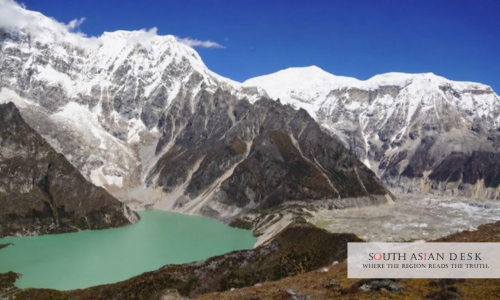
Bhutan glacier loss has intensified, with 27 glaciers disappearing and the country’s total glacier area shrinking by 57.69 square kilometres over a nine-year comparison period, according to a new national assessment.
The decline represents a 9.16 per cent reduction in Bhutan’s glacier cover. The latest inventory recorded 673 glaciers, compared with 700 in the earlier assessment, providing fresh evidence of the rapid physical transformation taking place across the country’s high-altitude Himalayan landscape.
The findings were presented by Bhutan’s National Centre for Hydrology and Meteorology, which monitors glaciers, snow, glacial lakes and other parts of the country’s cryosphere. Officials linked the continuing retreat and fragmentation of glaciers to rising temperatures associated with climate change.
Bhutan glacier loss reshapes the Himalayan landscape
The latest data show that the effects of Bhutan glacier loss are not limited to the complete disappearance of individual glaciers. Larger ice bodies are also retreating and breaking into smaller sections.
This fragmentation can make glacier numbers appear to increase in individual river basins even while the overall volume and area of ice continue to decline. The Mangde Chhu basin, for example, recorded an increase in the number of mapped glaciers because larger glaciers had separated into smaller units.
Most of Bhutan’s remaining glacier area is now concentrated at elevations between 5,000 and 5,700 metres above sea level. Smaller and lower-altitude glaciers are generally more vulnerable to warming because comparatively small changes in temperature and snowfall can significantly alter their annual balance of ice accumulation and melting.
The latest findings are consistent with broader evidence of Himalayan glacier retreat. A separate scientific study examining the Bhutanese Himalaya between 1976 and 2024 found that hundreds of small glaciers had disappeared over the longer period, with most recorded losses occurring after 1998. The study identified small glaciers as particularly vulnerable and found that glaciers ending in lakes were retreating more quickly than those terminating on land.
Glacial lake expansion accompanies shrinking ice
As Bhutan glaciers retreat, meltwater is collecting in depressions and valleys previously occupied by ice. The new national inventory counted 620 glacial lakes, an increase of 53 from the 567 recorded in the 2021 inventory.
The area covered by glacial lakes has expanded from approximately 55.04 square kilometres to 58.18 square kilometres. The Pho Chhu sub-basin remains the country’s most active glacial lake region, with the latest assessment recording 187 lakes there, compared with 157 in the previous inventory. Some lakes have reportedly doubled in size.
The increase in both the number and area of lakes reflects continuing glacial lake expansion, although comparisons between inventories require some caution. Differences in satellite resolution, mapping criteria, minimum lake-size thresholds and analytical methods can affect the number of features identified.
The latest assessment used Sentinel-2 satellite imagery and deep learning models, marking a shift from earlier approaches that relied more heavily on manual identification. Bhutan’s previous inventory also noted that different datasets and classification standards could produce substantial variations between national and regional estimates.
Glacial lake outburst floods threaten communities
The simultaneous retreat of glaciers and expansion of lakes is increasing concern about glacial lake outburst floods. These events occur when water suddenly escapes from a glacial lake after the failure or overtopping of a natural dam made of ice, rock or loose glacial debris.
Such floods can move rapidly through steep valleys, carrying water, sediment and boulders towards settlements, agricultural land, bridges, roads and power infrastructure.
Bhutan has experienced several such events. Lemthang Tsho disappeared from subsequent inventories after an outburst flood in 2015 widened its outlet, damaged bridges and affected trails downstream. The event demonstrated that glacial lakes can change or drain rapidly, making regular satellite and field monitoring essential.
A 2026 scientific assessment estimated that potential glacial lake outburst floods in Bhutan could expose more than 11,000 people, approximately 2,500 buildings, more than 250 kilometres of roads, over 400 bridges and around 20 square kilometres of farmland.
The study classified Thorthormi Tsho as a very high-hazard lake and identified five other lakes as high-hazard sites. It also found that several local government areas facing high or very high risks had not been fully recognised in previous assessments.
These findings suggest that hazard assessments cannot focus only on the size or physical condition of a lake. Authorities must also consider the number of people, buildings, farms, roads and public facilities located along possible flood paths.
Climate change in Bhutan raises water security concerns
The effects of climate change in Bhutan extend beyond the immediate danger of floods. Glaciers, seasonal snow and glacial lakes help regulate river systems by storing water during colder periods and releasing it during warmer months.
Accelerated melting may temporarily increase river discharge. Over the longer term, however, the loss of glacier mass can reduce the amount of stored ice available to sustain rivers during dry periods. This creates uncertainty for drinking water, agriculture, ecosystems and Bhutan water security.
Regional assessments warn that water availability across the Hindu Kush Himalaya could initially increase as melting accelerates, before reaching a peak and declining as glacier reserves become smaller. Even if global warming is limited to between 1.5°C and 2°C, glaciers across the region are projected to lose between 30 and 50 per cent of their 2015 volume by the end of the century.
Changing river flows also present challenges for Bhutan hydropower. Hydroelectric plants depend on reliable water supplies, while extreme floods can threaten dams, transmission networks, access roads and other supporting infrastructure.
The consequences may differ by season. Increased melting could produce higher flows and sediment levels in the near term, while continuing ice loss could eventually contribute to more variable or reduced dry-season water supplies.
Monitoring and early-warning systems become more urgent
The new inventory provides an updated baseline for national planning. Authorities intend to update glacier and glacial lake records every five years, allowing scientists to identify newly formed lakes, track expanding water bodies and monitor changes in glacier area.
However, satellite observation alone cannot remove the danger. Researchers have recommended stronger flood modelling, expanded early-warning systems, community evacuation planning and closer monitoring of high-hazard lakes.
Infrastructure planning will also need to account for changing flood routes, sediment loads and river conditions. Roads, bridges, settlements and hydropower facilities built on or near exposed valleys may require revised risk assessments as the mountain environment changes.
Bhutan is recognised as one of the world’s few carbon-negative countries, yet its glaciers remain exposed to warming caused largely by global greenhouse gas emissions. The country’s experience highlights the disproportionate burden climate change places on small mountain states that have contributed relatively little to the problem.
The disappearance of 27 glaciers is therefore more than a change on a national map. It is a warning that Bhutan’s water systems, mountain ecosystems, hydropower infrastructure and downstream communities are entering a period of increasing uncertainty.
Published in SouthAsianDesk, July 17, 2026
Follow SouthAsianDesk on X, Instagram and Facebook for insights on business and current affairs from across South Asia.