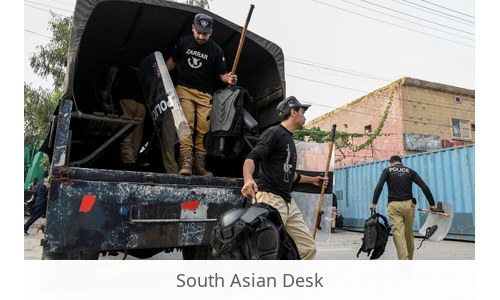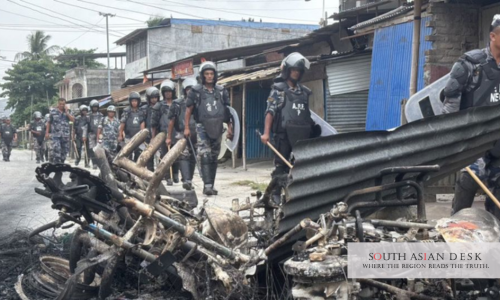
Nepal police riot control gear has moved to the top of the government’s procurement agenda following sustained public criticism over the deaths of four people in security force firings during communal tensions in the Tarai-Madhesh region. The Ministry of Home Affairs has confirmed that the purchase of non-lethal crowd control equipment is now proceeding under formal tender procedures, alongside preparations to amend the legislation that governs when officers may open fire.
The ministry is also moving to introduce advanced technologies, including drones capable of firing tear gas and broadcasting public announcements to assembled crowds.
Why the Nepal police riot control gear purchase stalled
Home Minister Sudan Gurung, who returned to the portfolio in June 2026 after resigning in April, has attributed the delay to budgetary constraints rather than policy reluctance. Speaking to local media, he said that operating under the previous budget had restricted the ministry’s capacity to authorise new purchases, and that the current budget cycle has cleared the way for procurement to begin.
The minister said the objective is to secure the full range of non-lethal weapons required for effective crowd management, rather than acquiring equipment piecemeal.
Drones and real-time monitoring in the new crowd management strategy
The revised strategy places drones at its centre, deployed for surveillance, public address, and tear gas delivery. According to the Home Minister, aerial monitoring linked to a central command will strengthen physical barricades and allow commanders to assess crowd movement as it develops. The stated priority is the protection of critical infrastructure without loss of life.
That emphasis reflects a specific institutional failure. During the Gen Z demonstrations of 8 September 2025, protesters breached police barricades outside the parliament building in New Baneshwar with relative ease. Security personnel subsequently opened fire, and 19 people, most of them young, were killed on the first day alone. Officials cited the Essential Goods Protection Act, which permits the Special Task Force to use lethal force where vital infrastructure faces imminent threat.
Legal amendments to accompany the equipment upgrade
The home ministry is preparing comprehensive amendments to both the Essential Goods Protection Act 1955 and the Local Administration Act 1971. The minister indicated that the ministry intends to introduce durable revisions following consultation, rather than repeated incremental changes.
He also acknowledged a cultural problem within the security services, noting that many personnel continue to default to live ammunition when tensions escalate, and that the ministry aims to establish an administrative system that treats non-lethal alternatives as the standard response.
The judicial commission led by former judge Gauri Bahadur Karki, which investigated the September 2025 violence and submitted its report in March 2026, had already recommended amending the Local Administration Act 1971 to define clearly the circumstances in which security forces may open fire during curfews. The commission’s report further identified a chronic shortage of basic protective and non-lethal crowd control equipment, including body armour, shields, and tear gas.
A documented shortage behind the Nepal police riot control gear deficit
Procurement records support that finding. Data from Police Headquarters in Naxal indicates that Nepal Police has not purchased significant quantities of tear gas since the 2020-21 fiscal year. The force acquired 4,000 canisters annually in 2019-20 and 2020-21, following purchases of 6,000 canisters in 2018-19 and 10,000 canisters in 2017-18. The resulting freeze left officers relying on expired stock during major demonstrations, a practice that attracted sharp public criticism.
The Home Minister has stated that expired tear gas has not been deployed under his tenure, adding that de-escalation through dialogue remains the first priority and that the use of expired munitions is strictly prohibited.
Earlier attempts to close the gap collapsed. Former inspector general of police Deepak Thapa recalled a proposal to acquire Rs760 million worth of non-lethal riot control equipment, including tear gas, shotguns, rubber bullets, and protective gear, which was cancelled at a late stage despite assured funding and an advanced tender process. Disputes arose after the letter of credit had already been opened.
Training gaps and government-to-government procurement
Senior officers argue that reliance on live rounds is a symptom of inadequate alternatives combined with insufficient practice. A serving deputy inspector general, speaking on condition of anonymity, observed that personnel who receive only five or six rounds of practice during training cannot reasonably be expected to deliver accurate fire below the knee in live conflict conditions. He called for continuous training and an end to the cancellation of equipment tenders whenever controversy arises.
Thapa has proposed government-to-government agreements as a remedy, arguing that competition among private contractors and commission bargaining are the principal drivers of tender disputes.
Digital security and border surveillance
Beyond crowd management, the ministry is addressing digital vulnerability. The Home Minister acknowledged that government infrastructure remains unprepared for cyberattacks, and said internal systems are being digitised so that directives can be tracked in real time to verify implementation.
Former deputy inspector general Bhim Prasad Dhakal welcomed the shift towards non-lethal technology and recommended parallel upgrades along border corridors, including artificial intelligence enabled gates, CCTV cameras, and X-ray scanners at crossing points to improve monitoring and crime prevention.
Published in SouthAsianDesk, August 10th, 2026
Follow SouthAsianDesk on X, Instagram and Facebook for insights on business and current affairs from across South Asia.