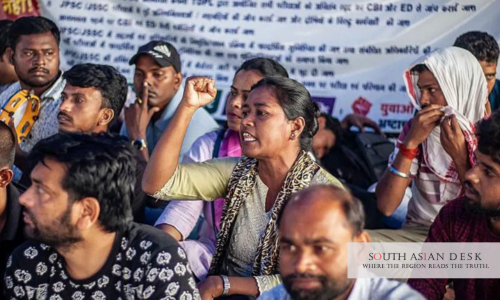
The Jharkhand exam corruption protest has entered its third week, with hundreds of students and job aspirants camped at a stadium in the state capital Ranchi, demanding an overhaul of the state’s government examination system. Several protesters have been sleeping in the open since 25 July, and dozens have gone on hunger strike, refusing to leave until their demands are met.
The demonstrations come weeks after thousands of young Indians took to the streets of Delhi in the so-called cockroach protests over examination paper leaks, a movement that has since extended its support to the Ranchi agitation.
What sparked the Jharkhand exam corruption protest
The immediate trigger was a preliminary civil service examination held in April. After the results were announced in July, candidates alleged that leaked answer sheets circulating on social media showed some successful applicants had answered far fewer questions than their scores suggested, fuelling suspicion that the results had been manipulated.
Protesters are demanding that the examination be scrapped and held again, and that the matter be handed to the Central Bureau of Investigation, India’s premier federal investigative agency. The allegations are currently being examined by Jharkhand’s Criminal Investigation Department, and the Jharkhand Public Service Commission has postponed the next stage of the examination process. The commission’s chairman, L Khiangte, resigned on 22 July and has since been questioned as part of the investigation. Investigators are also scrutinising the role of a private company that conducted parts of the examination, after candidates raised concerns about how it was selected.
Deepika Pandey Singh, a minister in the Jharkhand government, told the BBC that the state had begun investigating the allegations even before the current protest began. She urged demonstrators to allow the Criminal Investigation Department to complete its work rather than transferring the case to the federal agency, stating that the government wanted a fair investigation and that anyone responsible, whether a bureaucrat, employee, middleman or senior politician, would face action. She added that the government was willing to discuss the demand to cancel the April exam directly with protesters.
Personal stakes behind the Jharkhand exam corruption protest
For many demonstrators, the grievance extends well beyond a single examination. Umme Habiba, a 27-year-old from a farming family in Bokaro, has sat the state civil service examination three times while hoping it would secure her a government job. She said the protesters would not leave until they received justice, even at significant personal cost.
Savita Kumari, 28, has been waiting since 2019 and has taken the exam twice. Confident of having cleared this year’s preliminary stage, she found her name missing when results were released, and alleges that some candidates deliberately left answers blank so they could be filled in later. The Criminal Investigation Department has since sought answer sheets from successful candidates and raided the offices of the Jharkhand Public Service Commission and other locations connected to the exam.
Vikram Kumar, who has been waiting since 2019 for the state to recruit assistant engineers, said the relevant examination has been advertised only three times since Jharkhand was created as a state in 2000, despite hundreds of posts remaining vacant.
Political backing sets Ranchi apart from Delhi’s protests
Unlike the Cockroach Janta Party demonstrations in Delhi, which emerged outside formal party politics, the Ranchi agitation has attracted significant political support. The Bharatiya Janata Party, currently in opposition in Jharkhand, has backed the protesters, staged its own demonstrations, raised the matter in the state assembly and demanded a federal investigation. The Indian National Congress, a partner in the state government but a national rival of the BJP, has also voiced support for the students.
Even so, many protesters remain wary of being co-opted by any political party. Vikram Kumar said students would lead the movement and remain visible at the front, adding that politicians were welcome to support the cause but should leave party flags and agendas at home.
Devendra Nath Mahto, widely seen as the public face of the protest and himself on hunger strike, has campaigned on recruitment issues since his student days. He joined a similar protest in 2023 despite not having taken that particular examination, arguing that the cause affects all aspirants regardless of who sits which test.
Where the standoff stands
The camp has settled into a steady rhythm nearly two weeks in. Supporters supply food, water and other essentials, some channelled through Cockroach Janta Party networks. Hunger strikers rest on mattresses beneath tarpaulins during the day, with portraits of B R Ambedkar and independence-era freedom fighters placed nearby, while evenings bring larger crowds, speeches and slogans across the stadium grounds.
The government has offered talks, and protesters have formed an eleven-member delegation to represent their demands, though formal negotiations had not taken place as of Friday. For aspirants such as Habiba, past assurances have left little room for trust, and what they are seeking now is an investigation they can rely on and examinations they believe to be fair.
Published in SouthAsianDesk, August 10th, 2026
Follow SouthAsianDesk on X, Instagram and Facebook for insights on business and current affairs from across South Asia.