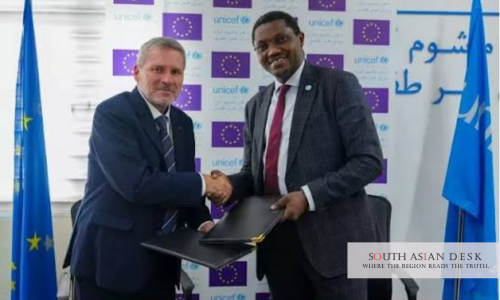
The Afghanistan Humanitarian Fund has received a fresh boost after the European Union pledged €10 million to support relief operations across the country. The United Nations Office for the Coordination of Humanitarian Affairs (OCHA) confirmed the contribution in a statement posted on X on Thursday, thanking the EU for its continued commitment to the people of Afghanistan.
According to OCHA, the new funding will help humanitarian organisations sustain life-saving assistance for millions of Afghans who are facing mounting needs. The agency welcomed the EU’s ongoing support and stressed the importance of continued cooperation between donors and humanitarian partners operating in the country. “Together, we invest in humanity,” OCHA said in its statement.
Why the Afghanistan Humanitarian Fund Matters
Established in 2014, the Afghanistan Humanitarian Fund is managed by OCHA under the leadership of the Humanitarian Coordinator and guided by an Advisory Board made up of donors, national and international NGOs, and UN agencies. As one of OCHA’s largest country-based pooled funds, it allows donors to channel flexible resources directly to frontline organisations delivering food, healthcare, clean water, and shelter to communities in need.
The fund has become an increasingly vital tool given the scale of the humanitarian crisis in Afghanistan. In 2024 alone, it reached an all-time donor contribution level of roughly $1.1 billion, placing it among the three largest pooled funds run by OCHA worldwide. That scale reflects just how central the mechanism has become to keeping aid operations running in a country where needs continue to outpace available resources.
The Scale of Afghanistan’s Humanitarian Crisis
The EU’s latest pledge arrives at a difficult moment. OCHA estimates that around 21.9 million people, roughly 45 percent of Afghanistan’s population, will require humanitarian assistance in 2026. Of these, humanitarian partners are prioritising support for 17.5 million people, with the overall response plan requiring close to $1.7 billion, a target that remains significantly underfunded halfway through the year.
Several overlapping shocks continue to drive the crisis. Afghanistan is now in its sixth consecutive year of drought-like conditions, with twelve provinces severely affected. Food insecurity has worsened sharply, with more than 17 million people projected to face acute hunger in 2026, including nearly 4.7 million in emergency-level conditions, more than double the figure recorded the previous year. Large-scale returns are adding further strain, with more than 2.6 million Afghans having crossed back from Iran and Pakistan in 2025 alone, placing additional pressure on host communities and already stretched basic services.
Aid agencies have also warned that funding shortfalls are directly affecting children. The World Food Programme reported that more than 13,000 children under five were turned away from malnutrition treatment programmes in 2025 because of budget constraints, a trend that aid workers fear could worsen without sustained donor support.
EU Humanitarian Aid to Afghanistan Continues Despite Global Funding Gaps
The EU has remained one of the more consistent contributors to Afghanistan humanitarian assistance even as overall donor funding has declined. Much of this support flows through the European Civil Protection and Humanitarian Aid Operations (ECHO), which has co-financed projects such as small clinics run by NGOs in remote areas of the country, offering a lifeline to internally displaced people, returnees, and host communities with limited access to health care.
This latest €10 million contribution adds to that track record. It comes shortly after the EU and Australia jointly announced more than $19 million in aid for Afghanistan, underscoring a broader push by international donors to keep the humanitarian response funded even as global attention and resources are stretched thin by other crises.
What the New Funding Means Going Forward
For OCHA and its partners, every contribution to the Afghanistan Humanitarian Fund helps close part of a persistent funding gap that has already forced some agencies to scale back operations. The €10 million from the EU will support continued delivery of food assistance, primary health care, clean water, and emergency shelter to some of the country’s most vulnerable communities, including women, children, and people with disabilities who face the greatest protection risks.
While the contribution will not resolve Afghanistan’s broader funding shortfall on its own, OCHA has framed it as a reminder of what sustained international cooperation can achieve. As needs continue to grow across the country, the fund’s ability to attract flexible, reliable support from donors like the EU will remain central to keeping humanitarian operations running through the rest of 2026.
Published in SouthAsianDesk, August 14th, 2026
Follow SouthAsianDesk on X, Instagram and Facebook for insights on business and current affairs from across South Asia.