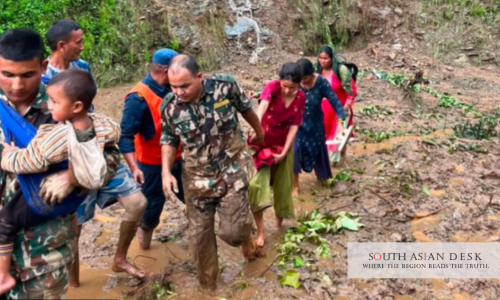
Nepal landslides in Jajarkot have struck communities that were already among the most vulnerable in the country’s western hills, killing residents and displacing hundreds of families in a district still recovering from a devastating earthquake three years ago. Kedar Karki, a resident of one of the remotest parts of Jajarkot, had survived the 6.4 magnitude earthquake that shook the region, only to sustain severe injuries in a landslide that struck his settlement on Saturday evening. He died on the way to a hospital in Nepalgunj.
The disaster is part of a wider crisis unfolding across Jajarkot, where extreme weather is battering communities that remain fragile years after the earthquake first damaged their homes and land. The most recent landslide killed four people and left six others injured, according to the ward chair of Bheri Municipality-2, who described the destruction as devastating for the entire village. Search teams recovered additional bodies on Sunday morning after residents went missing overnight.
Nepal landslides – Earthquake-Affected Settlements Bear the Brunt of the Damage
Earthquake-affected settlements across the district have proven especially vulnerable to the latest round of landslides. In Risang, nearly 90 percent of the roughly 300 households had already been affected by the 2023 earthquake, and the recent landslides have gone on to damage most of the structures that had survived across several surrounding areas. Local officials say that landslides have occurred in almost every neighbourhood, making it difficult for rescue workers to move between clusters or assess the full scale of the damage.
According to Jajarkot’s disaster management authorities, 68 earthquake-affected settlements across the district have been identified as being at high risk of further landslides, spanning multiple municipalities and rural areas. Officials say the earthquake weakened the underlying land structure years ago, and continuous monsoon rainfall has since worsened that instability, leading to repeated collapses.
Monsoon Rains Nepal Season Deepens the Displacement Crisis
The monsoon rains Nepal experiences each year have repeatedly triggered landslides in the same quake-damaged terrain, and this season has been no exception. Approximately 150 people remain trapped in isolated locations across the affected ward, and security forces, including personnel from the Nepali Army, the Armed Police Force and the Nepal Police, have been deployed to assist with search and rescue operations. Displaced residents are currently sheltering in community buildings, with local authorities distributing tarpaulins, tents, utensils and basic food supplies such as beaten rice, instant noodles and biscuits.
One local community leader described conditions as desperate, saying displaced families had not managed a proper meal or a full night’s sleep since the disaster struck, despite each family receiving only a single tarpaulin as ongoing rain continues to fall.
Geologists Point to Long-Term Risk From Earthquake Damage
Geologists have previously warned that landscapes affected by earthquakes face a significantly higher risk of landslides because of deep structural fractures left in the soil. Even brief rain showers or minor tremors can be enough to cause entire hillsides to give way in areas where the underlying rock formation has already been loosened. This pattern has repeated itself in Jajarkot on multiple occasions since the original earthquake, including a fatal incident in July that killed an elderly resident sheltering in a temporary hut, as well as separate landslides last year that killed several people in Jajarkot and in neighbouring Rukum West.
Jajarkot Earthquake Reconstruction Remains Incomplete
Jajarkot earthquake reconstruction has yet to formally begin in the district, even though tens of thousands of beneficiaries have already been identified and tens of thousands of temporary shelters have been erected in the years since the disaster. The original earthquake, which had its epicentre in Barekot Rural Municipality, killed 154 people and damaged around 76,000 houses across Jajarkot and neighbouring Rukum West. Thousands of displaced families continue to live in temporary shelters or in quake-damaged houses because permanent reconstruction and rehabilitation efforts have been delayed.
For many residents, the latest landslides represent a fresh blow layered on top of years of unresolved hardship. One local teacher said the destruction of remaining homes came before residents had even recovered from the pain of the earthquake, leaving displaced families without stable housing as the rain continues and the risks keep rising.
Published in SouthAsianDesk, August 19th, 2026
Follow SouthAsianDesk on X, Instagram and Facebook for insights on business and current affairs from across South Asia.