Nepal migrant recruitment fees will not be finalised until the country’s foreign employment law is formally amended, the government has confirmed, following days of tension between the Labour Ministry and private recruitment agencies. The Kathmandu-based Ministry of Youth, Labour and Employment said the new fee structure would only take effect once the Foreign Employment Act, 2007, and its accompanying regulations are revised.
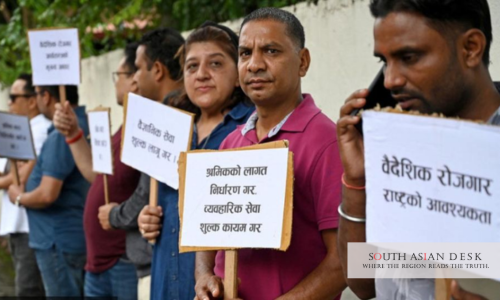
The announcement followed a decision by the Nepal Association of Foreign Employment Agencies to suspend a planned shutdown of recruitment companies after discussions with Minister Ramjee Yadav on Monday. The agencies had earlier warned they would halt the deployment of workers abroad unless the government responded to a 15-point set of demands, chief among them a clear and realistic service fee structure.
Nepal Migrant Recruitment Fees Await Legal Reform
Minister Yadav told the recruitment agencies that the government could not fix new fees until the revised law was in place. Officials confirmed that the ministry is in the process of amending the Foreign Employment Act, and said the agencies’ demands had been incorporated into the current draft.
Labour Ministry spokesman Pitambar Ghimire said a seven-member task force, formed in June and led by him, had finalised its report and recommended what he described as a scientific basis for setting the service fee. The exact figure proposed by the panel has not been made public. The task force was instructed to consider several factors when recommending a fee, including the destination country, the nature of the job and the worker’s expected monthly income.
Recruitment agencies, for their part, have pushed for a fee equivalent to two months’ salary for unskilled and semi-skilled workers, one month’s salary for skilled workers and half a month’s salary for highly skilled workers.
A Persistent Gap Between Official and Actual Costs
The dispute highlights a long-standing problem in Nepal’s foreign employment sector, where the gap between officially prescribed recruitment fees and what workers actually pay remains significant. According to government figures, workers typically pay between Rs150,000 and Rs500,000 to secure employment abroad, while those travelling to European destinations can pay between Rs500,000 and Rs1.2 million.
The Department of Foreign Employment has intensified enforcement against agencies found to be overcharging workers. The department reports that action has been taken against 771 recruitment agencies for violations including illegal fee collection, fraud, worker exploitation and the use of unauthorised intermediaries. Around 1,200 licensed recruitment agencies currently operate across the country.
Shifting Costs to Foreign Employers
Under the government’s proposed reforms, much of the financial burden of recruitment would shift toward employers in destination countries. The draft law specifies that foreign employers should bear the costs associated with recruiting Nepali workers, with workers required to pay a government-set service fee only in cases where employers do not cover those costs. The draft further bars agencies from charging service fees to workers recruited under contracts shorter than one year.
Beyond the fee structure, the Labour Ministry has proposed a broader set of procedural reforms. These include simplifying the certification of demand letters submitted by foreign employers through an accreditation system managed via Nepali diplomatic missions. Under this proposal, an accredited employer would remain on an approved list for two years, allowing subsequent worker demands to be verified without repeated monitoring.
The draft would also eliminate the requirement for recruitment agencies to seek separate prior approval from the Department of Foreign Employment before selecting workers once a demand letter has been certified by a Nepali diplomatic mission. Agencies would instead be permitted to begin selecting workers immediately after certification, provided the selection takes place through an electronic system, with employer vacancies advertised on the government’s Shram Sansar portal.
Political and Fiscal Pressure Over Migration Costs
The government has faced sustained pressure to reduce the cost of labour migration despite repeated commitments to promote what officials describe as zero-cost recruitment. Finance Minister Swarnim Wagle said in his budget speech that the government intended to promote zero-cost migration and make recruitment fees more favourable to workers, while also proposing collateral-free loans and instalment-based payment options to help finance migration costs.
Nepal first introduced a Rs10,000 service-fee ceiling for workers travelling to Gulf countries and Malaysia in 2015, replacing a previous official fee of Rs70,000 for those destinations. Following zero-cost recruitment agreements signed with Malaysia and the United Arab Emirates, agencies are now barred from charging service fees to workers bound for those two countries altogether.
Mira Acharya, director general of the Department of Foreign Employment, said recruitment agencies were reacting to selective enforcement of the existing law, particularly the provisions concerning recruitment fees. She noted that many other provisions of the Act remain unimplemented, and said intense, often unhealthy competition among agencies had led to indiscriminate handling of demand letters.
Scale of Nepal’s Foreign Employment Sector
Government data shows that of the 406,404 Nepalis who received new labour approvals for foreign employment in the last fiscal year, about 66 percent, or 268,990 workers, travelled through recruitment agencies. A further 31.6 percent left through individual arrangements, while roughly 2 percent were placed through government-to-government programmes covering employment in South Korea and Israel.
The Nepal Association of Foreign Employment Agencies confirmed that its decision to suspend the protest was intended to give the government time to act on its commitments. Association president Dik Bahadur Khatri said the agencies had not abandoned their demands, but had granted the government a window to advance the necessary legal amendments. According to Khatri, the government has committed to progressing the changes to the Act and its regulations within two months, failing which the agencies would resume their protest action.
Published in SouthAsianDesk, August 20th, 2026
Follow SouthAsianDesk on X, Instagram and Facebook for insights on business and current affairs from across South Asia.