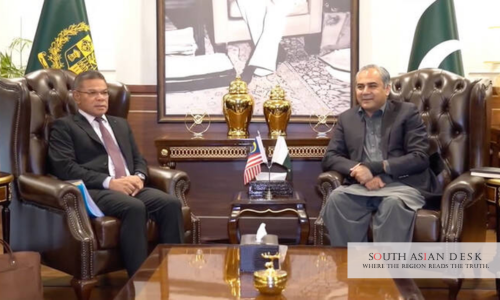
Pakistan Malaysia intelligence sharing arrangements took a significant step forward on Saturday, as the two countries agreed to increase cooperation against militants and drug traffickers during high level talks in Islamabad. The agreement was reached as both nations moved to deepen ties on security, migration and transnational crime, reflecting a broader push to formalize institutional cooperation between Islamabad and Kuala Lumpur.
Pakistan Malaysia Intelligence Sharing- Ministers Meet to Discuss Expanded Security Ties
The agreement was reached during a meeting between Pakistan’s Interior Minister Mohsin Naqvi and his Malaysian counterpart, Saifuddin Nasution bin Ismail. The Malaysian minister’s visit comes as both countries seek closer institutional ties spanning law enforcement, immigration, prisoner transfers and trade. According to a statement from Pakistan’s interior ministry, the two sides agreed to suppress terrorists and drug traffickers through intelligence sharing, a commitment that underscores the seriousness with which both governments are treating cross-border security threats.
Pakistan has faced a resurgence in militant violence in recent years, a factor that has added urgency to its efforts to secure stronger international partnerships on counterterrorism. Malaysia, for its part, has consistently sought greater cooperation against cross-border narcotics networks, making the timing of this agreement mutually beneficial for both countries.
Pakistan Malaysia Security Cooperation Extends to Human Smuggling and Cybercrime
Beyond intelligence sharing, the two sides also decided to establish a joint working group between their respective interior ministries. This body is expected to strengthen coordination on several fronts, including human smuggling and cybercrime, as well as illegal immigration. The creation of a joint working group signals that both countries intend to move beyond rhetorical commitments and build a structured mechanism for ongoing collaboration.
Naqvi and Nasution also agreed to strengthen cooperation between Pakistan’s National Police Academy and the Royal Malaysia Police College, including through joint training programs. The two ministers additionally discussed collaboration between their respective coast guard services, an area that is likely to gain importance given the maritime routes often exploited by human trafficking and smuggling networks in the region.
Employment, Travel and the Prisoner Transfer Agreement
Employment and travel featured prominently in Saturday’s discussions, with both sides addressing tourism and visa facilitation as part of the broader dialogue. Naqvi specifically called on Malaysia to increase its work quota for Pakistani nationals, arguing that a higher quota would allow more Pakistanis to enter Malaysia through legal channels rather than resorting to irregular migration routes.
The talks followed the signing on Friday of a prisoner transfer agreement, which will allow Pakistan and Malaysia to transfer convicted prisoners between the two countries. The agreement was witnessed by Prime Minister Shehbaz Sharif, lending it additional political weight and signaling the importance both governments place on formalizing legal cooperation alongside security measures.
A Broader Push for Institutional Cooperation
Taken together, the outcomes of the Islamabad talks point to a wider effort by Pakistan and Malaysia to institutionalize their relationship across multiple domains. The focus on intelligence sharing, combined with commitments on human smuggling and cybercrime, employment quotas and prisoner transfers, suggests that both countries are looking to build a comprehensive framework rather than isolated agreements.
For Pakistan, deeper security cooperation with Malaysia offers an additional layer of support in its ongoing efforts to counter militancy and organized crime. For Malaysia, the arrangement provides a structured channel to manage migration flows and address shared concerns around narcotics trafficking. As both countries move to implement the joint working group and expand training partnerships, the coming months are likely to reveal how effectively these commitments translate into practical outcomes on the ground.
Published in SouthAsianDesk, August 23rd, 2026
Follow SouthAsianDesk on X, Instagram and Facebook for insights on business and current affairs from across South Asia.