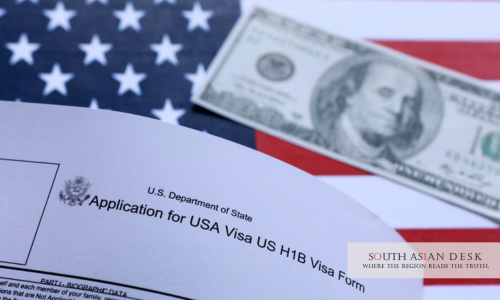
The Trump administration has moved to permanently establish a new H-1B visa fee of more than $100,000, releasing a proposed regulation on Monday that seeks to codify a charge first introduced last year through a temporary presidential proclamation and subsequently blocked by the courts. The rule marks the latest step in a broader effort by President Donald Trump’s administration to reshape how employers access foreign skilled labour through the programme.
What the New H-1B Visa Fee Rule Proposes
Under the proposal published by the Homeland Security Department, employers would be required to pay a fee of $103,265 for each H-1B petition subject to the annual statutory cap of 85,000 visas, which includes the 20,000 places reserved for applicants holding qualifying master’s degrees or higher. The charge would come on top of existing filing fees already paid during the H-1B application process.
Unlike the entry fee Trump imposed by proclamation last year, which applied only to workers hired from outside the United States, the new rule would extend to petitions for individuals already present in the country, including recent graduates transitioning from student visas. Cap exempt petitions, such as many positions at universities and nonprofit or government research institutions, would not be subject to the fee.
A Fee With a Troubled Legal History
The H-1B visa fee has faced sustained legal challenges since it was first announced. A federal judge in Boston ruled in June that the earlier version of the fee was illegal and blocked the Trump administration from collecting it, finding that it amounted to an unlawful tax imposed without authorisation from Congress. The administration’s emergency request to halt that ruling was denied by the U.S. Court of Appeals for the First Circuit, and the case remains under review by the same Boston based appeals court. A separate case is examining whether a judge in Washington properly dismissed a related challenge brought by a major business group.
Plaintiffs in the litigation argue that the president’s authority to restrict entry into the country does not extend to overriding the statute that created the H-1B visa program, and that the Homeland Security Department cannot impose fees or taxes to raise revenue without congressional approval. The Trump administration has countered that the charge is not a traditional tax and that courts have limited power to second guess the president’s authority over entry into the United States. Officials have said the new rule relies on separate legal authority from the original proclamation, which is due to expire in September unless extended.
Impact on H-1B Visa Applications and Employers
The push for a permanent H-1B visa fee comes amid a broader immigration crackdown that has already reshaped demand for the programme. Employers registered for about 344,000 H-1B visas last year, a decline of more than 25 percent from 2024 and less than half of the 794,000 applications submitted in 2023, according to figures from U.S. Citizenship and Immigration Services. The administration has also ordered enhanced vetting of H-1B applicants, proposed eliminating the 60 day grace period previously afforded to workers who lose their jobs, and introduced a weighted selection process intended to favour higher paid and more highly skilled candidates over the traditional lottery system.
The H-1B visa program, created in 1990, allows companies to sponsor foreign workers with specialised skills in fields such as engineering, software development and scientific research, typically for an initial three year term that can be extended to six years. The technology, education and research sectors have historically relied heavily on the programme to fill positions where employers say domestically trained talent is in short supply.
Business and Legal Reaction
The proposal is likely to deepen an existing divide within the business and political communities over high skilled immigration. Technology companies and industry groups that depend on the H-1B visa program have warned that a six figure fee would substantially raise the cost of hiring foreign specialists, forcing employers to choose between higher labour costs and a smaller pool of skilled hires. The U.S. Chamber of Commerce has previously sued the administration over the fee, arguing that employers who sponsor H-1B workers typically pay between $2,000 and $5,000 in related charges, a fraction of the new proposed amount.
Supporters of the fee within the administration have argued that it will encourage companies to train and hire American workers rather than rely on foreign labour. Officials have said the measure is intended to ensure that only the most highly skilled candidates are sponsored under the programme, rather than being used as a lower cost alternative to domestic hiring.
What Comes Next
The proposed rule will now move through a public comment period before the Homeland Security Department can finalise it, a process that is likely to draw further legal challenges given the fee’s contested history. With the original proclamation set to expire in September, the outcome of the rulemaking process and the ongoing appeals will determine whether the H-1B visa fee becomes a permanent fixture of the programme or is once again struck down by the courts.
Published in SouthAsianDesk, August 25th, 2026
Follow SouthAsianDesk on X, Instagram and Facebook for insights on business and current affairs from across South Asia.