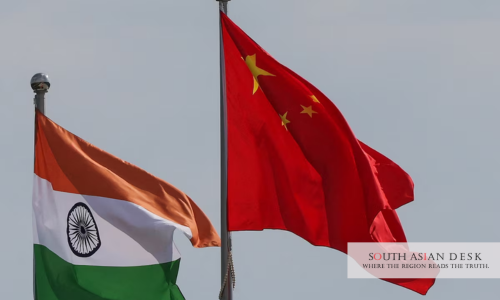
India-China border talks resumed in Beijing on Tuesday, as senior officials from both countries agreed to continue their dialogue and search for a boundary settlement that has eluded the two Asian giants for decades. The meeting brought together India’s National Security Advisor Ajit Doval and China’s Foreign Minister Wang Yi, both serving as their countries’ Special Representatives on the boundary question, for a round of discussions described by China’s foreign ministry as comprehensive, in-depth, friendly and candid.
The two sides reaffirmed their commitment to reaching what has long been termed a fair, reasonable and mutually acceptable settlement of their disputed frontier. The border in question stretches roughly 3,800 kilometres, or about 2,400 miles, across the Himalayas and remains largely undemarcated, making it one of the most sensitive fault lines between two nuclear-armed neighbours that together account for more than a third of the world’s population.
Doval and Wang Yi Hold 25th Round of Special Representatives Talks
Tuesday’s meeting marked the 25th round of the Special Representatives talks, a mechanism established in 2003 specifically to address the boundary dispute in a structured and sustained manner. The previous round took place in New Delhi in August last year, underscoring the annual rhythm the two countries have tried to maintain even as substantive progress on demarcation remains slow.
Ahead of the formal session, Doval also held a separate meeting with Chinese Vice President Han Zheng, during which the two discussed the broader trajectory of bilateral ties. According to China’s account of that conversation, Han pointed to the momentum built up over the past two years, noting that President Xi Jinping and Prime Minister Narendra Modi have met twice, in Kazan and in Tianjin, reaching a series of important understandings that have helped steer the relationship back toward stability.
In his remarks to Wang, Doval said the normalcy now visible in the relationship has come directly from both sides maintaining peace and tranquillity along the border. He added that the discussions had focused on how to reinforce that stability going forward. Wang, for his part, described the talks with Doval as very in-depth and candid and expressed hope that they would help the two countries reach new common ground.
Beyond the Boundary: India-China Relations Take on Global Significance
A notable theme of the Beijing meeting was the extent to which both sides framed the relationship as carrying weight well beyond the immediate border dispute. Wang told Doval that India-China relations are no longer of merely bilateral importance but now carry global and strategic significance, given the size and influence of the two economies. He called for stepped-up communication, greater mutual trust and a joint effort to remove the disturbances that have periodically strained ties since the deadly clashes in the Galwan Valley in 2020.
Wang also urged both countries to draw lessons from history and to place the boundary question in its proper context within the wider relationship, cautioning against stagnation, regression or deviation from the progress already made. Both governments pointed to tangible signs of that progress, including the steady resumption of people-to-people exchanges such as the Kailash Manasarovar Yatra pilgrimage and border trade through the three designated trading passes that had been suspended for several years.
What the India-China Border Talks Mean Going Forward
Officials from both sides indicated that the Special Representatives mechanism remains, in their view, the primary channel for addressing the boundary question, even though it has not yet produced a final settlement in more than two decades of periodic meetings. According to reports from the talks, the two representatives agreed to meet again in 2027, continuing the pattern of annual engagement that has resumed since the 23rd round was held in Beijing at the end of 2024, following a five-year gap caused by the border standoff.
The Beijing meeting also arrives at a moment of broader diplomatic activity between the two countries. Modi and Xi are expected to have further opportunities for engagement in the coming weeks, including on the sidelines of the Shanghai Cooperation Organisation summit, which gives added political weight to the outcomes of the Doval-Wang Yi discussions.
For now, neither side has suggested that a final boundary settlement is imminent. What both governments have signalled instead is a shared interest in keeping the dialogue active, preventing the kind of sharp deterioration seen in 2020, and allowing economic and diplomatic ties to continue normalising even as the underlying territorial dispute remains unresolved. Analysts tracking the relationship note that a mechanism meeting consistently, even without a conclusive outcome, still serves a stabilising function by keeping communication channels open between two militaries that continue to face each other across a long and largely undemarcated frontier.
Published in SouthAsianDesk, August 26th, 2026
Follow SouthAsianDesk on X, Instagram and Facebook for insights on business and current affairs from across South Asia.