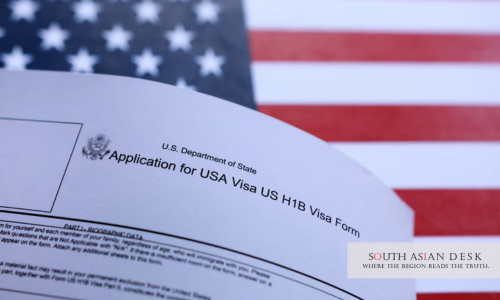
The proposed H-1B visa fee announced by the Trump administration has drawn a measured response from India’s technology sector, with industry body Nasscom urging Washington to weigh the programme’s broader role in addressing American skill shortages before finalising the change. The call came after the United States released a proposed regulation on Monday that would codify an unprecedented fee of $103,265 on new H-1B visas for highly skilled foreign workers.
Nasscom, which represents India’s $315 billion information technology sector, said it was actively engaged with all key stakeholders as the proposal moved through the regulatory process, signalling a desire to influence the outcome rather than oppose it outright.
Nasscom Responds to Trump Administration’s H-1B Visa Fee Plan
In its statement, Nasscom argued that any increase in the H-1B visa fee should be considered in the context of the programme’s original intent, which is to give American employers temporary access to specialised skills in areas where domestic shortages exist. The industry body pointed out that the number of H-1B workers employed by Indian IT companies has fallen sharply over the past five years, a trend it attributed to firms expanding their local workforce within the United States rather than relying as heavily on visa-sponsored staff sent from India.
Critics of the H-1B visa programme have long argued that it is misused by some companies to replace American workers with cheaper foreign labour, a criticism that has shaped much of the political pressure behind repeated attempts to raise fees and tighten eligibility rules. Nasscom’s response did not directly address these criticisms but instead emphasised the investments Indian firms have made in the United States workforce, noting that the industry has put more than $1.1 billion into strengthening the American STEM talent pipeline through university partnerships and programmes aimed at upskilling US workers.
How the Indian IT Industry Has Adapted to Visa Restrictions
This is not the first time India’s IT industry has had to respond to a steep increase in H-1B costs. India’s IT sector had already been forced to overhaul its decades-old strategy of rotating skilled talent into US-based projects after President Donald Trump first imposed a similar fee on H-1B visas last year. That earlier move prompted major American technology and financial firms, including Microsoft, JPMorgan and Amazon, to advise their H-1B visa holders to remain in the United States or return quickly, given the uncertainty surrounding the policy.
That first attempt at a steep H-1B visa fee did not survive legal scrutiny. In June, a US District Court in Boston struck down the measure, ruling that it amounted to an unlawful tax that Congress had never authorised. The latest proposal from the Department of Homeland Security appears designed to address that legal shortcoming by formally codifying the fee through the regulatory rulemaking process rather than through executive action alone.
Legal and Regulatory Path Ahead for the H-1B Visa Fee
The new proposal was published in the Federal Register on August 24 and will now undergo a 30-day public comment period before it can be finalised, a process expected to conclude later this year. It is not yet in force, and legal experts have suggested it could once again face court challenges similar to those that unwound the earlier fee structure.
For context, H-1B-related government fees had historically ranged between roughly $2,000 and $5,000, according to Reuters, though employers typically incur additional immigration and compliance costs on top of that base amount. A fee approaching $103,265 would therefore represent a substantial multiple of historical costs. Earlier this year, Moody’s Ratings estimated that a comparable $100,000 fee regime could raise annual operating expenses for large Indian IT companies by between $100 million and $250 million, equivalent to roughly one percent of revenue and an estimated 100 basis point impact on EBITA margins.
Broader Stakes for India-US Tech Ties
The renewed H-1B visa fee debate arrives at a sensitive moment for India-US relations, with roughly 70 percent of H-1B visa holders in the United States being Indian nationals, according to earlier estimates cited around the initial fee announcement. Indian IT companies, including major listed firms, have already seen investor reaction to previous rounds of visa policy uncertainty, underscoring how closely markets track developments in Washington’s approach to skilled worker visas.
Whether the latest proposal survives the public comment period and any subsequent legal challenges will significantly shape how Indian technology firms structure their US operations going forward. For now, Nasscom’s response suggests that India’s IT industry intends to engage directly with US policymakers on the substance of the H-1B visa fee change, framing its case around the economic contributions and local investments the sector has already made, rather than resisting the broader push toward stricter visa costs.
Published in SouthAsianDesk, August 26th, 2026
Follow SouthAsianDesk on X, Instagram and Facebook for insights on business and current affairs from across South Asia.