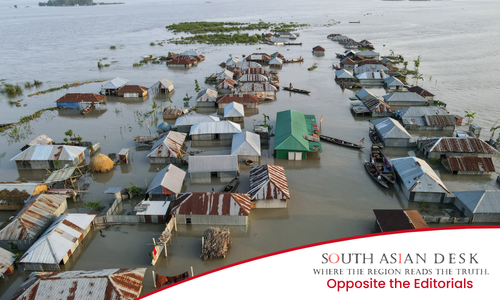
In the year of 2022—during the flood season, more than 480,000 people in Bangladesh’s Sylhet and Sunamganj districts left their homes for shelters in what the government called the worst flooding the region had seen in over a century, while roughly 7.2 million people were affected across nine districts.[1] Some of those families went home when the water receded. Some did not, because there was nothing solid enough left to return to. A smaller number, quietly and without much documentation, crossed into India. If asked any of them a simple question: “what are you, legally speaking?” and the honest answer would be is: nothing in particular. Not a refugee, because nobody is persecuting them. Not quite a migrant, because nobody would describe leaving a drowning village as a lifestyle choice. Not officially displaced either, because once they cross a border, the international frameworks built for internally displaced people stop applying the moment a person steps outside their own country.
This is not a gap that will close itself. The World Bank estimates that South Asia alone could see up to 40.5 million internal climate migrants by 2050 under a pessimistic emissions scenario, with the number of people moving for climate-related reasons increasing roughly sixfold between 2020 and 2050.[2] Most of that movement will stay inside national borders. But borders in South Asia—some are unusually easy to cross and unusually hard to police, and a meaningful fraction of that mobility will not stay tidy within them. Here the law has no name for the people who make that crossing: not “refugee,” and not simply “migrant,” but a distinct, protection-oriented status built around a single practical question: can this person safely and reasonably go home?
The 1951 Refugee Convention was drafted later after the Second World War, largely with the movement of European political refugees in mind. Its central definition protects a person who is outside their country of nationality owing to a well-founded fear of persecution for reasons of race, religion, nationality, membership of a particular social group, or political opinion.[3] A river swallowing a paddy field does not persecute anyone, a flood weeping away an entire house or a village doesn’t prosecute anyone. Nor does a monsoon that arrives six weeks early. UNHCR has been unusually candid about this. Its own guidance states plainly that the phrase “climate refugees,” however useful for headlines, has no basis in international law, and that most people displaced by climate-related disasters never cross an international border at all, which places them outside the Convention’s protection on that ground alone.[4] This is not UNHCR being evasive. It is UNHCR being accurate about a definition it did not write and cannot rewrite unilaterally. It has also noted that climate change functions as a “risk multiplier”, it can sharpen existing conflict, resource competition, or persecution to the point where a claim does fit within the 1951 definition but that is a case-by-case bridge, not a general solution.[5]
So, the honest legal position stands as that the refugee law was never meant to carry this weight, and asking it to stretch further risks distorting a framework that still does essential work protecting people fleeing war and persecution. The problem is not that refugee law is failing at its job. The problem is that an entire category of human movement was never assigned a job to anyone at all.
In the landmark decision in Ioane Teitiota v New Zealand (2020), the UNHRC considered whether climate-induced environmental degradation could prevent the removal of a person to their country of origin. Although the Committee the claimant’s claim on the facts, it recognized that climate change may, in certain circumstances, create a real risk to the right to life and thereby engage the principle of non-refoulement. The decision is significant for climate-displaced persons because it acknowledges that protection may arise even where traditional refugee law does not apply. However, it did not establish a distinct legal status for persons displaced by climate change or clarify what protection they should receive when return becomes unsafe.[6] This gap is particularly significant in South Asia, where climate-related displacement may increasingly cross international borders. Thus, the landmark decision offers protection against return in exceptional circumstances, but leaves unanswered the central question of “what legal status a climate-displaced person should have when home becomes uninhabitable?”
In the matter, South Asia region doesn’t remain as a hypothetical problem. It has already been living as an early version of it. South Asia with the countries with lesser carbon emission contribution but one of highest impact region, it has always been remained as a climate risk region. Bangladesh recorded more than 21 million disaster-related displacements between 2008 and 2024, and 2024 alone saw roughly 2.4 million people displaced by floods and cyclones, a fourth consecutive year of increase, placing the country fifth in the world for disaster displacement.[7] Across the wider region, 2024 brought nearly 9.2 million disaster-induced displacements, close to triple the previous year’s figure.[8] These are not one-off catastrophes. They are becoming the ordinary rhythm of a monsoon season. Most of that movement is internal, imagine a family moving from a flooded char to higher ground within Bangladesh, or a Nepali household moving from a landslide-prone hillside to the Tarai. But internal movement in this region sits right beside a long, largely open history of cross-border movement, particularly between Bangladesh and India and between Nepal and India, where decades of labor migration, kinship ties, and porous border management make it genuinely difficult to say, in any individual case, why a person left. India and Nepal, in particular, maintain a treaty relationship under which their citizens can cross the shared border and take up residence or employment on each other’s territory without a visa.[9] That relationship already normalizes movement that has nothing to do with persecution. It also means that when climate stress pushes someone across that same border, there is no mechanism distinguishing “seasonal laborer” from “person who can no longer farm land that no longer exists.”
The Maldives adds a different and starker dimension. Unlike displacement from a single flooded district, the Maldives faces a scenario in which the underlying territory itself may become unable to sustainably support its population, raising legal questions about nationality, statehood, and the right to relocate that go well beyond anything the 1951 Convention was built to answer. None of these fits comfortably into a single legal box, and none of it is adequately served by a debate that only asks whether “climate refugee” should become an official term. The real question is narrower and more useful: “when a person from this region crosses a border because staying is no longer viable, what happens to them next, legally, on the other side?”
Any legal framework built on this question will eventually be asked to prove causation, and this is where most proposals for climate displacement law quietly fall apart. Real displacement in South Asia is almost never monocausal. Imagine a farmer in the Nepali mid-hills whose maize yield drops because rainfall has become erratic. He borrows against next year’s harvest. The harvest again disappoints. He sells his last goats, takes on more debt, and eventually moves to Kathmandu, and later to India, for wage labor. At which point in that chain did “climate migration” begin? A state immigration officer, asked to make a binary judgment, will very reasonably conclude that this is economic migration, not climate displacement and technically, they would not be wrong. They also would not be right. This is precisely the finding that international climate science itself has converged on: that environmental stress interacts with rather than substitutes for existing economic and social drivers of movement, so that isolating a single climate “cause” is often analytically artificial. A legal test that requires an applicant to prove climate change was the dominant or exclusive cause of their movement will exclude almost everyone, because almost no one migrates for one reason.
The more workable legal trigger is not causation but capacity: not “did climate change cause this person to leave,” but “can this person now safely and reasonably remain in, or return to, their place of habitual residence.” That question does not require an applicant to reconstruct an impossible causal chain. It asks a decision-maker to look at present conditions “is the land still arable, is the water still drinkable, is the settlement still there” and decide whether return is a realistic option. This is not a radical idea. It is essentially the logic the case Teitiota gestured toward when it asked whether removal would expose a person to a real risk to life, rather than asking what originally drove them from home.[10] It simply needs to be built out into an actual, working legal status rather than left as an interpretive possibility buried in one non-binding Committee decision.
If South Asian states are unlikely to create a new category of “climate refugee”, and there are sound reasons why they should not. The more realistic approach is to establish a graduated legal status that operates alongside existing refugee law rather than replacing it. Such a framework could contain three tiers. Firstly, temporary climate displacement: covering persons who cross borders following sudden-onset events such as cyclones or flash floods and require short-term admission and humanitarian assistance; Secondly, protracted climate displacement: covering persons whose homes remain unsafe or unviable due to recurring flooding, degraded land or contaminated water, warranting renewable residence, work rights and access to basic services where return remains uncertain; and lastly, permanent climate displacement: covering situations in which return becomes objectively unreasonable or impossible, requiring durable residence or a planned relocation pathway developed in consultation with affected communities. Each tier should be subject to an evidence-based assessment of environmental conditions, livelihood loss and the availability of safe internal relocation, preventing the framework from becoming a general alternative route for migration. Such a graduated model would therefore recognize the different realities of climate-induced displacement while avoiding the creation of an overly broad or legally uncertain category, providing protection where existing refugee law leaves climate-displaced persons without a clear legal status.
South Asia does not need a new global convention, and pretending otherwise is a reliable way to ensure nothing happens for another two decades. What it needs is smaller and more achievable: a bilateral or sub-regional protocol, a Nepal-India climate mobility arrangement would be a natural starting point, given the two countries’ existing open-border relationship that gives immigration officers, courts, and displaced people themselves an actual legal vocabulary for what is already happening on the ground. Australia’s 2023 Falepili Union with Tuvalu, which created the world’s first operational climate-specific mobility visa for up to 280 people a year, shows that this kind of arrangement is not a theoretical exercise; it is administratively possible once states decide to stop waiting for Geneva.[11] The deeper point is this. The law currently asks a binary question “refugee or migrant” and climate-displaced people in South Asia keep failing to fit either box, not because their situation is unclear, but because the categories were never built to hold them. A farmer from the Nepali hills who can no longer grow enough to eat, a family from the Bangladesh whose land has turned to salt, a Maldivian community watching the tide take a little more of the island each year, none of them need the law to declare them refugees in the political sense. They need the law to stop pretending they are simply migrants who happened to move. The right question was never “did climate change make you leave.” It is, and should always have been, whether going home is still something a perso
[1] IFRC GO. “Bangladesh: Flash Flood 2022.” IFRC Go, go.ifrc.org/emergencies/5983.
[2] Rigaud et al. 27; World Bank, Groundswell Part 2.
[3] Convention Relating to the Status of Refugees art. 1A (2).
[4] UNHCR. “Climate Change and Displacement: The Myths and the Facts.” UNHCR, 2023.
[5] UNHCR. “Law and Policy for Protection and Climate Action.” UNHCR, www.unhcr.org/what-we-do/build-better-futures/climate-change-and-displacement/law-and-policy-protection.
[6] Ioane Teitiota v. New Zealand. CCPR/C/127/D/2728/2016, UN Human Rights Committee, 7 Jan. 2020.
[7] Internal Displacement Monitoring Centre. “Bangladesh.” IDMC, www.internal-displacement.org/countries/bangladesh/.
[8] The Climate Watch. “Disasters Displace 600,000 People in Bangladesh in Just One Year.” The Climate Watch, 14 May 2025, theclimatewatch.com/disasters-displace-600000-people-in-bangladesh-in-just-one-year/
[9] Treaty of Peace and Friendship. India and Nepal, 31 July 1950.
[10] Refworld. Ioane Teitiota v. New Zealand. CCPR/C/127/D/2728/2016, UN Human Rights Committee, 7 Jan. 2020, www.refworld.org/jurisprudence/caselaw/hrc/2020/en/123128
[11] Migration Policy Institute. “‘Climate Refugees’ Do Not Exist as a Concept—But Countries Are Testing New Approaches to Offer Protection.” Migration Policy Institute, migrationpolicy.org/journal/feature/climate-refugees-do-not-exist-concept-countries-are-testing-new-approaches-offer.