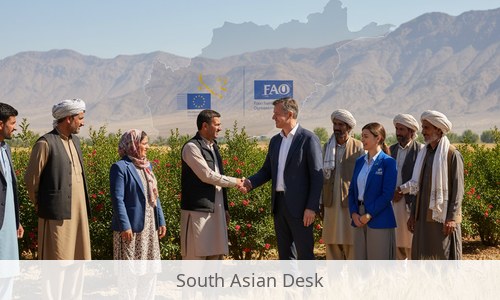
On September 13, 2026, the European Union and the Food and Agriculture Organization (FAO) launched a €5 million initiative to strengthen climate-resilient agriculture in Afghanistan, aiming to improve the agrifood sector’s resilience and support vulnerable farmers facing economic and environmental challenges.
Climate-Resilient Agriculture in Afghanistan: Impact on Local Farmers
The initiative targets agrifood businesses and smallholder farmers facing acute vulnerabilities from climate shocks and economic instability. However, farmers continue to grapple with water scarcity, soil degradation, and limited access to modern agricultural technologies. These challenges are exacerbated by prolonged droughts, erratic rainfall patterns, and the degradation of arable land, which have reduced crop yields and increased food insecurity across the country.
The program seeks to address these issues through targeted interventions, including the introduction of drought-resistant crop varieties, soil conservation techniques, and improved irrigation systems.
By focusing on climate-resilient agriculture in Afghanistan, the initiative aims to build long-term resilience in a sector that employs over 70% of Afghanistan’s labor force but remains highly vulnerable to environmental fluctuations.
The €5 million program includes support for Afghan farmers through training in sustainable practices and access to climate-smart technologies. This aligns with the EU FAO initiative to bolster agriculture resilience in a region where international aid in Afghanistan has historically focused on short-term relief rather than systemic change. The program emphasizes capacity-building and local ownership, ensuring that Afghan farmers can adapt to climate change independently while fostering economic stability.
Role of International Organizations
The EU and FAO’s collaboration underscores the critical role of international support in Afghanistan’s agricultural recovery. This initiative aligns with broader regional efforts to stabilize food systems amid ongoing economic and environmental pressures. The program builds on previous international aid in Afghanistan efforts, which have historically focused on short-term relief rather than sustainable development. Unlike earlier initiatives, this program emphasizes capacity-building and local ownership, aiming to empower Afghan farmers and agrifood enterprises to adapt to climate change independently. The EU’s contribution reflects its commitment to fostering sustainable development in conflict-affected regions, while the FAO’s involvement highlights its mandate to promote food security and agricultural sustainability globally. The collaboration also aligns with the United Nations’ Sustainable Development Goals (SDGs), particularly Goal 2 (Zero Hunger) and Goal 13 (Climate Action), which emphasize the need for resilient agricultural systems in vulnerable regions.
Broader Regional and Global Context
Afghanistan’s agricultural challenges are not isolated but part of a larger regional trend of climate-induced vulnerabilities in South and Central Asia. Neighboring countries such as Pakistan and Iran have also experienced similar environmental stressors, including water scarcity and desertification, which have strained regional food systems.
The EU-FAO program is part of a growing international recognition of the need for cross-border cooperation to address climate change’s impact on agriculture. By focusing on the result, the initiative also serves as a model for other conflict-affected regions where agriculture resilience is critical to economic recovery. The program’s success could influence future international aid in Afghanistan strategies, emphasizing the integration of climate adaptation into development projects in fragile states.
Long-Term Implications and Community Engagement
The EU FAO initiative is designed not only to provide immediate relief but also to create a sustainable framework for agriculture resilience in Afghanistan. This includes the establishment of local cooperatives, the dissemination of climate-smart agricultural practices, and the development of community-based resource management systems.
These efforts aim to ensure that the benefits of the €5 million program extend beyond the initial implementation phase, fostering a self-sufficient agrifood sector capable of withstanding future climate shocks. Additionally, the program includes a strong emphasis on support for Afghan farmers through mentorship programs and access to microfinance, enabling smallholder farmers to invest in resilient agricultural practices.
Follow SouthAsianDesk on X, Instagram and Facebook for insights on business and current affairs from across South Asia.