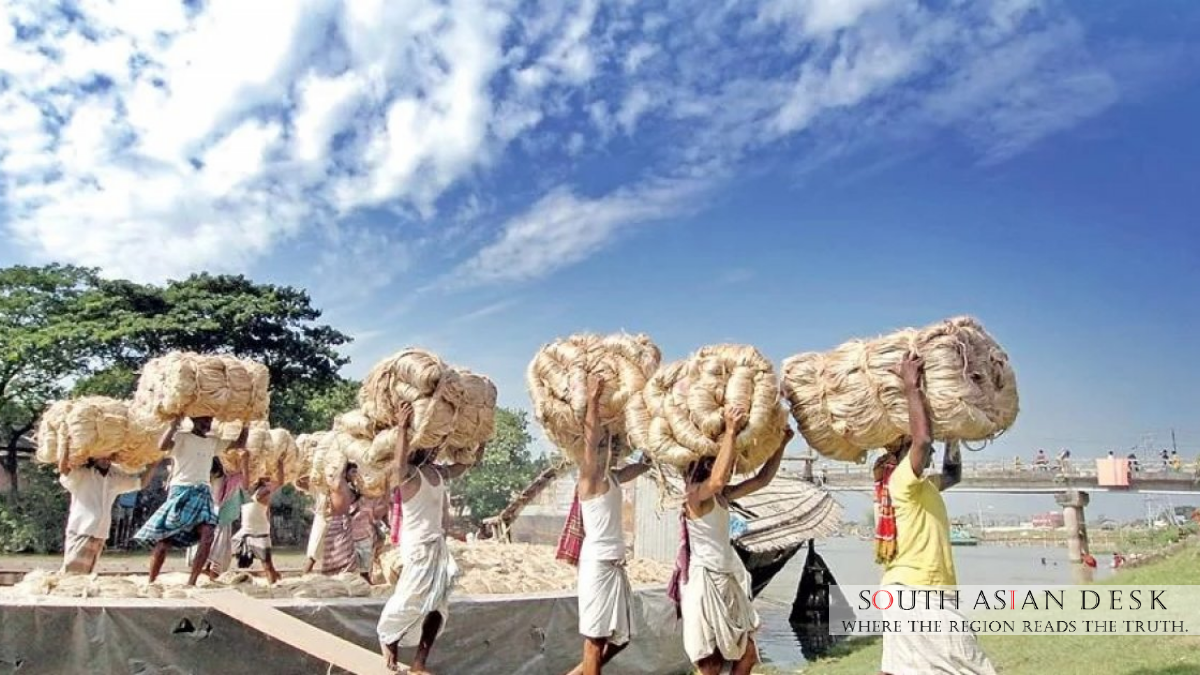
Jute as a plastic alternative is once again at the centre of Bangladesh’s environmental and economic ambitions, as the country tries to revive an industry that once defined its export economy. Bangladesh is the world’s second biggest producer of jute after India, though the so-called “golden fibre”, named for its colour and its once-high price, has lost its sheen as demand has fallen. With governments worldwide restricting single-use plastic, Dhaka sees an opening. Turning that opening into a lasting market, however, has proved far harder than passing laws.
A Heritage Industry Seeking a Second Life
The Bangladesh jute industry remains substantial. According to the Department of Jute, Bangladesh produced more than 8 million bales (1.44 million tons) of jute during the 2025-26 fiscal year, and more than 7.5 million bales (1.35 million tons) during the 2024-25 fiscal year. Around 3 million farming households are involved in jute production, and in the 2024-25 fiscal year, export earnings from raw jute and jute products stood at more than $820 million.
The decline began decades ago. In the 1950s, jute fell in popularity when polythene became a low-cost alternative for grocery bags and commercial packaging, and newer plastics later replaced almost every jute export. By the 1980s, Bangladeshi farmers were burning jute fields to replace them with other cash crops.
Laws on Paper, Plastic in Practice
Bangladesh was an early mover on plastic regulation. It was one of the first countries to ban the use of plastic and polythene bags, in 2002, in an effort to stop them collecting in waterways and on land, though the ban has had little success.
The Mandatory Jute Packaging Act followed in 2010. It stipulates that 19 essential items must be packaged in jute: paddy, rice, wheat, maize, fertiliser, sugar, chili, turmeric, coriander, potato, flour, ginger, garlic, onion, pulses, rice bran, husk, poultry feed and fish feed. Yet the move has been largely unsuccessful, with plastic and synthetic fibre continuing unabated as packaging materials.
Enforcement has intensified. Khandakar Abdul Muktadir, minister for textiles and jute, told Parliament that between July 2025 and June 2026, the government conducted 1,093 mobile courts and filed 1,399 cases against offenders. The minister also addressed the state-owned sector: the previous government shut down production at 25 state-owned jute mills in 2020, 14 of the closed mills had since been leased to the private sector, and nine had already gone into production. He said the government was hopeful of restarting the mills by December 2026.
Why Jute as a Plastic Alternative Faces a Cost Problem
Price remains the central obstacle. One rice mill proprietor in Sherpur district said a 50-kilogram synthetic bag costs 20 taka, while a jute sack costs 80 taka. Jute sacks, however, offer durability. The same jute sack can be used at least three times for carrying paddy or rice, then mended if torn and used three more times for carrying rice bran.
Supply is an equally serious constraint. There are around 5,000 automatic rice mills and thousands of semi-automatic rice processing units in Bangladesh, and most use synthetic or polythene bags. Millers complain that suppliers deliver plastic bags directly to their factories, while jute sacks must be sourced independently and are sometimes unavailable. Officials acknowledge the deadlock: private millers say they will only produce jute sacks when there is adequate market demand, while users want the government to ensure adequate supply.
Some experts argue that compulsion is the wrong tool altogether. M Wais Kabir, former executive chairperson of the Bangladesh Agricultural Research Council, said: “Saving jute through legislation is a wrong approach.” He attributed plastic’s inroads to cheaper prices and easy availability, and argued that privatised factories with better management can produce jute bags at lower prices.
The Sonali Bag and the Push for Biodegradable Packaging
Beyond sacks, Bangladesh has pursued innovation in biodegradable packaging. A Bangladeshi scientist found a way to turn the fibre into low-cost biodegradable cellulose sheets that can be made into throw-away bags that look and feel much like plastic ones. The scientist, Mubarak Ahmad Khan, an adviser to the state-run Bangladesh Jute Mills Corporation, led the team behind the Sonali bag, and said of the material: “The physical properties are quite similar.” The bags break down after being buried in soil for three months and can be recycled. In 2019, the government approved about $900,000 in funding from the country’s climate change trust fund to help pave the way for large-scale production of the bags.
Researchers caution against treating the golden fibre as an automatic environmental win. A 2025 study noted that while jute products are generally considered biodegradable, their cultivation, processing, and disposal may not automatically offer environmental advantages over plastic products, and called for identifying the specific conditions under which jute is a viable replacement.
What Comes Next for the Golden Fibre
The case for jute as a plastic alternative rests on more than environmental goodwill. It depends on whether Bangladesh can bring jute sacks and biodegradable bags to market at prices and volumes that compete with synthetics. Revived mills, private investment and sustained enforcement of the Mandatory Jute Packaging Act may shift the balance, but the experience of the past two decades suggests that regulation alone will not decide the outcome. For millions of farming households, the stakes are considerable: if demand does not recover, growers may abandon the crop, and plastic will fill the gap.
Published in SouthAsianDesk, September 23rd, 2026
Follow SouthAsianDesk on X, Instagram and Facebook for insights on business and current affairs from across South Asia.