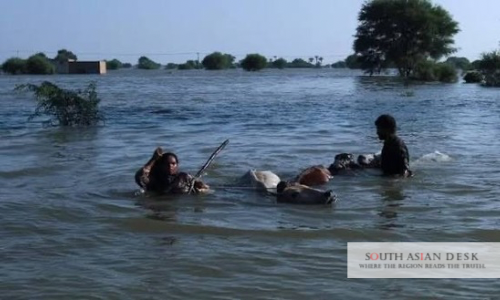
Punjab and Sindh brace for severe flooding as rivers swell, displacing millions and prompting urgent evacuations. On Friday, September 12, 2025, the flood threat severe at Panjnad confluence with 668,000 cusecs of water discharge triggered mass evacuations in Punjab’s Alipur tehsil, while Guddu and Sukkur barrages in Sindh recorded over 400,000 cusecs, intensifying the region’s ongoing flood emergency.
The severe flooding at the confluence of Punjab’s rivers, Sutlej, Ravi, and Chenab, not only threatens millions of lives and livelihoods but also underscores the recurring challenge of managing monsoon-driven deluges in South Asia, where climate change and cross-border water management complicate disaster response.
Unrelenting Flood Crisis in Punjab
The flood threat severe at Panjnad confluence with 668,000 cusecs has pushed Punjab into a state of emergency, with the Chenab River’s Panjnad Headworks recording an alarming surge in water flow. According to the Flood Forecasting Division (FFD), the discharge increased by 100,000 cusecs between Wednesday and Thursday, September 10–11, 2025, prompting evacuations in Alipur. A protective dyke near Shujabad collapsed for the second time late Thursday, September 11, 2025, flooding nearby communities.
In Rahim Yar Khan, 660,000 cusecs passed through Chachran Sharif, though local authorities reported no immediate threat to settlements. Punjab Relief Commissioner Nabil Javaid stated that 4,500 villages and 4.287 million people have been affected province-wide, with 2.262 million relocated to 396 relief camps. Tragically, 79 lives have been lost in the floods.
Guddu and Sukkur Barrages Under Pressure
In Sindh, the flood threat severe at Panjnad confluence with 668,000 cusecs has downstream impacts, with Guddu Barrage recording 506,433 cusecs and Sukkur Barrage maintaining flows above 400,000 cusecs. Both barrages remain in a “medium flood” state, but the pressure from upstream rivers has heightened concerns. According to the Provincial Disaster Management Authority (PDMA), relief operations are underway, with four helicopters and 2,000 tents deployed in Jalalpur Pirwala to assist displaced families.
Tragedies Amid Rescue Efforts
The human toll of the floods is stark. In Bahawalnagar, a Rescue 1122 boat carrying 23 evacuees capsized, resulting in two deaths. In Jalalpur Pirwala, another boat carrying 25 people overturned, leaving five, including children, missing. In Muzaffargarh, three teenagers fell into floodwaters near Basti Jarah; one died, while two were rescued. Over 706,000 people across 148 mouzas in Jalalpur Pirwala and 159,029 in Khanewal have been affected, with 128,658 acres of crops submerged.
Balochistan Braces for Impact
The flood threat severe at Panjnad confluence with 668,000 cusecs is expected to impact Balochistan, where preparations are in place along the Indus River’s left bank in Nasirabad division. Balochistan Irrigation Minister Sadiq Umrani confirmed that rescue teams, boats, and heavy machinery have been deployed in Nasirabad, Usta Muhammad, Sohbatpur, and Jaffarabad. The Hub Dam, at 338 feet, is one foot shy of its full capacity of 339 feet, raising fears of spillway openings. According to the Balochistan PDMA, 16 flood control centres are operational across four districts to manage the crisis.
Cross-Border Water Management Concerns
The floods have been exacerbated by rising water levels at India’s Bhakra (90% full), Pong (99%), and Thein (97%) dams, increasing downstream pressure on Pakistan’s rivers. Indian alerts issued on Wednesday, September 10, 2025, regarding Ganda Singh Wala and Ferozepur prompted renewed evacuations along the Sutlej River. This highlights the need for improved transboundary water-sharing mechanisms in South Asia, where disputes over river management often amplify flood risks.
Relief and Response Efforts
Punjab Emergency Service Secretary Dr Rizwan Naseer reported that 13,600 people were rescued in Multan over three days, with 362,000 evacuated province-wide using 139 rescue boats.
In Rahim Yar Khan, 12,000 people have been evacuated, and six relief camps with 1,800 tents have been established. Punjab Chief Minister Maryam Nawaz ordered the removal of Jalalpur Pirwala’s Assistant Commissioner over negligence following a boat capsizing incident, as confirmed by Punjab Information Minister Azma Bukhari.
What’s Next
NDMA Chairman Lt Gen Inam Haider Malik stated on Thursday, September 11, 2025, that Pakistan is facing its final monsoon spell, with floodwaters expected to stabilise in the next two to three days.
However, with the flood threat severe at Panjnad confluence with 668,000 cusecs persisting, authorities remain on high alert, and the focus is on reinforcing dykes, expanding relief camps, and ensuring timely evacuations to mitigate further loss of life and property.
Published in SouthAsianDesk, September 12th, 2025
Follow SouthAsianDesk on X, Instagram, and Facebook for insights on business and current affairs from across South Asia.