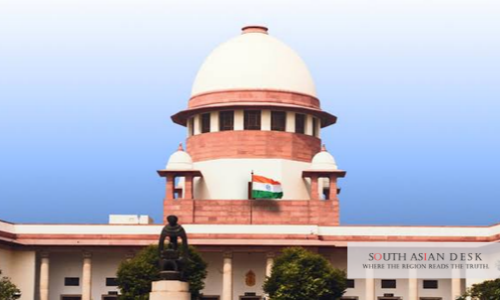
The Supreme Court on Tuesday questioned the Centre over medicine overpricing, pressing the government to explain how a wide gap between the maximum retail price of drugs and the prices at which retailers buy them has been allowed to persist. The bench, which reserved its order after the hearing, went as far as describing the country’s drug price regulator as appearing to be a totally defunct body.
What the Bench Said
A bench of Justices Vikram Nath and Sandeep Mehta was hearing two petitions concerning medicine prices when it asked whether the existing system was favouring pharmaceutical manufacturers at the expense of consumers, according to reporting by the Press Trust of India carried by Outlook. The judges told the Centre that the situation was unfolding under the government’s own eyes and that the government was allowing it to happen. They also asked whether such pricing practices should be allowed to run amok.
The court directed pointed scrutiny at the National Pharmaceutical Pricing Authority, the body responsible for implementing and enforcing drug price controls under the country’s pharmaceutical pricing framework. The authority was established in 1997 and operates under the Drugs (Prices Control) Order, 2013. By calling it totally defunct, the bench placed the effectiveness of the regulator, and the Centre’s oversight more broadly, under renewed examination.
The Centre’s Defence
Additional Solicitor General Aishwarya Bhati, appearing for the Centre, told the court that the government’s policy was that the entire ecosystem is not to be controlled. She argued that medicine prices in India are among the lowest in the world and said the government had to balance affordability with the availability of medicines and the wider interests of the pharmaceutical industry.
That position reflects a long-standing approach under which price ceilings apply to scheduled medicines, while the rest of the market is monitored rather than directly fixed. The Supreme Court’s questions suggest it is not persuaded that this approach adequately protects patients from excessive markups.
How Trade Margins Became the Focus
The latest hearing followed a session on October 12, when the bench expressed dissatisfaction with the Centre’s response on capping trade margins for anti-cancer drugs at 30 per cent of their maximum retail price. The judges described that response as hardly anything to be happy about and asked why similar limits could not be imposed on other medicines. The Centre told the court that the cap on anti-cancer drugs was expected to save patients about ₹2,500 crore annually. Outlook has also reported that the margin cap covers 137 cancer drugs, with price reductions expected to take effect from November 9.
Earlier in the proceedings, the court had highlighted what it described as a tenfold gap between the price of an essential cancer medicine sold to retailers and the amount charged to consumers. The bench referred to a drug that manufacturers reportedly sell to retailers for around ₹2,700 but which is sold in the market for ₹27,000. Senior advocate Kapil Sibal, representing pharmaceutical manufacturers, told the court at that stage that retailers rather than manufacturers were earning the profit from the difference.
Enforcement Concerns Behind Medicine Overpricing
Questions about enforcement have added weight to the court’s criticism. According to figures reported in the press from the proceedings, the regulator has demanded about ₹10,029.8 crore from companies for overcharging violations since 1979, of which ₹8,447.4 crore remained unpaid as of March 31, 2026. The same reports note that there is currently no direct mechanism to compensate consumers for amounts they were overcharged, although the authority does accept complaints from the public.
Such figures illustrate why the court is probing not only the pricing framework itself but also the ability of the regulator to recover dues and deter violations. Persistent medicine overpricing falls hardest on patients with chronic conditions such as cancer, who often pay out of pocket over long periods.
A Question the Court Has Raised Before
The Supreme Court has examined the issue before. In 2013, when it reviewed the national pharmaceutical pricing policy, the court observed that margins for manufacturers and dealers had ranged from 10 per cent to as much as 1,300 per cent of the cost of manufacture, according to a BioSpectrum report from that period. The recurrence of the concern more than a decade later suggests that structural gaps in oversight remain unresolved.
What Happens Next
With its order reserved, the court’s eventual direction will be closely watched by patients, manufacturers, retailers and regulators. The ruling could determine whether the government must extend trade margin controls beyond cancer drugs, strengthen the authority’s enforcement powers, or introduce new mechanisms for consumer redress. For now, the bench’s remarks make clear that it expects the Centre to do more than defend the present arrangement.
Follow SouthAsianDesk on X, Instagram and Facebook for insights on business and current affairs from across South Asia.