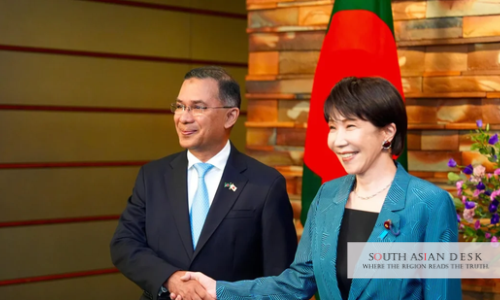
The Bangladesh-Japan summit held in Tokyo on Tuesday brought together Prime Minister Tarique Rahman and his Japanese counterpart, Sanae Takaichi, for talks that covered trade, investment, technology and infrastructure. According to a statement from the Bangladesh Prime Minister’s Office, both leaders emphasised strengthening the long-standing friendly relations between their countries, and Dhaka used the occasion to present an ambitious economic partnership agenda to Tokyo and the Japanese private sector.
A Visit Built on Invitation and Ceremony
Tarique Rahman arrived in the Japanese capital on Monday, October 26, at Takaichi’s invitation, for an official working visit scheduled to last until October 29. The talks began at 11:40 am local time at the Kantei, the Japanese prime minister’s office, after Takaichi received him and he inspected a guard of honour, according to Prothom Alo. A luncheon hosted by Takaichi was to follow.
The trip is the Bangladeshi leader’s third visit abroad since taking office on February 17. He is also due to deliver the keynote address at the Bangladesh-Japan Economic Forum and to meet Japanese business leaders. Japan’s Ministry of Foreign Affairs described Bangladesh as a key regional partner that shares values such as freedom, democracy and the rule of law, and said the visit would strengthen the strategic partnership and coordination toward the updated Free and Open Indo-Pacific vision.
Energy Security and the Economic Partnership Agreement
Tarique Rahman placed particular emphasis on energy security, telling Takaichi that a reliable and affordable energy supply is essential to sustaining economic growth. He thanked Japan for long-standing support, highlighting a recent emergency assistance loan of 50 billion yen under the Partnership for Power Asia initiative, and called for greater Japanese investment in liquefied natural gas infrastructure, efficient power generation and renewable energy.
Trade featured prominently as well. The Bangladesh-Japan Economic Partnership Agreement, signed in February 2026 according to Bangladesh’s foreign secretary, was a central reference point. Tarique Rahman expressed optimism about its swift implementation and said both sides must work together so that its benefits reach people in both countries. To attract Japanese firms, he said his government was committed to greater transparency, predictability and efficiency in regulation, taxation, customs clearance and profit repatriation.
Technology, Space and Infrastructure Proposals
The prime minister proposed a Bangladesh-Japan Tech Park to connect Japanese companies, universities and investors with Bangladeshi talent. He suggested prioritising artificial intelligence, cloud computing, robotics and electronics manufacturing, and also signalled interest in cooperation with Japan in space science and satellite engineering.
On infrastructure, he outlined plans for a high-speed rail network linking the country’s six divisional cities, along with nationwide elevated expressways, and asked Japan for planning, technical assistance, investment and financing. The PMO said he described Bangladesh as aiming to become an economic, technological and manufacturing hub, and cited projections that it could become the world’s ninth largest consumer economy by 2030 with gross domestic product exceeding one trillion US dollars by 2034. These are the Bangladeshi government’s own projections.
Regional Issues and Multilateral Support
The leaders also discussed regional and global affairs. Tarique Rahman noted their shared commitment to multilateralism, international peace and international law, and both sides reaffirmed the vision of an open, free, peaceful and inclusive Indo-Pacific. He thanked Japan for supporting the election of Bangladesh’s Foreign Minister, Dr Khalilur Rahman, as President of the 81st Session of the United Nations General Assembly.
He expressed concern about the deteriorating situation in Myanmar and the resulting Rohingya displacement crisis, called for an end to violence and unhindered humanitarian access, and praised Japan’s support for the Rohingyas sheltered in Bangladesh. He urged Tokyo to stay engaged with all parties to restore stability in Rakhine State and said the voluntary, safe and dignified repatriation of the Rohingyas must be ensured.
Labour Cooperation in the Background
Labour mobility was expected to be a significant element of the visit. Dhaka Tribune reported before the trip that the two governments were working to finalise a manpower agreement, building on two memoranda of understanding signed in Tokyo in May 2025 to develop skilled workers for the Japanese market. The reports reviewed for this article did not confirm whether such an agreement was concluded during the talks.
Bangladesh-Japan Summit: Looking Ahead
In his closing remarks, Tarique Rahman said the Bangladesh-Japan summit marked the beginning of a new chapter built on deeper trust, expanded economic cooperation and robust investment partnerships. He proposed a ministerial-level joint commission to identify priority sectors and turn cooperation opportunities into concrete initiatives, and stressed closer contact between the two business communities. He also invited Takaichi to visit Bangladesh at a mutually convenient time.
Japan has long been among Bangladesh’s most important development partners, and was one of the first countries to recognise it after independence in 1971. Whether the proposals made in Tokyo translate into firm commitments will depend on the outcome of the economic forum and on how quickly the Economic Partnership Agreement is put into practice.
Follow SouthAsianDesk on X, Instagram and Facebook for insights on business and current affairs from across South Asia.