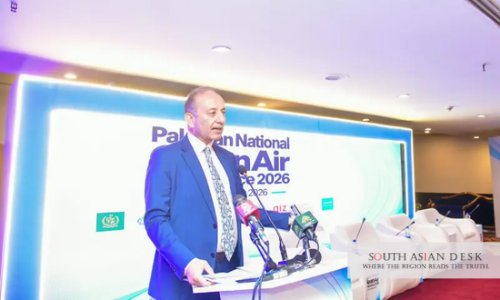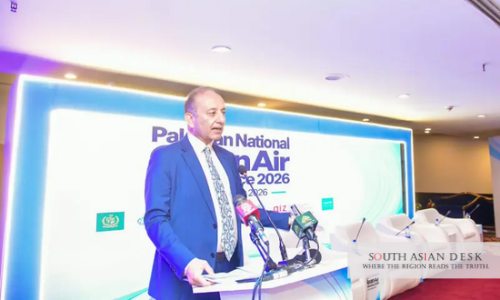
The government plans to set up a $10 million clean-air startup fund to back young companies developing solutions to Pakistan’s air pollution crisis, Federal Minister for Climate Change Musadik Malik announced on Wednesday. Speaking in Islamabad, he said the health and economic burden of dirty air falls most heavily on the poor and vulnerable, and that the state had a responsibility to act.
Announcement at the Clean Air Conference
Dr Malik made the announcement while addressing the Pakistan National Clean Air Conference 2026. He said wealthier households could buy air purifiers and take other precautions, whereas children, street vendors, farmers and daily-wage earners remained exposed to polluted air throughout the day. Street vendors and farmers in particular, he noted, could not avoid exposure without risking their livelihoods.
According to Dawn, the minister said the government had decided to create the clean-air startup fund from its own limited resources after approaching development partners for assistance. Approval from the fund’s board was expected the following day. He described the initiative as a responsibility towards future generations rather than a grant or a loan, and said the government intended to pursue clean-air measures even without external financial support. The reports did not provide details on how the fund would be structured or how startups would apply.
The Economic and Health Burden
Dr Malik estimated that air pollution imposes an economic cost equivalent to 6.5 per cent of Pakistan’s gross domestic product, citing illness, hospitalisation and the financial strain on families. He pointed to patients with chronic obstructive pulmonary disease, who depend on oxygen and medication, and referred to a Unicef report on the harmful effects of polluted air on children’s lung health and development. Schoolchildren travelling through polluted streets and people who work outdoors, he said, faced continued exposure.
The minister also addressed crop-residue burning, saying that solutions must protect the environment while taking into account the economic circumstances of farming communities. This reflects a recurring policy challenge, since measures that penalise farmers without offering practical alternatives are often difficult to enforce.
A Problem Shaped by Policy Choices
Describing the air pollution crisis as the result of human activity and policy decisions rather than an unavoidable natural disaster, Dr Malik called for practical interventions to control industrial emissions and other sources. He argued that determined action could overcome major obstacles, citing the construction of the Karakoram Highway through difficult mountain terrain and efforts to control dengue. He also referred to the progress made by Beijing and Shanghai in tackling pollution, and to China’s emergence as a major exporter of solar technology. Pakistan, he said, could similarly improve air quality through effective policies, technological innovation and cooperation with international partners.
The minister acknowledged support from the World Bank, the Asian Development Bank, Unicef and the German development agency GIZ for climate-related initiatives, adding that tackling pollution would require engineering solutions, sound policies and financial commitments.
Smog Season Gives the Announcement Urgency
The timing of the announcement coincides with the start of the annual smog season in Punjab. Lahore topped the Swiss monitoring platform IQAir’s ranking of the world’s most polluted major cities on October 23 with an air quality index of 344, according to Geo News, with the main pollutant, PM2.5, recorded at 57 times the World Health Organisation’s annual guideline. At 8am on October 28, Pakistan Observer reported that the city’s index stood at 358, again the highest in the world, with some neighbourhoods exceeding 500.
The Express Tribune reported that Lahore’s air quality in September and October this year was better than in the previous two years on average, but that pollution levels remain unhealthy. It also quoted Punjab’s Senior Minister Marriyum Aurangzeb as warning that the city could again rank as the most polluted in the world.
What the Fund Could Mean
Supporting innovation is a logical complement to regulation, since startups can develop low-cost monitoring tools, cleaner cooking and heating technologies, agricultural alternatives to burning, and filtration systems suited to local conditions. Much will depend on how quickly the board approves the clean-air startup fund, how transparently money is allocated and whether the selected projects can be scaled beyond pilot phases.
For residents who face hazardous air every winter, the announcement signals official recognition of the scale of the problem. Whether the $10 million commitment translates into measurable improvements in air quality will depend on implementation, and on whether it is matched by firm action to curb emissions at their source.
Follow SouthAsianDesk on X, Instagram and Facebook for insights on business and current affairs from across South Asia.