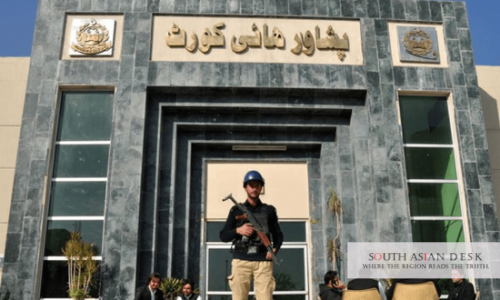
Health facilities in Upper South Waziristan are again under judicial scrutiny after the Peshawar High Court on Thursday issued fresh notices to senior provincial officials in response to a petition from local residents. The court had previously sought replies in June, but according to the petitioners’ counsel, no comments have been filed by the respondents since then.
The court’s latest order
A bench comprising Justice Syed Arshad Ali and Justice Farah Jamshed heard the matter and was informed by counsel Sajjad Ahmad Mehsud that the respondents had failed to submit their comments within the two weeks allowed in June. The bench responded by issuing notices again to the Khyber Pakhtunkhwa chief secretary, the health secretary and the director general of health services, directing each of them to file comments on the petition.
The petition was jointly filed by several residents of Ladha tehsil in the district, including Asifur Rehman. Its central request is for the court to declare that the denial of adequate healthcare to the people of Upper South Waziristan is unconstitutional and amounts to a violation of their fundamental rights.
What the petitioners are asking for
The petitioners have made several demands. They want the authorities to ensure that qualified and specialist doctors, including women medics, are available in the district, along with essential medicines and the necessary medical equipment. They also asked the court to order that all basic health units, rural health centres and civil dispensaries be made fully functional, with particular attention to remote areas such as Karama.
At the heart of the case is the absence of a district headquarters hospital. The petitioners say the district has yet to receive a fully functional facility of this kind, which they argue the government is legally bound to provide. They have also requested that medico-legal facilities and postmortem services be established in the district on an urgent basis.
How the district came to exist
In presenting the background, Mehsud said that before 2018 South Waziristan was a tribal agency forming part of the erstwhile Federally Administered Tribal Areas. Following the merger of those areas into Khyber Pakhtunkhwa through the Twenty-Fifth Constitutional Amendment in 2018, it was declared a settled district. He added that a notification issued by the provincial government in 2022 divided it into Upper and Lower South Waziristan.
According to the lawyer, the creation of the new district placed a legal and constitutional obligation on the respondents to provide essential infrastructure, including administrative offices, a law-enforcement system and, most importantly, a district headquarters hospital. He argued that despite the considerable time that has passed since then, no such hospital has been established, leaving the population without basic health services.
Allegations about conditions on the ground
The counsel described the existing healthcare structure as limited to a small number of basic health units and minor health centres. He claimed that these were either non-functional or severely under-resourced, lacking qualified staff, medicines and equipment. These are allegations made on behalf of the petitioners, and the respondents have not yet submitted their position to the court.
The absence of medico-legal facilities was highlighted as a separate problem. Mehsud contended that the district has no postmortem units or medico-legal officers, forcing families to transport the deceased to other districts. He said this causes delay, degrades forensic evidence and hampers the administration of justice.
Emergency care is another concern. The lawyer said patients needing urgent treatment often have to travel between five and seven hours to Dera Ismail Khan, or 14 to 15 hours to Peshawar. He argued that such journeys frequently lead to preventable deaths because timely medical intervention is unavailable on the way.
Health Facilities in Upper South Waziristan: What comes next
The case now depends on whether the provincial government responds to the court’s renewed notices. A substantive reply would allow the bench to examine what facilities currently exist in the district, what steps have been taken since its creation and what plans are in place for a hospital. Until then, the matter remains at a preliminary stage, with no findings by the court on the claims made. For residents of Upper South Waziristan, the outcome could determine whether urgent medical and forensic services are eventually available within their own district rather than hours away.
Follow SouthAsianDesk on X, Instagram and Facebook for insights on business and current affairs from across South Asia.
Read More: