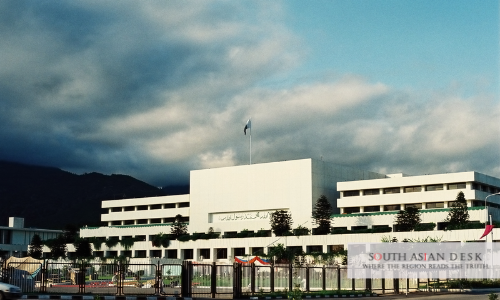
Emergency and governor’s rule in Khyber Pakhtunkhwa came under sharp criticism in both houses of Parliament on Thursday, as opposition members raised concerns about the political situation in the province and alleged violations of human rights. The proceedings, reported by Dawn, also touched on electoral reforms, the conduct of foreign policy and a Senate resolution on the country’s rapidly growing population.
How the measures came about
The federal government imposed the emergency under Article 232 of the Constitution and governor’s rule under Article 234 on October 11, after the president approved recommendations from the federal cabinet. According to Dawn and other outlets, the Centre cited the provincial government’s disengagement from the fight against terrorism and the breakdown of talks with provincial leadership over the deteriorating security situation. An 11-member advisory council was formed to assist the governor, Faisal Kundi, in running the province. The Pakistan Tehreek-e-Insaf, which leads the provincial government, rejected the decision.
Why emergency and governor’s rule in Khyber Pakhtunkhwa is contested
The decision has divided political opinion. Speaking on a point of order in the Senate, PTI parliamentary leader Barrister Syed Ali Zafar accused the government of undermining constitutional protections. He argued that fundamental human rights cannot be suspended or compromised regardless of the political situation. Senate Opposition Leader Allama Raja Nasir Abbas also criticised the measures, alleging that the province had been taken from its people and arguing that democratic institutions cannot function without respect for the law.
The government’s position, as set out by Parliamentary Affairs Minister Dr Tariq Fazal Chaudhary in response to earlier criticism from JUI-F chief Maulana Fazlur Rehman, is that governor’s rule is limited to six months and that the emergency applies only to a few districts affected by terrorism. Outside Parliament, commentators have also weighed in. A Business Recorder editorial argued that the security situation warranted intervention but suggested that an emergency alone could have been sufficient, without displacing the elected provincial government.
Concern over Noreen Niazi
Zafar also raised the detention of Noreen Niazi, a sister of jailed PTI founder Imran Khan. He claimed she had suffered a heart attack and was hospitalised, yet her family was not being allowed to meet her. Adviser to the Prime Minister on Political Affairs Rana Sanaullah responded that she had been given medical treatment in Lahore and was in satisfactory condition. On the allegation that relatives were denied access, he said details would be sought and the matter addressed according to the circumstances. He defended her detention, alleging that she had tried to create unrest by mobilising people for a protest march toward Islamabad.
Debate in the National Assembly
In the National Assembly, Opposition Leader Mehmood Khan Achakzai criticised the government for not taking parliament into confidence over recent diplomatic developments in Tehran. He asked how a handful of people could decide the future of the entire nation, and warned that such an approach could lead toward anarchy and civil war. He also opposed the suspension of trade with Afghanistan, describing Afghans as traditional friends of Pakistan and criticising past policies toward the neighbouring country.
PTI Chairman Barrister Gohar Ali Khan said the proceedings of the House and the prevailing situation in the province were leaving a negative impression on the public. He also called for an end to hereditary politics, a remark that was among the few explicit references to political reform during the day’s discussion.
A Senate resolution on population growth
Away from the confrontation over Khyber Pakhtunkhwa, the Senate passed a resolution urging urgent and coordinated national action on the challenges posed by the country’s rapidly rising population. The resolution was moved by PPP Vice President Senator Sherry Rehman and called for a comprehensive national response, citing the strain that population growth places on public services and socioeconomic development. Rehman said that, at the present rate, the population was projected to reach about 390 million by 2050, which she described as an unprecedented pressure on national resources.
Emergency and Governor’s Rule: What to watch
The legal and political questions around the measures are unlikely to be settled soon. Under the Constitution, governor’s rule can remain in place for a limited period, and the opposition is expected to keep raising the issue in both houses. The government, for its part, will have to show that the security objectives cited justify the displacement of an elected provincial administration. Until then, the debate over emergency and governor’s rule in Khyber Pakhtunkhwa will continue to shape relations between the federal government and the largest opposition party.
Follow SouthAsianDesk on X, Instagram and Facebook for insights on business and current affairs from across South Asia.