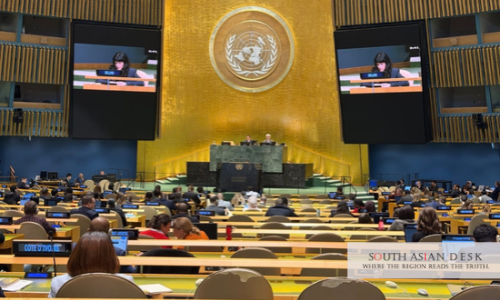
Nepal’s LDC graduation has been postponed by three years after the United Nations General Assembly unanimously approved an extension to the country’s preparatory period. The decision, reported by The Kathmandu Post, gives Nepal until November 24, 2029, to prepare for its exit from the category of least developed countries, and grants the same additional time to Bangladesh.
The General Assembly decision
The extension was adopted at the 81st session of the General Assembly in New York through Resolution 81/L.8, following a proposal the two South Asian countries pursued jointly. Khalilur Rahman, who presides over the session and also serves as Bangladesh’s foreign minister, said the decision acknowledged the economic uncertainties, external shocks and lingering vulnerabilities confronting both nations. He described the move as “an investment in lasting progress” rather than a retreat, and said success should be judged by the resilience and reforms achieved during the added time.
Nepal’s Permanent Mission to the United Nations thanked member states for their cooperation, solidarity and support in securing the resolution.
Why Nepal’s LDC graduation was delayed again
Nepal had been due to leave the least developed countries category on November 24, 2026. That date stemmed from a General Assembly decision in November 2021, which allowed an exceptional five-year preparatory period instead of the standard three years, in recognition of the disruption caused by the Covid-19 pandemic.
Kathmandu formally asked for more time on May 13, 2026, in a request addressed to the chair of the UN Committee for Development Policy. The Ministry of Foreign Affairs pointed to shifting domestic and international economic and political conditions, geopolitical tensions, disruptions to global supply chains and the possible effect on remittance inflows. It also warned that Nepali exports could lose duty-free and quota-free access to foreign markets, and noted that the country’s productive and institutional capacity remained limited. Studies cited by the government projected that employment in productive sectors could fall by as much as 35 percent after graduation if adequate transition measures were not in place.
Officials further argued that implementation of the country’s graduation plan had fallen behind, leaving the economy exposed to the loss of support reserved for least developed countries.
A long and repeatedly delayed path
Nepal has belonged to the least developed category since 1971. It first met the UN’s graduation criteria in 2015, but in 2018 the government sought a deferral, citing the setbacks of the 2015 earthquake and later disasters. The Committee for Development Policy agreed to postpone its recommendation.
In its 2021 triennial review, the committee again recommended graduation after Nepal satisfied the thresholds for the Human Assets Index and the Economic and Environmental Vulnerability Index. Nepal’s gross national income per capita remained below the required level, but the country still qualified under the UN’s rules by meeting the other two criteria. The General Assembly endorsed that recommendation on November 24, 2021.
How the extra time will be used
The additional period is intended to help Nepal carry out its Smooth Transition Strategy, which was adopted in February 2024. The document sets out six priority areas: macroeconomic stability, trade and investment, economic transformation, productive capacity, climate change and disaster risk management, and social inclusion. Its aim is to limit the adverse effects of graduation while helping the country take advantage of new development opportunities.
Nepal has said it will use the longer preparatory period to strengthen productive capacity and institutions, speed up economic and social transformation, and ensure effective delivery of the 2030 Agenda for Sustainable Development and the Doha Programme of Action. The government also expects the extra years to improve the competitiveness of its industries before international support measures available only to least developed countries are withdrawn.
Nepal’s LDC Graduation: What comes next
The extension eases an immediate deadline but does not remove the underlying challenge. Nepal must now show measurable progress on the reforms outlined in its transition strategy, or it may face the same pressures in 2029 that prompted this request. For policymakers, the decision offers breathing space, and how that space is used will determine whether Nepal’s LDC graduation, when it finally arrives, is a durable step forward rather than a disruptive one.
Follow SouthAsianDesk on X, Instagram and Facebook for insights on business and current affairs from across South Asia.
Read More: