The Islamabad Clean Air Compact was adopted on Thursday at the close of the two-day Pakistan National Clean Air Conference, setting out a framework for coordinated federal and provincial action against air pollution. According to Dawn, the document calls for stricter enforcement, regular emissions inventories and annual reviews of progress, at a time when the country is preparing for another season of poor air quality.
A conference built around implementation
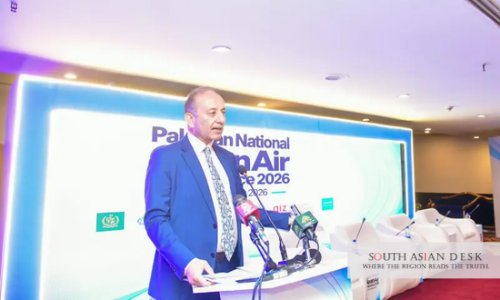
The event was organised by the Pakistan Environmental Protection Agency with support from development partners. It brought together government officials, environmental protection agencies from the provinces, Azad Jammu and Kashmir and Gilgit-Baltistan, and international partners. Federal Minister for Climate Change Musadik Malik addressed the gathering on October 28, according to Dawn’s photograph caption.
Discussions covered pollution from transport, industry, agricultural burning, household cooking and waste. Participants stressed that the success of the compact would depend on funded programmes, clearly assigned responsibilities and regular assessments. The closing session underlined that progress must move beyond policy commitments toward practical implementation, supported by reliable data, defined institutional roles and sustainable financing.
What the Islamabad Clean Air Compact commits to
The compact’s central message is coordination. Syed Abrar Hussain, director general of the agency, urged coordinated strategies, early preparation ahead of the winter smog season and stronger monitoring mechanisms. The timing is significant, as northern Pakistan, and Punjab in particular, regularly records hazardous air quality in the colder months. A separate Dawn report this week noted that Lahore had been ranked the most polluted major city in the world.
Data emerged as a recurring theme. Wajid Ijaz of the Environment Protection and Climate Change Department said reliable information was essential for identifying pollution sources and guiding regulation and public spending. He called for investment in monitoring networks, emissions inventories, source-apportionment studies and real-time tracking, so that authorities can direct interventions where they will have the greatest effect.
The financing challenge
Money proved to be one of the hardest questions. Andrew McCarthy of the Asian Development Bank called for agreement on federal and provincial responsibilities and for a National Clean Air Financing Framework to draw in public funds, climate finance, development assistance and private investment. Clean air financing, in other words, would be pooled from several sources rather than left to individual budgets.
Dr Waqas Ahmed Khan of the World Bank pointed to the potential for transport and agriculture projects that could attract investment through carbon credits. He cautioned that such schemes require credible emissions baselines, monitoring and verification systems, safeguards and approvals to prevent double counting. Dawn separately reported that the government is planning a $10 million fund to support clean-air startups, though details were not part of the conference report.
Measures for transport, farms, factories and kitchens
Participants discussed phased steps to cut transport emissions, including better vehicle inspections, electric-vehicle charging infrastructure, expanded public transport, improved freight efficiency and wider use of railways. For agriculture, proposals included raising awareness among farmers, promoting mechanisation, finding alternative uses for crop residues and offering financial support to reduce burning.
Industrial measures included emissions monitoring, energy audits, cleaner technologies and the modernisation of brick kilns. Clean cooking was identified as a further priority. Muhammad Abid of GIZ called for locally appropriate solutions, reliable supplies of alternative energy, public-private partnerships and opportunities for women entrepreneurs.
Links to existing policy
Dr Zaigham Abbas, spokesperson for the environmental agency, urged development partners, among them the World Bank, the Asian Development Bank, UNICEF, GIZ and ICIMOD, to support implementation of the National Clean Air Policy 2023 through technology-driven measures that target pollution at its source. The request suggests that the compact is intended to give practical effect to a policy framework that already exists, rather than replace it.
What happens next
The compact is a statement of intent, and its value will depend on follow-through. The conference’s own participants emphasised that funded programmes, clear accountability and regular reviews will decide whether it changes conditions on the ground. As the winter approaches, the first test will be whether federal and provincial agencies coordinate their preparations in time to reduce the worst pollution episodes. For millions of residents in cities such as Lahore, the success of the Islamabad Clean Air Compact will be judged not by the document itself but by the air they breathe in the coming months.
Follow SouthAsianDesk on X, Instagram and Facebook for insights on business and current affairs from across South Asia.