Taliban repression in Afghanistan has come under renewed international scrutiny, as Pakistan warned the United Nations that militant groups continue to operate from Afghan territory while a UN human rights expert urged governments not to normalise relations with the Taliban without verifiable improvements in rights protections.
The statements were made during separate discussions at the United Nations, where Pakistan raised concerns about cross-border terrorism and the deteriorating human rights situation in Afghanistan. UN Special Rapporteur Richard Bennett, meanwhile, warned that five years after returning to power, the Taliban had shown no willingness to reverse systematic human rights violations.
The developments highlight the growing challenge facing the international community as it seeks to address security concerns, protect Afghan civilians and establish accountability for alleged abuses under Taliban rule.
Taliban Repression in Afghanistan: UN Expert Calls for Accountability
Presenting his report to the UN General Assembly on October 29, Bennett said the Taliban had continued to deepen and formalise restrictions on fundamental rights since seizing power in 2021. He urged member states to ensure that engagement with the Taliban authorities did not confer legitimacy without measurable and independently verified improvements in human rights.
Bennett’s report documented arbitrary detention, torture and other forms of ill-treatment, including sexual violence, enforced disappearances and extrajudicial killings. It also highlighted severe restrictions on freedom of expression and civic space, alongside discrimination against ethnic, religious and linguistic minorities.
The report further raised concerns about the treatment of LGBTI people and the exclusion of persons with disabilities. Bennett warned that the consequences of these policies extended beyond immediate violations, threatening the rights and prospects of an entire generation of Afghans.
His intervention reflects a wider concern within the United Nations that diplomatic engagement with the Taliban must not come at the cost of accountability, equality or justice.
Afghanistan Women’s Rights Remain at the Centre of UN Concerns
Bennett placed particular emphasis on the restrictions imposed on women and girls, warning that recent Taliban decrees had further undermined their rights and protections.
He said the measures had enabled violence against women, made it increasingly difficult for women to leave abusive relationships and permitted child marriages. These concerns add to the longstanding restrictions on girls’ access to education and women’s participation in public life.
The UN expert urged member states to support accountability mechanisms and pursue justice for serious violations. He cited the International Criminal Court’s arrest warrants for Taliban leaders as an important step, while calling for support for the Independent Investigative Mechanism for Afghanistan and national prosecutions under universal jurisdiction.
Bennett also called for accelerated progress in efforts to recognise gender apartheid as an international crime. He warned that the denial of education and the wider exclusion of women and girls could have profound consequences for Afghanistan’s future development and stability.
Pakistan Warns UN of Cross-Border Terrorism
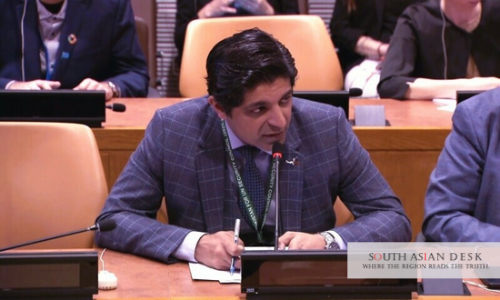
Pakistan’s representative, Muhammad Jawad Ajmal, told the UN Human Rights Council’s interactive dialogue on Afghanistan that more than 4,700 Pakistanis had been killed in terrorist attacks originating from Afghanistan over the past three years.
Ajmal accused the Taliban of maintaining close links with terrorist organisations operating from Afghan territory. He alleged that these groups were able to operate with impunity and receive support from external actors targeting Pakistan and other neighbouring countries.
He said the Taliban’s failure to publicly denounce these organisations demonstrated what Pakistan regarded as their complicity and active support. The allegations reflect Islamabad’s continuing concerns about militant activity across the border and the security implications for Pakistan.
Pakistan’s statement focused heavily on the threat posed by these groups, while also criticising the Taliban’s human rights record. Ajmal said the deteriorating situation in Afghanistan reflected the Taliban’s disregard for their international obligations.
He also referred to the ninth Ministerial Conference on Women, hosted by Pakistan in Islamabad in July. The Organisation of Islamic Cooperation adopted the Islamabad Declaration at the conference, expressing concern that the Taliban’s restrictions on women and girls were inconsistent with Islamic values.
Pakistan’s position therefore linked its security concerns with broader objections to the Taliban’s treatment of Afghan women and girls.
Pakistan-Afghanistan Relations and International Accountability
The statements come amid continuing tensions between Pakistan and Afghanistan, with both countries facing pressure to address security concerns and protect civilians.
While Pakistan has emphasised the threat posed by militant groups operating from Afghan territory, Bennett urged both sides to respect international human rights and humanitarian law. He called for precautions to protect civilians and independent investigations into allegations of civilian harm.
The UN expert’s position highlights the need to distinguish between security disputes and the responsibility of all parties to comply with international law. It also places renewed emphasis on accountability, particularly where alleged violations involve civilian casualties or serious human rights abuses.
For Pakistan, the issue remains closely connected to its national security concerns. For the United Nations, the challenge is to ensure that engagement with the Taliban does not undermine efforts to protect human rights or pursue justice for alleged violations.
The international response will therefore depend on whether governments can maintain diplomatic engagement while insisting on concrete improvements in human rights and meaningful accountability.
International Engagement Must Not Normalise Taliban Rule
Bennett’s warning against normalising relations with the Taliban reflects concerns that diplomatic recognition or closer engagement could be interpreted as acceptance of the authorities’ policies.
He urged governments to support the Afghan people, protect their rights and sustain humanitarian assistance. His recommendations included continued support for education, healthcare, mine action, independent media and civil society, particularly initiatives led by women.
The UN expert’s position does not call for humanitarian assistance to be withdrawn. Instead, it emphasises that assistance and engagement should continue alongside efforts to secure improvements in human rights and accountability.
The distinction is significant for Afghanistan, where restrictions on women and girls have affected access to education, employment and public life, while humanitarian needs remain substantial.
The Taliban have continued to face international criticism over their treatment of women and girls, but the latest statements demonstrate that concerns extend beyond gender-based restrictions to include arbitrary detention, torture, enforced disappearances and the treatment of minorities.
The report also underscores the importance of preserving evidence and supporting international mechanisms capable of investigating serious violations and pursuing accountability.
What Comes Next for Afghanistan?
The latest discussions at the United Nations have renewed pressure on the Taliban to address allegations of human rights violations and on the international community to ensure that engagement produces measurable results.
For Pakistan, the immediate concern remains the threat it says originates from militant groups operating from Afghan territory. For the UN, the priority is to protect civilians, support the Afghan people and ensure that alleged violations do not go unpunished.
The challenge will be to translate international warnings into sustained action. This will require cooperation among member states, support for accountability mechanisms and continued assistance to Afghan communities affected by restrictions and humanitarian hardship.
Bennett’s intervention makes clear that the international community should not treat diplomatic engagement as a substitute for improvements in human rights. Pakistan’s statement, meanwhile, highlights the continuing security concerns that complicate relations with Afghanistan.
Whether these concerns lead to meaningful changes will depend on the Taliban’s response and the willingness of governments to maintain pressure for accountability, while protecting the rights and welfare of the Afghan people.
Follow SouthAsianDesk on X, Instagram and Facebook for insights on business and current affairs from across South Asia.