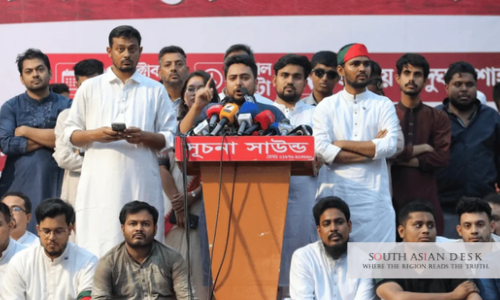
Nahid Islam’s allegations against Tarique Rahman have intensified political tensions in Bangladesh, with the National Citizen Party (NCP) convener accusing the prime minister of returning from London without a plan to govern and with intentions of corruption, extortion and land grabbing. Speaking at a protest rally in Dhaka on Friday, Islam also criticised the Bangladesh Nationalist Party (BNP) government over public hardship and what he described as its failure to honour commitments on political reform.
Islam made the remarks as chief guest at a mass rally organised by the NCP’s Dhaka North and South units outside the National Museum in Shahbagh. He accused the government of failing to address people’s immediate concerns and to fulfil promises made under the July Charter, the BNP’s 31-point agenda and its election manifesto.
The allegations were made by an opposition leader and have not been independently established. The BNP government’s response to the claims was not included in the report.
Nahid Islam’s allegations against Tarique Rahman focus on governance and public hardship
Islam said NCP representatives had spent the previous week visiting parts of the capital and speaking with residents. According to him, households were struggling with gas shortages, rising prices for liquefied petroleum gas (LPG) cylinders and the increasing cost of everyday goods.
He also said shopkeepers and small business owners feared extortion and intimidation. Electricity and gas shortages, the politicisation of state institutions and worsening law and order were among the other concerns he cited.
The NCP convener argued that the government was failing to respond to these problems. He said the home and energy ministers had not fulfilled their responsibilities and should be held accountable. Islam warned that, without action, the opposition movement could expand beyond Dhaka.
His remarks linked the allegations against the prime minister to a wider criticism of the government’s performance, particularly on household costs, public services and security. The report did not provide independent data on the shortages or price increases cited by Islam.
Dispute over the July Charter
Islam also accused the government of disregarding commitments under the July Charter and the public mandate expressed through a referendum. He alleged that a process to amend the constitution was being pursued unilaterally.
Citing a figure of 70% support for reforms in the referendum, he demanded the cancellation of what he called a unilateral constitutional amendment committee and the formation of a Constitution Reform Council. The report did not independently verify the referendum figure or provide details of the proposed committee’s mandate.
The dispute places constitutional reform at the centre of the NCP’s opposition to the BNP government. Islam framed the issue as a question of whether the administration would honour the reform process and act in accordance with the public mandate.
He also warned that Bangladesh risked replacing one form of authoritarian rule with another. Referring to the ouster of the previous government, Islam said the NCP would oppose both the former ruling force and what he described as the emergence of a new autocrat.
NCP raises concerns over security and relations with India
The rally also addressed border security and regional issues. Islam referred to the killings of Bangladeshi citizens along the border and unrest in the hill areas. He mentioned Felani Khatun and Swarna Das while alleging that more than 10 Bangladeshi citizens had been killed during the current government’s tenure. The report did not provide details supporting that figure.
Islam also warned against any arrangement that would establish what he called an illegal corridor through Bangladesh in connection with India. He said people would return to the streets if Bangladesh did not receive its fair share of water under the Ganges Water Sharing Treaty.
He further referred to the treatment of Muslims in India’s Assam and West Bengal and to the demolition of mosques in Delhi. These comments broadened the rally’s focus from domestic governance to border policy and Bangladesh’s regional relations.
The NCP’s criticism comes as the party seeks to position itself as a force for political reform and public accountability. Its demands include action on living costs and security, as well as changes to the constitutional process. The government’s response to the rally’s accusations and demands will shape the next stage of the dispute.
For now, Islam’s speech underscores the growing confrontation between the NCP and the BNP administration. The allegations remain political claims, while the questions raised about reform commitments, public services and accountability are likely to remain central to the opposition’s campaign.
Follow SouthAsianDesk on X, Instagram and Facebook for insights on business and current affairs from across South Asia.