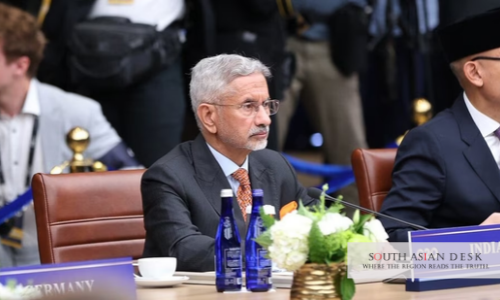
Global energy market disruptions are creating a growing threat to economic stability, External Affairs Minister S Jaishankar warned at the G20 Foreign Ministers’ Meeting in Atlanta, where he urged member countries to keep energy markets open and predictable.
Jaishankar said deliberate attacks on energy trade and infrastructure were a calculated strategy to hold prices hostage, arguing that the world was facing an energy crisis driven not by a shortage of production but by uncertainty, interrupted supplies, rising costs and difficulties in accessing energy.
The minister made the remarks on October 30 during the meeting convened by US Secretary of State Marco Rubio. His comments came amid continuing tensions in West Asia, disruptions to energy supplies and changes in international sanctions affecting oil trade.
Jaishankar’s intervention highlighted the growing importance of energy security in international diplomacy, particularly for developing countries that remain vulnerable to fluctuations in global fuel prices.
Global Energy Market Disruptions Raise Concerns Over Supply Security
Speaking at the G20 meeting, Jaishankar said disruptions to energy trade were becoming more frequent, complex and far-reaching.
He warned that obstacles to international trade, sanctions and restrictions at key transit routes were distorting energy markets and creating uncertainty for countries dependent on imported supplies.
The minister argued that these disruptions were having consequences beyond the countries directly involved in geopolitical disputes. In a globalised economy, changes in energy availability and prices can affect transportation, manufacturing, food production and household expenditure across national borders.
Jaishankar called on G20 countries to demonstrate leadership in ensuring that energy markets remained accessible and predictable.
His remarks reflected India’s concern that geopolitical tensions could undermine the reliability of energy supplies, even when sufficient production capacity exists to meet global demand.
The minister also criticised what he described as selective distinctions between oil and gas in the application of restrictions. He said the wider consequences of such measures, as well as the interdependence of countries in a globalised market, should not be underestimated.
The comments placed energy security alongside other major international concerns, including economic stability, access to essential resources and the consequences of geopolitical conflict.
US Sanctions on Iranian Oil and Disruptions in West Asia
Jaishankar’s remarks came amid US sanctions on Iranian oil and disruptions to energy supplies from West Asia.
The region remains central to global energy trade, with major oil and gas producers supplying markets across Asia, Europe and other parts of the world. Any disruption to production, transportation or exports can therefore have consequences for countries far beyond the immediate area of conflict.
Restrictions on Iranian oil exports have also affected the wider debate over international energy trade. India’s dependence on imported energy makes the reliability and affordability of supplies an important consideration in its foreign policy.
Jaishankar’s comments also came after the United States decided to lift sanctions on the sale of Russian diesel, highlighting the changing nature of restrictions affecting international fuel markets.
The minister’s criticism focused on the broader effects of sanctions and disruptions, rather than on a single measure. He argued that energy markets were becoming increasingly vulnerable to political decisions and interruptions to trade.
The comments underscored India’s concern that restrictions affecting one part of the energy market can have consequences elsewhere, particularly when countries rely on interconnected supply chains.
G20 Urged to Protect Affordable Energy Supplies
Jaishankar said the G20 must recognise the difficulties faced by low-income countries, which are often more vulnerable to rising energy costs and supply disruptions.
For developing economies, higher fuel prices can increase the cost of electricity, transport and essential goods. Countries with limited financial resources may also find it more difficult to secure alternative supplies when established trade routes are disrupted.
The minister called for greater access to finance and more international cooperation to address these challenges.
He also emphasised the importance of reliable and predictable liquefied petroleum gas supplies for India’s clean cooking requirements. LPG remains an important fuel for households that rely on it for cooking, making the stability of imports significant for both energy security and public welfare.
India’s concerns reflect the wider challenge of ensuring that energy transitions do not leave vulnerable communities without affordable and dependable supplies.
Jaishankar’s remarks therefore linked international energy trade with the practical consequences of market instability for households and developing economies.
India Calls for Investment in Alternative Energy Sources
Alongside his concerns about disruptions to conventional energy supplies, Jaishankar highlighted the need for greater investment in alternative and emerging energy technologies.
He said the G20 should widen access to finance and advance energy storage, small modular reactors, green hydrogen and biofuels.
The minister also referred to India’s National Critical Mineral Mission, which covers activities ranging from exploration to recycling. He said India had proposed a G20 Critical Minerals Circularity Initiative.
Critical minerals are important for technologies such as batteries, renewable energy systems and electric vehicles. Their availability and supply chains have therefore become increasingly significant in discussions about energy security and economic resilience.
Jaishankar’s comments suggested that improving energy security would require both reliable access to existing fuels and investment in technologies that could diversify future energy supplies.
The emphasis on financing also reflected the challenges facing developing countries seeking to expand energy infrastructure and adopt new technologies.
Energy Security Remains a Major Challenge for the G20
The G20 meeting highlighted the difficulty of maintaining stable energy markets in an increasingly uncertain geopolitical environment.
Jaishankar’s remarks focused on the need to protect international energy trade from disruptions, reduce the vulnerability of developing economies and improve access to affordable supplies.
His intervention also reflected India’s position that energy security cannot be separated from wider questions of international cooperation, economic stability and access to essential resources.
The challenge for the G20 will be to translate these concerns into practical measures that improve the reliability of energy supplies while addressing the financial and technological barriers faced by developing countries.
As geopolitical tensions continue to affect global energy trade, the stability of international markets will remain an important concern for governments, businesses and consumers.
Jaishankar’s message to the G20 was that energy security requires more than adequate production. It also depends on predictable trade, reliable infrastructure and international cooperation to ensure that disruptions do not place essential supplies beyond the reach of those who need them.
Follow SouthAsianDesk on X, Instagram and Facebook for insights on business and current affairs from across South Asia.