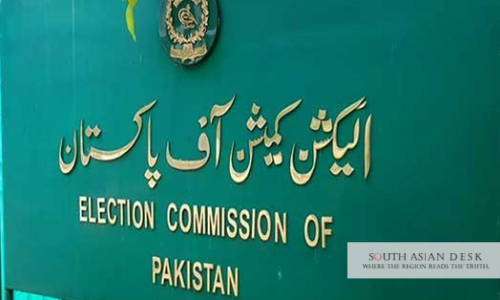
The ECP voter registration drive announced on Saturday seeks to bring more women onto the electoral rolls in Kasur district of Punjab and Qamber-Shahdadkot district of Sindh. The Election Commission of Pakistan (ECP) described the initiative as a pilot project designed to reduce the gender gap in voter registration in the two districts, where fewer women than men are currently enrolled.
According to the commission, data collection will be carried out in November 2026, while registration activities will run from December 2026 to February 2027. The programme aims to identify women who are eligible for Computerised National Identity Cards (CNICs) and for enrolment as voters, encourage them to come forward, and make the process easier for them.
How the ECP Voter Registration Drive Will Work
The campaign relies on local presence rather than on women travelling to government offices. Local social workers and enumerators will visit households door to door, prepare statistical block-wise lists of eligible women, and run awareness campaigns in their communities. The National Database and Registration Authority (Nadra) will then deploy its Mobile Registration Vans to the doorsteps of those identified, bringing CNIC registration for women directly to neighbourhoods where access has traditionally been limited. Facilitation will also be available at registration centres established in government buildings.
The link between identity documents and the electoral roll is central to the design. ECP Secretary Omar Hamid Khan explained in December 2025 that facilitating a woman to obtain her national identity card would automatically enrol her as a voter, which is why the commission treats CNIC issuance as the gateway to political participation.
Targets for Kasur and Qamber-Shahdadkot
The ECP has set specific numbers for each district. Through the campaign, it aims to facilitate the registration of 115,689 women in Kasur and 59,156 in Qamber-Shahdadkot, which amounts to 174,845 women across the two districts. Areas where the disparity between men and women is wider will be prioritised in the initial phase, allowing the commission to concentrate its resources where the need is greatest.
Representatives of the education and health sectors, civil society organisations and local communities will assist the ECP in carrying out the initiative. Their involvement is likely to matter, since teachers, health workers and community organisations often have established relationships with households that a visiting enumerator may lack.
Narrowing the Gender Gap in Voter Registration
The pilot follows a period of measurable progress at the national level. Speaking at a board review meeting of the Pakistan Legislative, Electoral, Digital Governance and Empowerment (Pledge) project in December 2025, Mr Khan said the gender gap among Pakistan’s voters had fallen from 11.8 per cent in 2018 to 7.1 per cent in 2025. He noted that female voter registration had grown by 27 per cent over the previous five years, compared with 17 per cent for male voters.
He attributed that progress to a targeted campaign conducted in four phases for the registration of women’s national identity card numbers and the enrolment of voters. A fifth phase was under way in 62 districts where the gap exceeded 10 per cent. The United Nations Development Programme, which supports the ECP under the Pledge project, planned to begin activities in 15 districts from January 2026 to help 25,000 women obtain their national identity cards.
Despite these gains, the disparity remains considerable. Human Rights Watch has noted that the general elections of February 8, 2024, were held with 127 million registered voters, of whom roughly 10 million more were men than women, in a country where women make up 49 per cent of the population. Earlier ECP figures showed that the electoral rolls in 2018 contained 59.22 million men and 46.73 million women, a difference of 12.49 million. The gender gap in voter registration has therefore narrowed steadily, but it has not closed.
What Comes Next
The Kasur and Qamber-Shahdadkot pilot will test whether a doorstep model, combining local enumerators, awareness work and Nadra’s Mobile Registration Vans, can accelerate progress in districts where the gap persists. With data collection beginning this month and registration continuing until February 2027, the results of the ECP voter registration drive will become clearer once the activities conclude, and they may inform how the commission approaches similar efforts elsewhere in the country.
Follow SouthAsianDesk on X, Instagram and Facebook for insights on business and current affairs from across South Asia.
Read More: