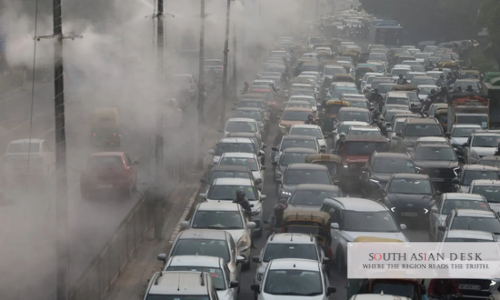
Delhi air pollution worsened sharply on Friday, November 13, pushing India’s capital ahead of Lahore in the global ranking of the world’s most polluted major cities. Hazardous air quality and dense smog reduced visibility across Delhi, highlighting the continuing severity of the winter pollution crisis affecting northern India and Pakistan.
According to Swiss air quality monitoring organisation IQAir, Delhi recorded an Air Quality Index (AQI) of 334, placing it at the top of the organisation’s global ranking. The city, which has a population of approximately 20 million, was covered in a layer of smog as pollution levels deteriorated. India’s Central Pollution Control Board (CPCB) reported an even higher AQI of 403, classifying the conditions as severe.
The difference between the two readings reflects the separate measurement scales and methodologies used by IQAir and India’s official pollution monitoring authority. Although the figures are not directly interchangeable, both indicated a serious deterioration in Delhi’s air quality.
Delhi Air Pollution Pushes Lahore Down the Global Ranking
Delhi’s rise to the top of the global pollution ranking came after Lahore had occupied the position for several consecutive days. IQAir’s hourly figures showed that Delhi’s AQI had fallen to 208 by 11am Pakistan time on Friday, while Lahore recorded 155 and stood seventh among the world’s most polluted major cities at that point.
The change in ranking does not mean that Lahore’s air pollution crisis has ended. Rather, it reflects fluctuations in pollution levels across the two cities and the wider region. Lahore had recorded an AQI of 394 between 5pm and 6pm on Thursday, according to IQAir data reported by Dawn. The reading placed the city in the hazardous category under the US AQI classification.
These figures also demonstrate why live pollution rankings should be interpreted with care. AQI readings can change considerably over the course of a day depending on weather conditions, emissions and the movement of pollutants. A city’s position in an hourly ranking is therefore not a complete measure of its longer-term air quality or public health exposure.
Winter Smog Continues to Affect Northern India and Pakistan
The deterioration in Delhi air quality is part of a recurring seasonal pattern across northern India and Pakistan. During winter, colder and heavier air can restrict the movement and dispersion of pollutants, allowing emissions to accumulate close to the ground. Vehicle exhaust, construction dust, industrial activity and smoke from agricultural burning all contribute to the problem.
These conditions can produce persistent smog, reduce visibility and expose residents to harmful concentrations of fine particulate matter. The problem is particularly concerning because pollution does not remain confined to one city. Weather patterns and regional sources of emissions can affect air quality across large parts of the Indo-Gangetic Plain and neighbouring areas of Pakistan.
In Lahore, recent findings from the Pakistan Air Quality Initiative (PAQI) underline the scale of the challenge. A report released earlier in the week found that the city’s average PM2.5 concentration stood at 126 micrograms per cubic metre over the period examined. This was approximately eight times the World Health Organisation’s recommended 24-hour guideline value.
The report also found that Lahore exceeded Pakistan’s 24-hour National Environmental Quality Standards on all 40 days for which valid data were available. Although the average concentration was 11 per cent lower than during the corresponding period in 2025, pollution remained substantially above recommended limits.
Crop-Residue Burning and the Wider Pollution Crisis
Agricultural burning remains an important part of the regional discussion surrounding winter smog. PAQI’s analysis detected 18,825 fires across Punjab, Pakistan, during the period covered by its report. Around 89 per cent were classified as likely crop-residue burning, with the highest daily count recorded on November 1, when 1,102 fires were detected.
However, the report cautioned against treating these detections as proof that agricultural burning alone caused Lahore’s pollution. Satellite observations can identify likely fires, but they do not establish the precise contribution of those fires to the concentration of pollutants measured in the city. Weather conditions, stagnant air and limited atmospheric dispersion also influence how pollution accumulates.
This distinction is important when assessing the causes of Delhi air pollution as well. The seasonal deterioration is linked to several overlapping sources, and the relative contribution of each can vary across locations and days. Addressing the problem requires more than focusing on a single source or relying on temporary measures when pollution reaches hazardous levels.
Health Concerns as Air Quality Reaches Hazardous Levels
High concentrations of fine particulate matter, particularly PM2.5, pose significant risks to public health. These particles are small enough to penetrate deep into the lungs and can enter the bloodstream. Exposure is associated with respiratory and cardiovascular problems, while people with existing health conditions, children and older adults may face heightened risks.
The World Health Organisation identifies air pollution as a major environmental health risk and recommends substantially lower particulate matter concentrations than those recently recorded in Lahore. An AQI reading above 300 is classified as hazardous under the US AQI system, indicating that pollution can affect the wider population rather than only people considered particularly sensitive.
Reduced visibility is another immediate consequence of severe smog. In Delhi, the thick pollution layer obscured parts of the city’s roads and street lighting, while vehicles moved through visibly reduced visibility. Such conditions can also create difficulties for road users and disrupt everyday activities.
A Regional Response Is Needed to Address Winter Smog
Delhi overtaking Lahore in the global pollution ranking is a change in position, not evidence that the underlying environmental crisis has shifted from one city to another. Both cities continue to face serious air quality challenges, and the latest readings show how quickly pollution levels can deteriorate across the region.
For Pakistan, the recent figures from Lahore and other parts of Punjab point to the need for sustained action on transport emissions, industrial pollution, agricultural practices and construction-related dust. Monitoring systems and public reporting also need to distinguish between short-term changes in AQI and longer-term exposure to harmful pollutants.
India faces a comparable challenge in Delhi and the surrounding National Capital Region, where seasonal pollution requires coordinated measures across multiple jurisdictions and sectors. Because air pollution can travel across administrative and geographical boundaries, cooperation on monitoring, emissions reduction and agricultural practices could strengthen efforts on both sides of the border.
As winter progresses, the latest deterioration in Delhi air quality serves as a reminder that the region’s smog crisis cannot be addressed through rankings or emergency interventions alone. The persistent health risks in Delhi and Lahore make long-term pollution control, reliable monitoring and regional cooperation essential to improving the air that millions of people breathe.
Follow SouthAsianDesk on X, Instagram and Facebook for insights on business and current affairs from across South Asia.