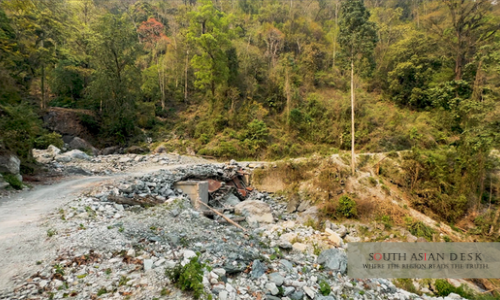
Ginger farming in Logchina Gewog is under growing strain as crop disease and unpredictable weather undermine the livelihoods of families in one of Bhutan’s traditionally fertile farming communities. Farmers report that ginger is rotting in the fields and that maize is being damaged by armyworms, leaving households worried about their earnings and their food supply. The gewog lies along the narrow farm roads leading from Phuentsholing, and its experience reflects a wider challenge for agricultural communities across the country.
Why Ginger Farming in Logchina Is Becoming Less Reliable
Logchina Gewog has around 448 households, many of which depend on agriculture. Almost 90 percent of them rely on ginger for income, while maize is important for household food. That dependence on two crops has left families exposed. Heavy rainfall, high humidity and irregular sunshine have helped pests and diseases spread, turning once-productive fields into damaged plots.
Atam Rai of Dhokham, who has farmed for more than 15 years, said the work demands long hours of clearing stones and other obstacles before planting can begin, and that income changes every year with production and market conditions. In a good season, he said, a farmer can earn up to Nu 100,000, but earnings fall sharply when disease strikes. According to him, the disease turns plants yellow and white and reduces yields, and it has affected his crops for about seven years despite continuing prevention efforts.
Farmers Describe Mounting Losses
Menu Kumari Ghalley, who has grown ginger and maize for nine to ten years, said the early years brought few problems, but recent seasons have led to serious losses for households. She described ginger as the backbone of her village and said farmers hope the government will hear their concerns and provide support.
Nar Bdr Bishwa, who has grown both crops since childhood, said transportation used to be the main obstacle, not disease. He said about 60 percent of his land is planted with ginger and nearly 30 percent of that area has been damaged. The quality of what remains has also deteriorated, he said, and he fears that the village, once known for good ginger and maize, may retain the reputation only in name.
Local Officials Seek Technical Support
Tham Bdr Rai, the Gup of Logchina, said the problem is not new, but that several villages have faced increasing difficulties from crop disease and declining production, which have directly affected farmers’ income and food security. The gewog administration has asked the Ministry of Agriculture and Livestock and other agencies for technical guidance and assistance in managing the problem.
The Gup said the agriculture department supplied a treatment called Cypermethrin in 2025. It helped to some extent and slightly reduced the problem, he said, but it did not stop or fully control the disease, and farmers continue to struggle with both ginger and maize.
How Climate Variability Complicates Disease Control
Gyembo Dorji, the Gewog Agriculture Officer, said farmers have found crop management increasingly difficult. According to him, raindrops that strike diseased ginger plants carry the infection to healthy ones, which makes the spread hard to contain. Maize is also affected, he said, because shifting weather and sunlight patterns prevent proper growth.
He explained that ginger and maize are grown on a large scale in the gewog, which makes disease management more demanding. Measures such as drainage systems and seed treatment have been provided to farmers to reduce the impact. However, he noted that the weather cannot be controlled and that the crops remain vulnerable to climate variability.
A Broader Challenge for Bhutan’s Farmers
The account from Logchina illustrates a challenge facing many farming communities in Bhutan, where crops that once offered dependable income and food security are increasingly threatened by disease, pests and shifting climate patterns. Local officials have begun offering technical support and preventive measures, yet farmers say more sustained efforts are needed to protect production.
For the people of Logchina, the future of ginger farming will depend on stronger disease management, climate-resilient practices and continued support, so that these traditional crops remain a source of livelihood and not of uncertainty.
Follow SouthAsianDesk on X, Instagram and Facebook for insights on business and current affairs from across South Asia.
Read More: