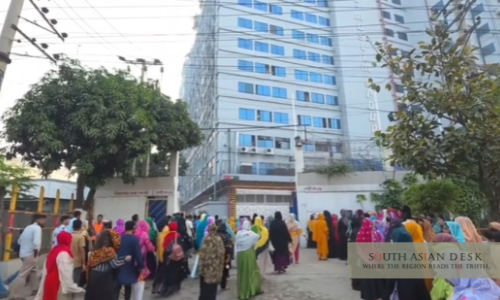
Gazipur factory closures widened on Sunday after authorities shut 13 garment factories indefinitely amid continuing garment labour unrest, while five others declared a one-day general holiday, according to The Business Standard (TBS). The closures came after workers were reported to be returning to factories earlier on Sunday morning under tight security, as SAD reported. In total, 25 platoons of law enforcement personnel have been deployed across the district’s industrial areas to maintain order and protect factories.
What Led to the Gazipur Factory Closures
The 13 factories are in the Mouchak and Konabari areas, and include Interstoff Apparels Limited in the Palli Bidyut area of Kaliakair. They were closed under Section 13(1) of the Bangladesh Labour Act, 2006, which allows owners to suspend operations during illegal strikes or disorder. The five factories that declared a holiday are in Mouchak, Konabari and Jarun.
Industrial police and local sources said workers have staged protests and work stoppages in different parts of Gazipur over the past few days, demanding among other things a minimum monthly wage of Tk30,000. On Sunday morning, workers gathered in front of a factory in the Mouchak area of Kaliakair but left about half an hour after law enforcement personnel arrived. Isolated incidents of unrest were also reported in Konabari and Jarun.
Security Deployed Across the Industrial Belt
The deployed forces include 13 platoons of Border Guard Bangladesh, five platoons of Ansar and eight platoons of the Special Response Battalion, led by 25 executive magistrates. Superintendent of Police of Gazipur Industrial Police Amjad Hossain said continuous unrest and work stoppages had forced factory authorities to close the 13 units, and that they could reopen once the situation improves. He added that law enforcement agencies remain on high alert to protect lives and property.
The disruption remains limited relative to the size of the sector. Gazipur has about 2,300 garment factories, and only the 18 closed or holiday-declared units have suspended operations, with production continuing at most others.
Owners Invoke the Bangladesh Labour Act
The closures follow a harder stance from factory owners. At a press conference on Saturday, Bangladesh Garment Manufacturers and Exporters Association (BGMEA) President Mahmud Hasan Khan said factories in affected areas that cannot continue production would be closed indefinitely from 15 November under the Bangladesh Labour Act. Under the same provision, workers are not entitled to wages or allowances while a factory stays shut because of illegal strikes or unrest.
Khan described the step as difficult but unavoidable, saying conditions for production and security could not be ensured. The association said production was suspended on Saturday at 147 factories in areas including Savar and Gazipur, as workers did not report for duty or owners feared vandalism, and that owners had by then declared 55 factories closed under the law. It added that around three lakh workers could temporarily lose their livelihoods if the 147 factories fail to operate.
Minimum Wage Board Talks Under Pressure
The unrest has a clear background. Garment workers have been protesting since mid-October for a monthly minimum wage of Tk30,000, up from the current Tk12,500, according to earlier reports. The government formed a new minimum wage board on 1 November, which has held two meetings, but demonstrations have continued in Ashulia, Savar and Gazipur despite appeals from the government, owners and labour leaders.
At the board’s meeting on 9 November, workers’ representative Babul Akter proposed a minimum wage of Tk32,000, while owners were given four days to submit their own figure. The BGMEA has confirmed it will attend Monday’s meeting to submit its proposal, though it warned that its participation in later sessions will depend on conditions on the ground. BGMEA leaders speaking anonymously told TBS that the consensus at an internal meeting was that a minimum wage above Tk14,000 would be unsustainable, although opinions among owners were divided. The association has also alleged that protests continuing after the board’s formation are aimed at pressuring for an unreasonable increase, a claim that has not been independently verified.
Pressure on Exports and Shipments
Some factories have been unable to operate for nearly two weeks, which has raised concern about missed shipment deadlines. According to TBS, a supplier that misses a deadline must bear the extra cost of sending goods by air, which can be around 13 times the usual shipping cost, and some owners fear order cancellations or deferred shipments.
What Comes Next
Monday’s wage board meeting is the next key test. If owners table a figure far below the workers’ demand, the gap between the two sides could keep the unrest alive, and with it the risk of further Gazipur factory closures. If a compromise emerges, factories may reopen quickly, as police have indicated. For now, the combination of heavy security, unpaid closures and unresolved wage talks leaves Bangladesh’s largest export sector in an uncertain position.
Follow SouthAsianDesk on X, Instagram and Facebook for insights on business and current affairs from across South Asia.
Read more: https://southasiandesk.com/dhaka-tangail-highway-garment-workers-gazipur/