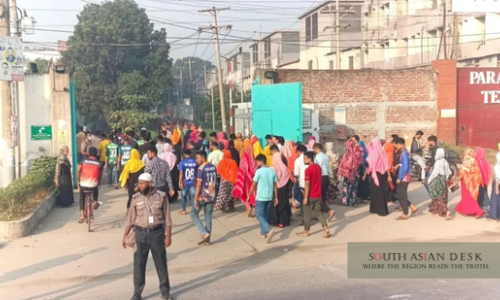
Gazipur garment workers return to work on Sunday morning as authorities tighten security across the district’s industrial belt following days of unrest over demands for a higher minimum wage. According to Dhaka Tribune, 25 platoons of law enforcement personnel have been deployed under the supervision of 25 executive magistrates, and no fresh incidents of protests or road blockades had been reported as of 8:30am.
Why Gazipur Garment Workers Return to Work Under Heavy Security
Workers began reporting for duty at various garment factories across Gazipur on Sunday morning, signalling a cautious return to routine in one of Bangladesh’s most important manufacturing hubs. Authorities nevertheless declared a holiday at six factories as a precautionary measure, reflecting continued concern over the potential for renewed disruption.
The security build-up follows a turbulent period in the district. Garment workers in different parts of Gazipur staged protests and blocked the Dhaka-Tangail and Dhaka-Mymensingh highways while demanding an increase in the minimum wage. Several clashes broke out between protesters and law enforcement personnel, leaving workers and members of the security forces injured. A number of factories announced holidays in the aftermath of the violence.
A Return That Follows Earlier Setbacks
Sunday’s resumption is not the first time operations in the Gazipur industrial belt have appeared to stabilise. Workers returned to their factories on November 5, when the Gazipur Industrial Police Superintendent, Amjad Hossain, said that 99.99 percent of garment factories in the district were operational. A further return was reported on November 8, when the district administration said no workers were occupying or blocking roads.
Calm did not hold throughout. On Thursday, workers from several factories blocked the Dhaka-Tangail highway at Mouchak in Kaliakair around 9:30am, bringing traffic to a standstill until police dispersed them. Authorities at eight to nine factories subsequently declared a holiday for the day. The repeated cycle of resumption and disruption explains why officials have kept the security presence in place rather than scaling it back.
The Minimum Wage Dispute at the Centre of the Unrest
The unrest has been driven largely by workers’ demand to raise the minimum monthly wage in the garment sector from Tk12,500 to Tk30,000. Reports from earlier this month also cited grievances over the reinstatement of laid-off workers and an end to the blacklisting of workers who took part in demonstrations.
The government responded by forming a six-member minimum wage board on November 1, according to The Daily Star. On November 4, Labour and Employment Minister Ariful Haque Choudhury said that factory owners and workers’ representatives had agreed in principle to accept the board’s recommendations, following a high-level tripartite meeting in Dhaka. He urged workers to return to their workplaces and factory owners to reopen closed units, assuring them of government support and security. The Daily Star reported that the revised wage structure is expected to take effect in December, with workers receiving their first salaries under it in January 2027.
What Lies Ahead for the Gazipur Industrial Belt
The Gazipur industrial belt is home to a large concentration of garment factories and other industries, which makes any prolonged stoppage costly for employers, workers and the wider export economy. For workers, a steady return to the production lines means continuity of income. For manufacturers, it allows them to resume fulfilling orders after a period of lost output.
Whether the present calm endures will depend on several factors, including how quickly the wage process delivers a result that workers consider acceptable and whether outstanding grievances over layoffs and blacklisting are addressed. The visible deployment of law enforcement personnel and magistrates is intended to deter fresh blockades and protect factory premises, but authorities and labour leaders alike have indicated that lasting stability will require progress on the underlying demands.
For now, the sight of workers arriving at factory gates in Gazipur offers some reassurance to an industry that has endured weeks of disruption. The precautionary holiday at six factories, however, is a reminder that normality has not been fully restored, and that officials will continue to monitor the situation closely in the days ahead.
Follow SouthAsianDesk on X, Instagram, and Facebook for insights on business and current affairs from across South Asia.