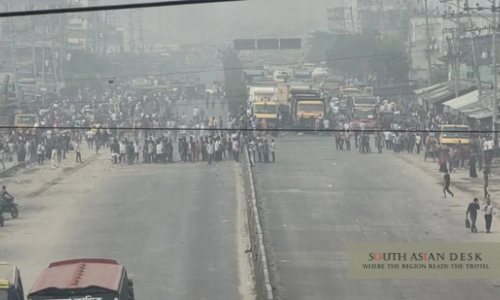
The Bangladesh garment workers protest entered another tense day on Monday when police fired tear gas and sound grenades to disperse workers who had gathered outside two factories in the Konabari area of Gazipur. Police and Border Guard Bangladesh (BGB) personnel have since been posted at key points across the industrial zone to maintain law and order, according to local media reports.
Workers Block Konabari Road Before Police Move In
Police said workers from the ABM Fashion and Jamuna factories assembled outside their workplaces and blocked the Konabari-Kashimpur road. After receiving information, police and BGB personnel reached the site and asked the workers to clear the road. As the workers became agitated, officers fired tear gas and sound grenades to disperse them. The workers later left the area, and the situation returned to normal.
Mohammad Amzad Hossain, Superintendent of Police of Gazipur Industrial Police-2, told Dhaka Tribune that workers from the two factories had gathered to protest and that police used tear gas shells and sound grenades to disperse them. He added that police and BGB personnel had been deployed throughout the industrial zone as a precaution.
Bangladesh Garment Workers Protest Rooted in Wage Demands
The latest incident follows weeks of unrest in the country’s readymade garment sector, which has been driven largely by a demand for a minimum monthly wage of Tk 30,000. At least 13 garment factories in the area have been closed indefinitely since Sunday amid labour unrest and security concerns, Dhaka Tribune reported.
The agitation had already turned violent at the start of the month. On 1 November, workers clashed with police in Dhaka and Gazipur, blocked major roads and highways, and damaged vehicles. A police box in Konabari was set on fire, and demonstrations spread across several parts of Gazipur, including Palli Bidyut, Bhogra, Naojor, Safipur and Mouchak, disrupting traffic on the Dhaka-Tangail Highway. Gazipur Industrial Police confirmed at the time that 45 factories had declared general holidays.
Government Forms Wage Board and Deploys Border Guard Bangladesh
The government responded on 1 November by constituting a six-member minimum wage board for the readymade garment sector. The board includes representatives of employers, workers and neutral parties and is headed by Senior District and Sessions Judge Sheikh Ashfaqur Rahman. It has been tasked with determining revised minimum wages under the Bangladesh Labour Act. Labour and Employment Minister Ariful Haque Choudhury urged workers to return to their factories, saying the demand for a wage-setting mechanism had been addressed. The unrest nevertheless continued.
Border Guard Bangladesh also deployed five platoons in Gazipur, covering areas such as Chandra, Palli Bidyut, Safipur, Konabari, Mouchak, Naojor and the Bhogra Bypass. The BGB said they would remain in place under the supervision of five executive magistrates until 7 November. Monday’s events show that security forces remain on the streets of the industrial belt well beyond that date.
Rights Group Raises Concern Over Use of Force
The conduct of the security forces has drawn scrutiny from abroad. On 5 November, Human Rights Watch expressed grave concern over the violence surrounding the demonstrations. The US-based group said police had used batons and tear gas against thousands of garment workers demanding higher wages, and it noted that more than 200 factories in Savar and Ashulia had been forced to declare holidays. It also flagged reports of violence by men allegedly linked to factory owners and political parties, as well as arson, vandalism of factories and attacks on police.
The organisation said that, consistent with international standards, authorities should ensure that police use force only when necessary and proportionate, and that those responsible for violence are held accountable. It also reported that a garment worker, Toufiq Hossain, who was critically injured in a clash in Gazipur’s Joydebpur area, died in a Dhaka hospital on 3 November. Human Rights Watch further alleged that authorities were blaming the political opposition for instigating the protests instead of addressing legitimate demands for living wages. Dhaka police said they had arrested 33 Awami League supporters on 3 November for sabotage, while some workers alleged that members of the youth wing of the ruling Bangladesh Nationalist Party had targeted protesting workers.
Outlook for the Garment Sector
Bangladesh depends heavily on its garment industry, and prolonged factory closures in Gazipur and neighbouring industrial areas carry clear consequences for workers, employers and exporters alike. With the wage board now at work and security personnel still deployed, attention turns to whether the review can produce a revised minimum wage that satisfies workers and ends the unrest. Until then, the Bangladesh garment workers protest is likely to remain a test of both the government’s wage policy and its approach to policing public dissent.
Follow SouthAsianDesk on X, Instagram and Facebook for insights on business and current affairs from across South Asia.