Indian AI start-ups are increasingly turning their attention to some of the country’s most stubborn practical problems, from disputed property titles to pothole-ridden streets. Rather than competing to build frontier language models, a growing number of founders are applying artificial intelligence to legal-tech, healthcare, infrastructure, education and agriculture, according to a BBC report published this week.
Landeed and the Challenge of India’s Land Records
Few problems illustrate the approach better than land ownership. In 2020, Sanjay Mandava flew from Chicago to Chennai to resolve a personal land dispute and spent months moving between government offices to gather a dozen records proving that the property belonged to his family. A sale deed from the time his parents bought the land was not enough on its own. Frustrated by the experience, he built Landeed, an AI-led digital platform that lets users aggregate fragmented land records from multiple sources, verify titles and conduct legal checks across 24 states.
Mr Mandava explained that the difficulty stems from a system of presumptive titling. In countries such as the United States and the United Kingdom, the government verifies ownership when a property is purchased. In India, the buyer is responsible for establishing ownership, and a sale deed merely records the transaction. Building certificates, property tax receipts and land survey maps may all be needed to prove title. The consequences are significant, as property disputes account for a large share of civil litigation in a country where roughly 80 per cent of household wealth is held in real estate.
Landeed has mapped large parts of the country using geo-spatial technology and data from state land revenue departments, registration offices, survey records and municipal databases. An additional AI layer reads titles, extracts information and flags inconsistencies within minutes, a task that takes lawyers and brokers several days. With a repository of 1.8 billion documents, the company says its app is used by millions of individual and enterprise customers in property transactions.
Pothole Detection and Healthcare Tools Reach City Authorities
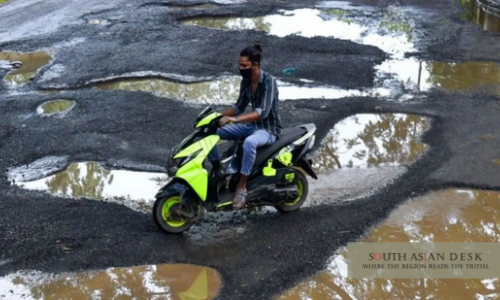
Roads present a different but equally visible challenge. Gaurav Sen, a Bengaluru-based YouTube teacher, has developed an app for pothole detection that combines a dash-cam, satellite-based navigation and an AI vision model to analyse images. The app then identifies the civic officials responsible for repairs and sends them the data. Mr Sen said a municipal corporation could install such a tool on public buses and taxis to obtain real-time information on road conditions. By the BBC’s count, at least half a dozen similar offerings now map and report road damage to authorities across the country.
In healthcare, Fractal Analytics, one of the few listed AI companies in India, has deployed a tool called Vaidya in hospitals run by Mumbai’s civic authority. Citizens can use the app to receive simplified, AI-generated summaries of their lab reports in several languages and to locate nearby healthcare facilities. Doctors gain AI-guided pre-consultation support, including medical history and medication details, while hospital administrators receive a public health dashboard built from aggregated and anonymous lab data that can reveal emerging infections or disease trends.
Funding Surges but Commercial Hurdles Remain
Investors have noticed the shift. According to the start-up information platform Inc42, funding for AI start-ups rose 265 per cent year on year, with companies raising more than $1bn in the first nine months of the year despite a relatively muted fundraising climate for the wider ecosystem. The report notes that India’s AI boom is taking place in data centre infrastructure and consumer applications rather than in basic research, which distinguishes it from the frontier-model race led by the United States and China.
Even so, many companies struggle to move beyond pilot projects. Srikanth Velamakanni, Fractal’s co-founder, said the cost of building in India is sometimes much higher than what Indian customers are willing to pay, since the computing power needed to run a model is the same in India as in the United States while American customers can pay far more. Founders also face limited access to high-quality chips. Mr Mandava said he has found it extremely difficult to acquire GPUs, even though the government has promised 38,000 of them to start-ups through its AI mission, because demand far exceeds supply.
Indian AI Start-ups: Regulation, Talent and the Risk of Shallow Solutions
Cumbersome regulation and bureaucracy add to the pressure, along with a shortage of experienced talent, difficulty in converting successful pilots into recurring government contracts and heavy dependence on expensive foreign technology. Experts quoted in the report warn that without these basic issues being addressed, Indian companies risk building shallow solutions that a later generation of founders could quickly make redundant. Mr Sen acknowledged the point himself, saying that a large technology company would take little notice of his current pilot and that the product must become far more sophisticated to be sustainable.
For policymakers, the message from founders is direct. Mr Mandava said start-ups are not asking for protection but for the means to compete with the best. The coming year will show whether Indian AI start-ups can turn promising local fixes into durable businesses, and whether better access to chips and more predictable public contracts can help them do so.
Follow SouthAsianDesk on X, Instagram and Facebook for insights on business and current affairs from across South Asia.
Read More: