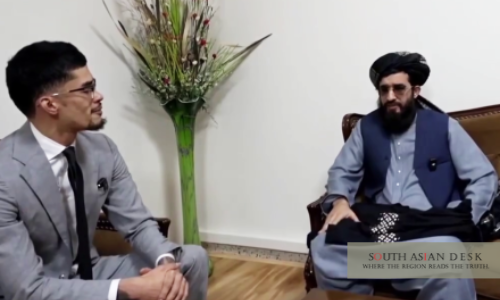
US plans in Afghanistan extended well beyond the September 11 attacks, according to Abdul Qahar Balkhi, the spokesperson for the Ministry of Foreign Affairs of the Islamic Emirate, as the Taliban administration calls itself. Mr Balkhi made the remarks in an interview with the American internet personality Sneako, in which he argued that the biggest misconception among Americans is the belief that the war was launched because of the attacks of 2001.
What Balkhi Says About US Plans in Afghanistan
Mr Balkhi said he had spoken with former US Marines, army officers and other American citizens who, in his account, feel they were misled about the war. He relayed what he described as their views, saying they had gone to Afghanistan believing the Afghan people were responsible for 9/11, but changed their minds after meeting and interacting with Afghans. According to this account, they concluded that they had been lied to, that they had fought on the basis of those claims and that they now regret their actions.
The spokesperson went further, arguing that Americans do not understand the real nature of the conflict. In his words, the war was about geopolitics, and the US security apparatus of the time saw the need to take action in Afghanistan and later in Iraq to serve its own interests. He also pointed out that Washington had targeted North Korea and Iran at that time as part of what it called the Axis of Evil, before concluding that American plans were far broader than the September 11 attacks. The accounts attributed to former US service members could not be independently verified.
The Official US Case for the War
Mr Balkhi’s interpretation differs sharply from the justification given by Washington at the time. The September 11 attacks were carried out by al-Qaeda, the group led by Osama bin Laden, which was sheltered in Afghanistan by the Taliban government then in power. The US-led military campaign began in October 2001 after the Taliban declined American demands to hand over bin Laden, and the operation drew wide international support, including the first invocation of the collective defence clause of the NATO treaty.
The Taliban have long denied any role in the attacks, and the hijackers were not Afghan nationals. Most of them were from Saudi Arabia. That distinction lies at the heart of the argument made by Taliban officials, who contend that the Afghan people were punished for a crime they did not commit.
The Axis of Evil and the Wider Strategic Debate
The phrase Mr Balkhi referred to comes from a January 2002 speech by then US president George W. Bush, who described Iran, Iraq and North Korea as an axis of evil. The Iraq war began in 2003, and critics of that war have long argued that the US case for it rested on faulty intelligence about weapons of mass destruction. That history has made some observers more receptive to the argument that strategic calculations shaped American decisions after 9/11, although there is little agreement on how far such motives drove the decision to enter Afghanistan.
Analysts who study the period generally distinguish between the initial intervention, which was widely seen as a response to al-Qaeda, and the later expansion into a long campaign of state-building and counterinsurgency. The extension of the mission over two decades, and the broader debates it produced in the United States, remain subjects of dispute among historians and policymakers.
Context of Strained Relations Between Kabul and Washington
The remarks come as the Taliban administration continues to seek wider engagement with the outside world. In September, Mr Balkhi told CBS News that the government wanted formal diplomatic relations with the United States, according to reports of the interview. He also said then that the Taliban condemn attacks on civilians and that Afghan territory would not be used against the US or any other country, a commitment tied to the Doha agreement signed in February 2020.
The United States completed its withdrawal from Afghanistan in August 2021, ending a war that lasted nearly 20 years. Since then, the Islamic Emirate has not received formal recognition from most governments, and relations with Washington remain unsettled. Statements such as the one made to Sneako appear aimed at shaping public opinion in the United States as well as at presenting the Taliban’s own reading of the conflict. Whether such arguments will influence the policy debate in Washington remains uncertain, since the official American position continues to rest on the events of September 2001.
Follow SouthAsianDesk on X, Instagram and Facebook for insights on business and current affairs from across South Asia.
Read More: