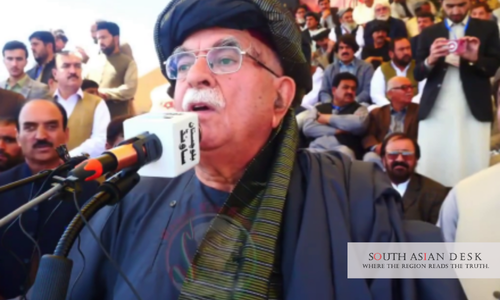
Compensation for Afghanistan has become a central demand in remarks by Pakistani opposition leader Mahmood Khan Achakzai, who has called on Russia, the United States and their allies to accept responsibility for the destruction caused by decades of conflict in the country. Speaking at a gathering in Balochistan, the chairman of the Pashtunkhwa Milli Awami Party (PkMAP) argued that the countries involved in Afghanistan’s wars should contribute to its reconstruction and provide financial assistance to those affected by the violence.
Achakzai’s remarks addressed both Afghanistan’s long history of conflict and the treatment of Pashtuns in Pakistan. He called for greater unity among Afghans in shaping the country’s future and urged religious scholars, tribal elders and politicians to speak out against what he described as discrimination and oppression against Pashtuns in Punjab and Sindh.
His comments bring together two issues that have remained significant in regional political discourse: the international responsibility for Afghanistan’s prolonged instability and the rights and treatment of Pashtun communities within Pakistan.
Mahmood Khan Achakzai Calls for Compensation for Afghanistan
During his address, Achakzai specifically named Russia and the United States, arguing that both countries had inflicted substantial harm on Afghanistan through their military involvement. He said they should compensate the Afghan people, help rebuild the country’s infrastructure and support efforts to make Afghanistan economically self-sufficient.
Achakzai also emphasised that Pashtuns had been among the communities affected by decades of violence. He urged religious leaders, spiritual figures and political representatives to recognise the suffering experienced by Pashtuns and to ensure that deaths and other losses were not overlooked.
In his remarks, he drew a comparison between the attention given to the death of animals and what he described as the insufficient recognition of human casualties among Pashtuns. He also criticised the treatment of people in Punjab and Sindh, alleging that visible aspects of Pashtun identity, including traditional beards and turbans, had become sources of difficulty for some members of the community.
The politician called for collective participation in determining Afghanistan’s future, arguing that Afghans should remain united in defending their homeland. His appeal placed national unity alongside the demand for international accountability, suggesting that reconstruction and political stability would require both domestic cooperation and external support.
Afghanistan War Reparations and the Responsibility for Reconstruction
The demand for Afghanistan war reparations reflects the continuing debate over the consequences of foreign military interventions in the country. Afghanistan experienced the Soviet invasion in 1979, followed by years of conflict involving Afghan factions and international actors. The United States later led a military intervention in 2001, which developed into a prolonged international military presence before the withdrawal of foreign forces in 2021.
These successive periods of conflict contributed to extensive destruction, displacement and economic disruption. The effects have continued to shape Afghanistan’s infrastructure, public services and development prospects. Achakzai’s argument is that countries whose military involvement contributed to this history should play a role in addressing its consequences.
Former Afghan diplomat Aziz Maarij supported the call for compensation, saying that countries responsible for damage in Afghanistan should contribute to rebuilding the country. He argued that assistance should extend beyond general reconstruction funding to include long-term investment in infrastructure and financial support for families who lost relatives during the conflicts.
Maarij maintained that such assistance would help address the hardships experienced by affected households and contribute to Afghanistan’s recovery. His remarks reflect a broader position that compensation should recognise not only damage to public infrastructure but also the human and economic costs borne by ordinary Afghans.
However, the question of war reparations involves complex political and legal considerations, including the attribution of responsibility, the identification of affected communities and the determination of appropriate forms of compensation. Achakzai’s statement represents a political demand for accountability rather than an established international compensation arrangement.
Achakzai Raises Concerns Over Pashtun Rights in Pakistan
Alongside his comments on Afghanistan, Achakzai criticised what he described as discrimination against Pashtuns living in Pakistan’s Punjab and Sindh provinces. He urged religious scholars, tribal elders and political leaders not to remain silent and called for collective action to prevent mistreatment.
His remarks reflect longstanding political concerns raised by some Pashtun representatives regarding security, economic opportunities, discrimination and the treatment of Pashtun communities outside their traditional areas of residence.
Political analyst Enayatullah Adel said that Pashtuns in Pakistan, particularly those living in border regions, had raised concerns about insecurity, economic deprivation and mistreatment. He argued that stability could not be achieved through pressure or discrimination, emphasising the importance of justice, the protection of citizens’ rights and political participation.
Adel’s comments highlight the relationship between security policy and the treatment of ethnic communities. Complaints about discrimination and unequal treatment have featured in political discussions involving Pashtun communities, although the nature and extent of these concerns vary across regions and circumstances.
The issue has also appeared in public demonstrations. On August 10, 2025, protesters gathered in Chaman to raise concerns about insecurity, military operations and arrests, which they described as part of a policy directed against Pashtuns. Demonstrators demanded guarantees for their rights and greater protection against what they considered unjust treatment.
Political and Ethnic Grievances in Pakistan-Afghanistan Relations
Achakzai’s remarks have implications for discussions about both domestic political cohesion and Pakistan-Afghanistan relations. His call for compensation for Afghanistan is linked to a wider argument about the historical consequences of foreign intervention, while his criticism of the treatment of Pashtuns raises questions about ethnic representation and equal citizenship within Pakistan.
Analysts cited in the report view the comments as reflecting political and ethnic grievances among a segment of the Pashtun population. They warn that unresolved complaints about discrimination and unequal treatment could place further strain on relations between communities and contribute to political tensions.
The remarks also underline the importance of distinguishing between calls for accountability and the establishment of legal responsibility. Although Achakzai has urged Russia and the United States to compensate Afghanistan, any formal reparations process would require political negotiations and a clear framework for determining responsibility and distributing assistance.
For Afghanistan, reconstruction remains a long-term challenge after decades of conflict. Financial support, infrastructure investment and assistance to families affected by violence are among the issues raised by those advocating international responsibility. At the same time, addressing concerns about Pashtun rights in Pakistan would require attention to security, equal treatment and meaningful political participation.
Achakzai’s speech therefore connects Afghanistan’s demand for post-war reconstruction with continuing debates over the rights of Pashtuns in the region. Whether these demands lead to concrete political measures will depend on the responses of the governments concerned and the willingness of regional and international actors to address the grievances being raised.
Follow SouthAsianDesk on X, Instagram and Facebook for insights on business and current affairs from across South Asia.
Read More: