Nangarhar jaggery production is expanding as the closure of the Torkham border crossing halts imports of jaggery from Pakistan, creating new opportunities for local sugarcane farmers and processing facilities. Agricultural officials in Afghanistan’s eastern Nangarhar province say that 240 traditional jaggery production facilities are currently operating across nine districts, with a combined production capacity of approximately 11,750 metric tons.
The development comes as local producers seek to meet domestic market demand through increased processing of sugarcane grown within the province. According to the Department of Agriculture, Irrigation and Livestock, sugarcane is cultivated on approximately 19,220 jeribs of land across Nangarhar, with an estimated harvest of 181,400 metric tons this year.
The expansion of local production has become particularly significant following the closure of the Torkham crossing, which has disrupted the movement of goods between Afghanistan and Pakistan. Officials say the interruption of jaggery imports has provided domestic producers with an opportunity to increase their market presence and supply consumers with locally manufactured products.
Nangarhar Jaggery Production Benefits From Torkham Border Closure
Ajmal Subhani, spokesperson for Nangarhar’s Department of Agriculture, Irrigation and Livestock, said the closure of the Torkham crossing had stopped imports of Pakistani jaggery, allowing local producers to respond to increased demand.
According to Subhani, the province currently has 240 operational jaggery production facilities employing thousands of people. He said locally manufactured jaggery was being supplied to markets and receiving a positive response from consumers.
Subhani also described the locally produced variety as higher in quality than the imported products that had previously entered the market. His comments reflect the department’s view that the disruption of cross-border trade has created an opportunity for Afghanistan’s domestic jaggery industry to strengthen its position.
The Torkham crossing is an important commercial route connecting Afghanistan and Pakistan, facilitating the movement of agricultural products and other goods. Its closure has affected established trade channels, but it has also encouraged some local businesses to rely more heavily on domestic production.
For Nangarhar’s sugarcane farmers and jaggery manufacturers, the changing market conditions could provide an opportunity to expand operations, increase sales and create employment within the province.
Traditional Jaggery Production Supports Local Employment in Kama
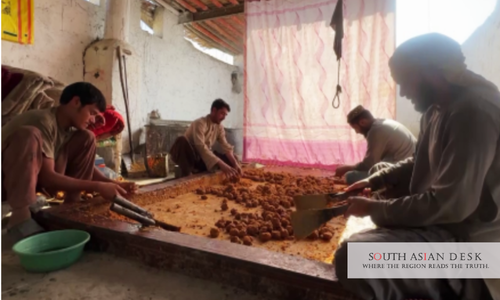
In Kama district, traditional jaggery production has been practised for decades and remains an important part of the local agricultural economy. The process begins with the harvesting of mature sugarcane, which is transported from fields to nearby processing facilities.
At these facilities, machines are used to extract juice from the sugarcane. The juice is subsequently boiled to remove excess water and concentrated before being transferred into large trays, where it is processed into solid jaggery.
Imran Salarzai, who manages a jaggery production facility in Kama, said local manufacturers were producing several varieties to accommodate different consumer preferences.
He explained that producers manufacture three or four types of jaggery, including plain varieties as well as products containing peanuts and walnuts. Salarzai added that production had begun earlier than usual this year to meet market demand.
Another producer, Alam Sher, described the manufacturing process, explaining that workers collect sugarcane from agricultural fields before extracting its juice using machinery. The extracted juice is boiled for approximately two to two and a half hours before being transferred to large trays for further processing.
The continued use of traditional production methods, alongside mechanical equipment for extracting sugarcane juice, illustrates how local industries are combining established practices with modern agricultural machinery.
With 240 facilities operating across the province, jaggery manufacturing also provides employment opportunities for workers involved in harvesting, transportation, processing and distribution.
Afghanistan Sugarcane Production Reaches 181,400 Metric Tons
The expansion of Nangarhar’s jaggery industry is supported by the province’s substantial sugarcane output. Department officials estimate that the current harvest will reach approximately 181,400 metric tons, cultivated across 19,220 jeribs of agricultural land.
This level of production provides an important supply base for local processing facilities. However, maintaining consistent agricultural output will depend on addressing the challenges faced by farmers, particularly those relating to crop diseases, access to improved seeds and the availability of agricultural inputs.
The Department of Agriculture has also undertaken training initiatives to improve farming practices. According to spokesperson Ajmal Subhani, approximately 9,800 farmers have received training through the department’s district offices.
Such initiatives are intended to improve agricultural knowledge and encourage the adoption of better cultivation techniques. Greater access to training could help farmers improve crop management, reduce losses and strengthen the quality of sugarcane supplied to local processing facilities.
The relationship between agricultural production and local manufacturing is particularly important for the province. Increased sugarcane cultivation can provide processing facilities with a more reliable supply of raw materials, while expanding jaggery production can create additional demand for locally grown crops.
Sugarcane Farmers Seek Government Support to Improve Crop Yields
Despite the expansion of local jaggery production, farmers have called for additional assistance from agricultural authorities and aid organisations to address persistent challenges affecting sugarcane cultivation.
Abdul Zahir, a sugarcane farmer, said plant diseases continued to create difficulties for agricultural producers and could significantly affect crop output. He called for assistance in controlling diseases and preventing damage to sugarcane fields.
Zahir explained that effective support in managing crop diseases would allow farmers to supply larger quantities of sugarcane to local markets each year.
Another farmer, Mohammad Rasool, said sugarcane cultivation was increasing in Nangarhar but could expand further with access to improved seeds and chemical fertilisers.
His concerns highlight the importance of agricultural inputs in sustaining production growth. Improved seed varieties can help farmers achieve better crop performance, while appropriate fertiliser use can support plant development and productivity.
For farmers, access to these resources could reduce production difficulties and improve the consistency of sugarcane supplies available to local manufacturers.
The concerns also indicate that increased demand for jaggery alone may not be sufficient to guarantee long-term growth. Sustained expansion will require improvements throughout the agricultural supply chain, from cultivation and harvesting to processing and distribution.
Local Jaggery Industry Could Reduce Afghanistan’s Import Dependence
The growth of Nangarhar jaggery production presents an opportunity to strengthen Afghanistan’s domestic agricultural processing sector and reduce reliance on imported products.
The interruption of imports through Torkham has created additional market opportunities for local manufacturers, but maintaining this momentum will require continued investment in production facilities, agricultural training and improved farming inputs.
The province’s existing sugarcane output and network of traditional processing facilities provide a foundation for further development. However, farmers’ concerns about crop diseases and the need for improved seeds and fertilisers demonstrate that agricultural support will remain essential.
Greater coordination between farmers, manufacturers and government departments could help improve the availability and quality of raw materials while enabling processing facilities to meet consumer demand more consistently.
For Afghanistan, strengthening domestic jaggery production could also contribute to broader efforts to develop local industries, create rural employment and improve the value generated from agricultural resources.
As producers in Nangarhar respond to changing trade conditions, the future of the industry will depend on whether the current expansion can be sustained through better agricultural practices, investment and reliable access to production inputs. The province’s experience demonstrates the potential of local agricultural industries to respond to disruptions in cross-border trade while creating new opportunities for farmers and businesses.
Follow SouthAsianDesk on X, Instagram and Facebook for insights on business and current affairs from across South Asia.
Read More: