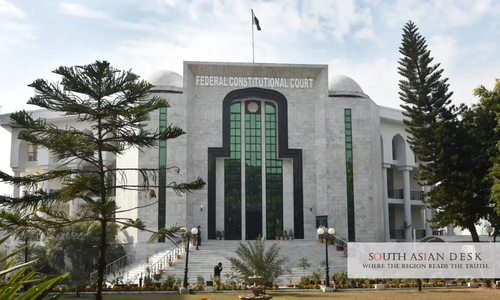
KP lawyers court boycott has been announced across Khyber Pakhtunkhwa following a controversial Federal Constitutional Court (FCC) decision suspending the Peshawar High Court’s powers to hear certain constitutional petitions under Article 199 of the Constitution. The Khyber Pakhtunkhwa Bar Council (KPBC) announced that lawyers would refrain from appearing before courts across the province on Tuesday, November 10, in protest against the ruling, which it described as an infringement of the fundamental rights of the people of the province.
The announcement follows growing concerns within the legal community over the implications of the FCC verdict, particularly its impact on constitutional remedies and pending cases involving political leaders, lawmakers and other individuals facing detention.
In a statement issued after an emergency meeting of its general body, the KPBC said that the decision had caused serious concern among its members. The council maintained that the suspension of the Peshawar High Court’s jurisdiction would adversely affect access to justice in the province.
The meeting was chaired by KPBC Vice Chairman Mohammad Rafiq and attended by Chairman of the Executive Committee Sardar Waqarul Mulk, along with other members.
KP Lawyers Court Boycott Follows FCC Decision on Peshawar High Court Powers
The lawyers’ protest stems from a decision issued by a two-member bench of the Federal Constitutional Court on Thursday. The court ruled that proceedings initiated before the Peshawar High Court under Article 199 on or after October 12 would remain suspended under Article 245(4) of the Constitution.
The ruling was connected to the deployment of the armed forces in aid of civil power throughout Khyber Pakhtunkhwa, pursuant to an order issued on October 11.
Article 245 provides the constitutional framework governing the functions of the armed forces and their deployment in aid of civil power. Clause 4 addresses the jurisdiction of courts during such deployments, restricting their ability to exercise jurisdiction under Article 199 in circumstances covered by the provision.
The FCC relied on this constitutional provision to conclude that the relevant proceedings before the Peshawar High Court would remain suspended for the period covered by the order.
The decision has raised concerns because Article 199 provides the constitutional basis for the High Court’s writ jurisdiction. It allows individuals to approach the court for relief in matters involving the enforcement of fundamental rights and other questions falling within its constitutional jurisdiction.
The suspension therefore has implications extending beyond individual cases, affecting the availability of an important constitutional remedy for residents of Khyber Pakhtunkhwa.
KP Bar Council Plans to Challenge Federal Constitutional Court Verdict
In addition to announcing the boycott, the Khyber Pakhtunkhwa Bar Council decided to approach the Federal Constitutional Court and seek permission to become a party to the proceedings concerning the suspension of the Peshawar High Court’s powers.
The council constituted a panel of lawyers tasked with immediately moving the FCC in this regard. The decision indicates that the legal community intends to challenge the implications of the ruling through judicial proceedings rather than limiting its response to a protest.
According to the KPBC statement, members strongly opposed the suspension of the High Court’s constitutional jurisdiction, arguing that it undermined the rights of people in the province.
The council also reiterated its opposition to what it described as undemocratic measures, including governor’s rule and the imposition of emergency. It maintained that it would continue raising its concerns on every available forum in support of the restoration of democracy.
The Tuesday boycott is consequently part of a broader expression of opposition within the province’s legal community to measures that it believes could undermine constitutional protections and democratic institutions.
Peshawar High Court Stops Hearing Constitutional Petitions
Following the FCC ruling, the administrative committee of the Peshawar High Court met on Friday and decided to comply with the order.
The committee resolved that the High Court would not proceed with petitions filed under Article 199 on or after October 12. It also decided that fresh petitions under the same provision would not be entertained and would instead be returned to petitioners, who were advised to approach the appropriate forum.
The administrative decision has significant implications for individuals seeking judicial intervention against government actions and other matters falling within the High Court’s constitutional jurisdiction.
Article 199 is particularly important because it provides a mechanism through which citizens can challenge unlawful actions by public authorities. Its jurisdiction also covers matters involving unlawful detention, the exercise of public powers and the enforcement of fundamental rights.
The suspension of proceedings has therefore created uncertainty for petitioners who would ordinarily approach the Peshawar High Court for constitutional relief.
PTI Leaders’ Detention Cases Among Those Affected
The FCC verdict is expected to affect several high-profile cases involving Pakistan Tehreek-i-Insaf (PTI) leaders and lawmakers in Khyber Pakhtunkhwa.
These include petitions challenging the imposition of emergency and governor’s rule in the province, as well as cases concerning the alleged illegal detention or abduction of provincial political figures.
Among those whose cases could be affected are Chief Minister Sohail Afridi, KP Assembly Speaker Babar Saleem Swati and PTI provincial president Junaid Akbar, along with several other lawmakers and party leaders.
The ruling is also expected to affect petitions concerning the detention of PTI workers and leaders under the Maintenance of Public Order (MPO) Ordinance.
Beyond politically sensitive proceedings, the suspension could have consequences for other categories of litigation. These include habeas corpus petitions, anti-encroachment disputes, service matters and family-related cases.
The impact on habeas corpus petitions is particularly significant because such proceedings provide a judicial mechanism for challenging unlawful detention and seeking the production of individuals allegedly held without lawful authority.
With the Peshawar High Court no longer proceeding with the affected Article 199 petitions, individuals seeking relief in these matters may face additional uncertainty over the appropriate legal forum.
Legal Community Raises Concerns Over Access to Justice in KP
The KP lawyers court boycott highlights broader concerns regarding the relationship between constitutional security provisions and the protection of fundamental rights.
While Article 245 provides for the deployment of armed forces in aid of civil power, its application also raises questions about the extent to which ordinary judicial remedies remain accessible during such periods.
For the legal community in Khyber Pakhtunkhwa, the immediate concern is the effect of the FCC ruling on the ability of citizens to seek constitutional relief through the province’s High Court.
The KP Bar Council has indicated that it intends to contest the decision before the Federal Constitutional Court, while its boycott announcement reflects the seriousness of the opposition within the provincial legal fraternity.
The developments have placed the constitutional jurisdiction of the Peshawar High Court at the centre of an important legal and political debate. With pending petitions involving political detentions, emergency measures and ordinary civil disputes potentially affected, the consequences extend well beyond the immediate protest.
As lawyers across the province observe the boycott on Tuesday, attention is likely to remain focused on the KPBC’s planned legal challenge and the extent to which the FCC ruling will continue to restrict access to constitutional proceedings in Khyber Pakhtunkhwa.
Follow SouthAsianDesk on X, Instagram and Facebook for insights on business and current affairs from across South Asia.
Read More: