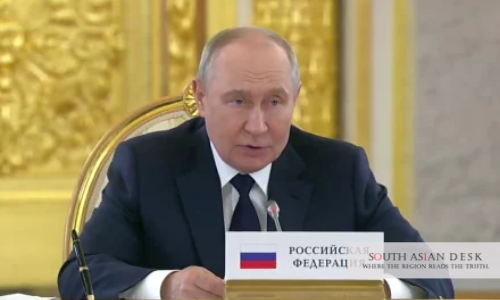
The Afghanistan security situation featured prominently at a meeting of the Collective Security Council of the Collective Security Treaty Organization (CSTO) in Moscow, where Russian President Vladimir Putin said the alliance has been following developments in the country closely. Speaking at the Kremlin on Wednesday, 11 November, Mr Putin linked the monitoring to wider efforts to protect the external borders of the bloc, while Tajik President Emomali Rahmon used the occasion to set out his country’s priorities as it prepares to take over the CSTO chairmanship.
Putin Stresses Coordination Among Security Agencies
Mr Putin told the council that close operational contacts among security agencies, law enforcement bodies and other relevant authorities have strengthened coordination among member states in tackling terrorism, extremism, drug trafficking and illegal migration. He added that, as part of work to improve security along the organisation’s external borders, the situation in Afghanistan has also been monitored closely.
The Russian president said Moscow made joint military training a priority during its 2026 chairmanship, pointing to exercises held in Russia, Belarus, Kazakhstan and Tajikistan. He also noted that 2027 will mark 35 years since the signing of the collective security treaty and 25 years since the formal establishment of the organisation. The CSTO groups Russia, Belarus, Kazakhstan, Kyrgyzstan, Tajikistan and Armenia.
Tajikistan Sets Border Priorities for Its Chairmanship
Chairmanship of the CSTO passes from Russia to Tajikistan on 1 January 2027. Addressing the meeting, Mr Rahmon identified the strengthening of the Tajikistan-Afghanistan border and greater effectiveness in protecting the bloc’s external frontiers as leading priorities. He also listed improved readiness of collective forces, the development of military and technical cooperation and crisis response mechanisms, stronger efforts against terrorism, extremism, drug trafficking and transnational crime, and closer political coordination with international and regional organisations.
Tajikistan is the only CSTO member that shares a border with Afghanistan, which explains why the issue weighs so heavily on its agenda. The alliance has been advancing a multi-year programme to reinforce that frontier. Officials have said its second phase, covering 2026 and 2027, focuses on equipping the most vulnerable sections, while a final phase running from 2027 to 2029 is intended to cover the entire length of the border. CSTO representatives have stressed that the initiative is not directed against Afghanistan or its people.
Kyrgyz President Sadyr Japarov, for his part, confirmed that Kyrgyzstan is ready to host CSTO activities in 2027. His remarks on Afghanistan went beyond security, as he called for international support for economic recovery and humanitarian assistance, a reminder that some members see development as part of the regional response.
Kabul Rejects Concerns About Threats
The Islamic Emirate has consistently rejected suggestions that Afghan territory poses a danger to its neighbours. In late August, after CSTO Secretary General Taalatbek Masadykov described security along the Tajikistan-Afghanistan border as a concern for all member states, Islamic Emirate spokesman Zabihullah Mujahid said that no threat to other countries emanates from Afghan soil. He suggested that some hostile intelligence circles might be spreading inaccurate information, and said that any country or organisation with security concerns could share them directly with Afghan authorities.
Outside assessments have been more cautious. A UN Security Council sanctions monitoring team said in August that the threat posed by terrorist groups operating in Afghanistan had changed little and remained a concern for neighbouring states and the wider Central Asian region. The latest exchange reflects the differing positions of Kabul and regional security bodies, with the former insisting that its borders are secure and the latter continuing to plan for contingencies.
What the Afghanistan Security Situation Means for the Region
Political analyst Sayed Ebadullah Sadiq told TOLOnews that Afghanistan holds strategic importance for security because of its position at the heart of Asia, and that Russia and the Central Asian states are working to ensure that stability is maintained there. His view echoes the broader logic of the CSTO’s approach, which treats the Afghanistan security situation as a matter of collective interest rather than one confined to a single border.
Much will depend on how the Tajik chairmanship translates its stated priorities into practice, and on whether dialogue between Kabul and the CSTO’s members can narrow the gap in how each side describes conditions on the ground. For now, the alliance has made clear that it intends to keep Afghanistan under close observation, while the Islamic Emirate has repeated its assurance that no neighbour has cause for alarm.
Follow SouthAsianDesk on X, Instagram and Facebook for insights on business and current affairs from across South Asia.
Read More: