KABUL — Communities across Afghanistan are grappling with a deepening Afghanistan climate crisis that is threatening livelihoods, food security, and stability, the United Nations Assistance Mission in Afghanistan (UNAMA) warned on Thursday, June 5, 2026, World Environment Day, calling for urgent, coordinated action to address what it described as overlapping and intensifying environmental hazards affecting millions across the country.
Afghanistan Climate Crisis – Drought and water scarcity grip the country
More than half of Afghanistan’s population is affected by drought and water scarcity, with prolonged dry periods severely impacting agriculture, the backbone of rural livelihoods.
In eastern provinces such as Nangarhar, farmers are reporting repeated crop failures while shrinking water resources are fuelling competition over land and water. The human toll of this instability is stark. “Our river has become unpredictable. Last year, it dried when we needed it most; this year it flooded and destroyed half of our crops,” a farmer in Goshta District told UNAMA, describing the growing uncertainty facing rural communities.
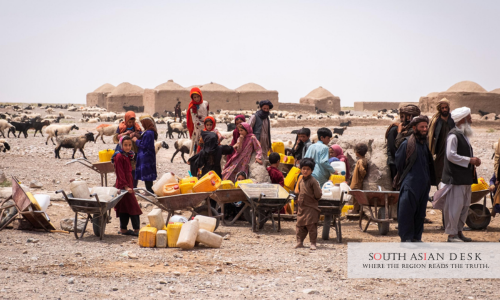
In the southern provinces of Kandahar, Helmand, Nimroz, Zabul, and Uruzgan, the situation is particularly severe. Recurrent drought, declining rainfall, and unregulated groundwater extraction have pushed water systems to the brink. Rivers are drying up, traditional irrigation systems have collapsed, and many communities are forced to drill increasingly deep wells, often without success.
Agricultural output is declining, access to safe drinking water is shrinking, and families are being displaced in search of water. Rising competition over limited resources is also increasing tensions. Experts warn that without rapid and coordinated intervention, including water-efficient irrigation and improved water management, parts of the region could become uninhabitable.
Floods, dust storms, and environmental degradation compound the crisis
In the western region, communities face a different but equally severe challenge. While provinces such as Ghor and Farah experience prolonged drought, others are hit by heavy rainfall and flash floods that destroy homes, farmland, and infrastructure, forcing communities to cope with water shortages while simultaneously rebuilding what floods have swept away.
Flooding is becoming more frequent and unpredictable in central and eastern provinces such as Logar, Parwan, and Kapisa, while strong winds and dust storms in the south damage crops and contribute to respiratory health problems.
Environmental degradation is compounding these pressures considerably. Deforestation in Kunar, Nuristan, and Logar has reduced natural protection against floods and landslides, while overgrazing and ecosystem degradation in mountainous areas such as Badakhshan are contributing to biodiversity loss. Unregulated mining activities are further damaging land and polluting water sources.
Urban areas are also under strain. In Kabul, air pollution, particularly during winter months, is a major health threat, driven by the use of low-quality fuels and poor waste management. In tourist-frequented areas including Panjshir, Kapisa, and Maidan Wardak, growing tourism has led to increased waste in rivers and valleys, highlighting the need for stronger environmental management.
Communities and UNAMA scale up their response
Despite the severity of the crisis, mobilisation is under way. The Qush Tepa Canal, one of Afghanistan’s largest irrigation projects, aims to divert water from the Amu Darya to northern provinces to expand irrigation and boost agricultural production. While expected to support livelihoods and improve food security, UNAMA cautions that its long-term impact will depend on sustainable water management practices.
At the same time, nature-based and community-led measures are being scaled up, including planting drought-resistant vegetation to stabilise sand dunes and protect riverbanks, as well as improving irrigation methods and water retention systems to conserve scarce resources.
UNAMA, through its field offices, is supporting climate awareness and environmental protection efforts nationwide, bringing together authorities, environmental institutions, journalists, and communities to promote sustainable practices and strengthen public awareness. In Kabul, community leaders in Hoodkhail have engaged with UNAMA to address drainage, safe drinking water, and waste management, while similar activities are taking place across provinces throughout June.
Background
Afghanistan is among the countries least responsible for global greenhouse gas emissions, yet it consistently ranks as one of the most vulnerable to climate change. According to the International Organization for Migration, nearly five million Afghans were affected by climate-related disasters between January and March 2025 alone. Approximately 175,000 people were internally displaced during this period, with 79 per cent of displacements directly linked to environmental hazards. Food insecurity remains a critical concern, with 47 per cent of communities assessed by IOM citing lack of food as their most urgent challenge.
Nearly 70 per cent of the population depends on climate-sensitive agriculture for their livelihoods, while a changing water cycle is intensifying water scarcity nationwide, with urban centres such as Kabul confronting acute groundwater depletion. Four decades of conflict have compounded the country’s environmental vulnerability, leaving institutions weakened and communities ill-equipped to absorb successive shocks. As UNAMA’s Charity Watson observed at a Kabul climate conference, “Climate change is not a far-off phenomenon; it is already unfolding now,” noting that the most affected are invariably those already most vulnerable, especially rural communities and women and children.
What’s next
Aid agencies are calling for urgent investment in disaster risk reduction, early warning systems, and long-term climate adaptation strategies, warning that without sustained support, environmental hazards could become one of the leading drivers of displacement and humanitarian crisis in Afghanistan. As the Afghanistan climate crisis continues to intensify, the consensus among UN agencies and international partners is that coordinated, evidence-based action, linking communities, authorities, and donors, is the only viable path towards resilience.
Published in SouthAsianDesk, June 6, 2026
Follow SouthAsianDesk on X, Instagram and Facebook for insights on business and current affairs from across South Asia.