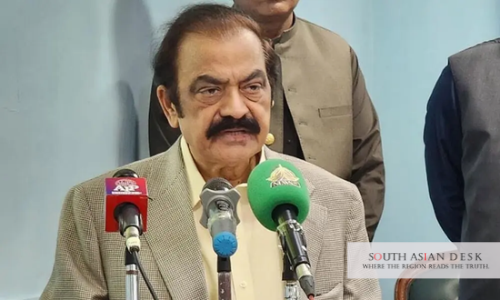
Anti-terror operations in Khyber Pakhtunkhwa (KP) will continue through intelligence-based action in sensitive areas, Adviser to the Prime Minister on Political Affairs Rana Sanaullah said on Friday, October 23, as he urged local residents either to expel militants from their communities or to make way for security forces. Speaking on Geo News’ programme “Naya Pakistan,” he warned that failure to do either could lead to harm to civilians.
Residents Given Two Options
Mr. Sanaullah said terrorists were living among the population in sensitive parts of the province and that residents had been asked to remove them from populated areas. If residents were unwilling to do so, he said, they should move aside so that operations could be conducted. He cautioned that if neither option was possible, there would be a risk of collateral damage.
The adviser said intelligence agencies knew the number and location of the militants and described their work as “perfect.” He claimed that the militants operated in groups of at least three and up to 15 individuals, and that 70 per cent of such groups were present in the sensitive areas. These figures were offered by Mr. Sanaullah in the interview, and no independent verification was provided in the report.
What Anti-Terror Operations in Khyber Pakhtunkhwa Mean for Local Communities
The remarks highlight a long-standing challenge in counter-terrorism: militants embedded within civilian populations make targeted action difficult and raise the risk of civilian casualties. By asking residents to take a side, the government is placing responsibility on communities that often have limited ability to confront armed groups themselves.
Mr. Sanaullah said the current administration’s priority in the province was the elimination of terrorism. He expressed confidence that it could be achieved within “weeks and months” and would not take much longer, adding that KP could then return to normal conditions. He also said the government expected the Pakistan Tehreek-e-Insaf (PTI) to cooperate in the fight against terrorism.
Governor’s Rule and the Political Backdrop
The comments follow the imposition of an emergency and governor’s rule in the province. President Asif Ali Zardari proclaimed the measures on October 11, effectively sidelining the PTI-led provincial government. The summary was approved on the advice of Prime Minister Shehbaz Sharif under Articles 232 and 234 of the Constitution, after recommendations from the federal cabinet.
According to the proclamation, the move was prompted by a surge in terrorist attacks and extremist activities, including attacks on infrastructure, government installations and law enforcement agencies. It also accused the provincial government of lacking the ownership, will and intent needed to tackle terrorism and lawlessness.
Mr. Sanaullah alleged that the provincial government led by Sohail Afridi, which he described as dysfunctional, had discouraged people from cooperating with law enforcement agencies. He maintained that KP was now being run under a setup headed by the governor. The PTI has challenged the governor’s rule in court, and the Peshawar High Court has issued notice to the Attorney General on its petitions, as reported by The News International. The party’s response to Mr. Sanaullah’s latest remarks was not included in the report.
Prime Minister Defends the Decision
Prime Minister Shehbaz Sharif said on Thursday that the emergency and governor’s rule had been imposed under extreme compulsion. He criticised the PTI over the deteriorating security situation and said that, with the cooperation of the field marshal, the government would restore peace to the province. He also promised that KP would receive development on par with other provinces.
Overtures to the Opposition
On the wider political situation, Mr. Sanaullah said the government was prepared to hold talks with the opposition leader at the Prime Minister House and would offer him tea if he came. He described Tehreek Tahaffuz-e-Ayeen-e-Pakistan chief Mahmood Khan Achakzai as a brother who had supported the ruling side in the past, though he said Mr. Achakzai’s insistence on a particular position did not befit his stature.
Outlook
The government has set an ambitious timeline and publicly tied its approach to community cooperation. How the planned anti-terror operations in Khyber Pakhtunkhwa unfold, and how residents and the province’s political parties respond, will shape both the security situation and the legal and political debate over governor’s rule in the weeks ahead.
Follow SouthAsianDesk on X, Instagram and Facebook for insights on business and current affairs from across South Asia.