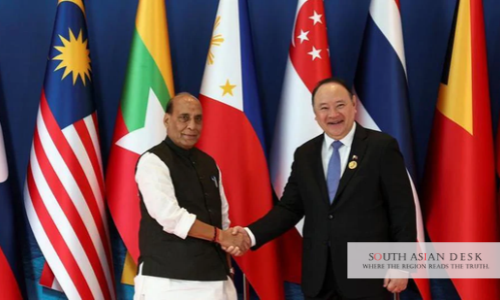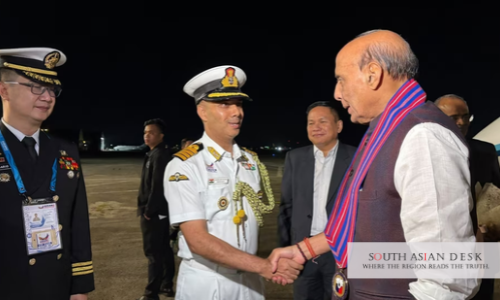
Defence Minister Rajnath Singh has arrived in the Philippine city of Cebu to attend the 13th ASEAN Defence Ministers’ Meeting-Plus, where India intends to strengthen defence partnerships and press its case for a stable regional order. The meeting is scheduled for October 28 and 29, and Singh is leading the Indian delegation on a three-day visit that will also include bilateral talks with counterparts on the sidelines.
A Visit Anchored in the Act East Policy
Singh left New Delhi on Tuesday and was received on arrival in Cebu by Major General Fabian Pedregosa (Retd), Undersecretary of the Philippine Department of National Defence. Before departing, he said India remained committed to strengthening regional security cooperation, promoting ASEAN centrality and ensuring peace and stability in the Indo-Pacific under its Act East Policy. He added that he would hold several bilateral meetings with counterparts from participating nations.
According to the Ministry of Defence, Singh will also review ongoing defence ties with partner countries and explore ways to further strengthen strategic partnerships. The ministry’s statement framed the forum as an opportunity to engage with defence leaders from across Southeast Asia and beyond on cooperation and shared security challenges.
What the ASEAN Defence Ministers’ Meeting-Plus Brings Together
The ASEAN Defence Ministers’ Meeting, known as the ADMM, is described by the Ministry of Defence as the highest defence consultative and cooperative mechanism within the Association of Southeast Asian Nations. Its expanded format, the ADMM-Plus, brings together the 11 ASEAN member states, namely Brunei, Cambodia, Indonesia, Laos, Malaysia, Myanmar, the Philippines, Singapore, Thailand, Timor-Leste and Vietnam. They are joined by eight Dialogue Partners, which are India, the United States, China, Russia, Japan, South Korea, Australia and New Zealand.
India became a Dialogue Partner of ASEAN in 1992. The inaugural ADMM-Plus meeting was held in Hanoi, Vietnam, on October 12, 2010, and since 2017 the participating defence ministers have met every year. The Philippines is chairing the forum in 2026.
India also carries specific responsibilities within the ADMM-Plus structure. Under the framework, it is co-chairing the Experts’ Working Group on Counter-Terrorism with Malaysia for the 2024 to 2027 cycle, which gives New Delhi a continuing role in practical security cooperation among the participating states.
Naval Cooperation Ahead of the Ministerial
The ministerial meeting follows practical engagement at sea. Last month, Indian Naval Ships Sahyadri and Kulish reached Subic Bay in the Philippines to take part in the ADMM-Plus Joint Cooperation Activity. The exercise brought together maritime forces from ASEAN member states and the eight partner countries, with a focus on interoperability, mutual understanding and cooperation in the maritime domain.
Strengthening India-Philippines Defence Cooperation
The venue and the chairmanship give added significance to India-Philippines defence cooperation, which has grown considerably in recent years. India and the Philippines formally elevated their relationship to a Strategic Partnership in August 2025, during President Ferdinand Marcos Jr.’s visit to New Delhi, backed by a Plan of Action covering 2025 to 2029. The two sides also agreed to facilitate the regular convening of the Joint Defence Cooperation Committee and the Joint Defence Industry and Logistics Committee, with an emphasis on defence industrial collaboration, technology, research, training and capacity building.
The most visible element of that cooperation has been the sale of BrahMos supersonic cruise missile systems. The Philippines became the first export customer for the missile, which was developed jointly by India and Russia. The deal, reported to be worth $375 million, was signed in 2022, and deliveries began in 2024. Philippine Ambassador to India Josel Ignacio has described the acquisition as an important contribution to his country’s efforts to achieve credible deterrence, and has indicated that further cooperation in equipment, training and indigenous defence industry development remains possible.
Why Indo-Pacific Security Remains the Focus
Analysts note that growing great-power competition and maritime disputes have encouraged regional states to deepen defence partnerships. For India, forums such as the ADMM-Plus offer a platform to advocate a rules-based approach to Indo-Pacific security while building ties with ASEAN states and other partners at the same table.
The outcome of the Cebu meeting will depend on the discussions among all 19 participating countries. For New Delhi, however, the visit is an opportunity to consolidate relationships built over three decades of engagement with ASEAN, and to translate recent gains with Manila into a broader and more durable regional security role.
Follow SouthAsianDesk on X, Instagram and Facebook for insights on business and current affairs from across South Asia.
Read More: