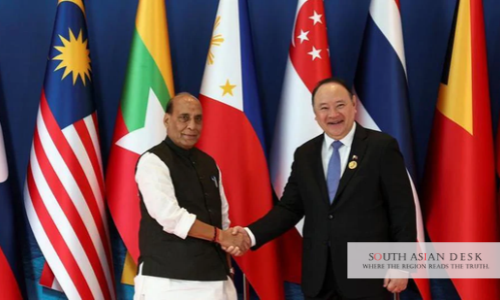
Indo-Pacific security dominated a series of bilateral meetings held by Defence Minister Rajnath Singh with his counterparts from the United States, Australia and Japan on the sidelines of a regional defence forum in the Philippines. The talks, held in Cebu, completed a round of meetings with the defence ministers of all of India’s Quad partners. They were separate bilateral discussions rather than a formal gathering of the Quad grouping.
A Round of Meetings in Cebu
Singh is in Cebu from October 28 to 29 to attend the 13th ASEAN Defence Ministers’ Meeting-Plus, known as the ADMM-Plus. According to The Tribune, he met US Secretary of War Pete Hegseth and Australia’s Deputy Prime Minister and Defence Minister Richard Marles on Wednesday, and was also scheduled to meet Japanese Defence Minister Shinjiro Koizumi. Reports from The Statesman and The Tribune later confirmed that the meeting with Koizumi had also taken place.
The Ministry of Defence said the discussions with Washington and Canberra both referred to the need for a free, open and secure Indo-Pacific. The Tribune noted that in strategic circles the phrase is widely understood as a reference to opposing Chinese dominance and any attempt to impede maritime traffic. Neither government used such language directly in the statements quoted.
Talks With the United States
Singh and Hegseth reviewed progress under the 10-year India-US Defence Framework, focusing on military technology, information sharing and co-production, according to the Ministry of Defence. Hegseth said on X that the two sides celebrated the one-year anniversary of the Framework for the Major Defence Partnership and explored ways to strengthen cooperation. The framework was signed in Kuala Lumpur in October last year during the previous ADMM-Plus.
The Statesman reported that Singh called for a zero-tolerance approach towards countries that support, train or finance terrorist groups, while Hegseth reaffirmed American support for India in its fight against cross-border terrorism. Singh described the partnership as a cornerstone of a free, open and secure Indo-Pacific.
The Tribune, citing sources, also reported that Singh raised concerns about the ongoing US-aided sustainment and modernisation package for Pakistan’s F-16 fleet, which it valued at $686 million. The report said the package is intended to extend the operational life of the aircraft to 2040. These details come from unnamed sources and were not part of the official readouts.
Australia and Japan
With Marles, Singh said the two sides held productive discussions on reviewing bilateral defence cooperation, enhancing military interoperability and addressing regional security challenges. He said India places great value on its Comprehensive Strategic Partnership with Australia.
In his meeting with Koizumi, Singh reviewed the progress of bilateral defence cooperation since their previous meeting in August, according to The Statesman. Both sides reaffirmed their commitment to the India-Japan Special Strategic and Global Partnership. They also agreed to accelerate discussions towards the fourth Japan-India Foreign and Defence Ministerial Dialogue, known as the 2+2, and a Japan-India Defence Ministers’ Meeting in Tokyo later this year.
Why the Quad Partners Matter
The Quad brings together India, the United States, Japan and Australia, and the four countries have repeatedly stressed cooperation on maritime security, technology and a rules-based regional order. Holding separate meetings with each of the Quad partners on the same day allowed Singh to advance defence ties on several tracks at once. Each discussion carried a different emphasis, from co-production and technology with Washington, to interoperability with Canberra and a structured dialogue calendar with Tokyo.
The meetings also come at a time when India has been seeking to deepen its role in Southeast Asia under its Act East Policy. Singh said before leaving that India is firmly committed to ASEAN centrality and to the peace, stability and collective growth of the Indo-Pacific.
The Wider ADMM-Plus Agenda
The ADMM is the highest defence consultative mechanism in ASEAN, and its expanded format brings together the 11 ASEAN members and eight dialogue partners, namely India, the United States, China, Russia, Japan, South Korea, Australia and New Zealand. The Philippines is chairing the forum in 2026. India became a dialogue partner of ASEAN in 1992, and the first ADMM-Plus meeting was held in Hanoi in October 2010, with annual meetings since 2017.
On Thursday, Singh is due to address the forum on an exchange of views on regional and international security issues. He is also expected to meet the defence ministers of Vietnam, South Korea, Singapore and the Philippines. India co-chairs the Experts’ Working Group on Counter-Terrorism with Malaysia for the 2024 to 2027 cycle.
Indo-Pacific Security: Outlook
The Cebu meetings show New Delhi using multilateral forums to strengthen bilateral relationships. Whether the discussions translate into concrete outcomes will depend on follow-up work, including the planned Japan-India 2+2 dialogue and the implementation of the India-US framework. For now, the focus on Indo-Pacific security gives India’s partners a consistent message about its priorities in a region of intensifying strategic competition.
Follow SouthAsianDesk on X, Instagram and Facebook for insights on business and current affairs from across South Asia.