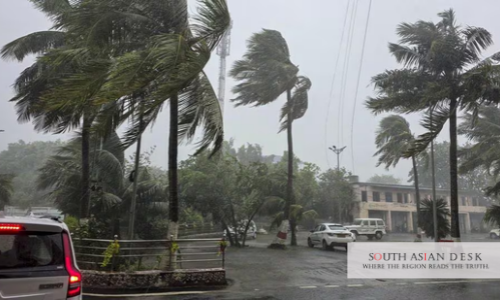
Cyclone Arnab has weakened into a deep depression after making landfall in Andhra Pradesh, but the system continues to bring heavy to extremely heavy rain to south Odisha, where thousands of people have been moved to safety. The India Meteorological Department (IMD) kept a red alert in force for six districts as the storm moved inland.
Landfall and Weakening
Cyclone Arnab struck the Andhra Pradesh and Yanam coasts early on Wednesday as a very severe cyclonic storm, which is the third-highest category on the IMD’s scale. India.com reported that the landfall process began near Narsapur in West Godavari district at around 1.30 am. Reuters, in a report carried by ABC News, said sustained winds of 125 to 135 kilometres per hour with gusts of up to 150 kilometres per hour were forecast, along with a storm surge of one to 1.5 metres above the normal tide in low-lying areas.
After crossing the coast, the storm weakened. The Regional Meteorological Centre in Bhubaneswar said the system had lost strength but had still triggered heavy to extremely heavy rainfall in several parts of southern Odisha over the previous 24 hours. The IMD’s bulletin said the system would weaken into a deep depression by midnight of October 28, as reported by The Federal. A deep depression is a stage above a depression and below a cyclonic storm, with sustained winds of about 52 to 61 kilometres per hour.
Impact in Andhra Pradesh
Andhra Pradesh bore the brunt of the storm. Narendra Singh Bundela, a senior official of the National Disaster Response Force, told reporters that three people had lost their lives. Chief Minister N Chandrababu Naidu said in a letter to Union Home Minister Amit Shah that at least 180 houses were destroyed and 220 trees were brought down, while power supply was disrupted in several areas. More than 180,000 people were evacuated across Andhra Pradesh and Odisha before the cyclone arrived, and operations at three airports in Andhra Pradesh were suspended.
Rain Batters South Odisha
In Odisha, the effects were felt mainly in the south of the state. The Federal reported that Mahendragarh in Gajapati district recorded the highest rainfall at 249.9 millimetres, followed by Pottangi in Koraput district at 188 millimetres and Mohana in Gajapati at 168.8 millimetres. Ganjam recorded 161.4 millimetres. Special Relief Commissioner Rajesh Prabhakar Patil said almost all blocks in Gajapati and some blocks in Ganjam received more than 150 millimetres in 24 hours, according to OdishaBytes.
The IMD issued a red alert for extremely heavy rainfall in Ganjam, Gajapati, Rayagada, Koraput, Malkangiri and Nabarangpur districts, with wind speeds of 50 to 70 kilometres per hour forecast. The alert remained in force until 8.30 am on Thursday. Odisha’s chief minister, Mohan Charan Majhi, said the government had concentrated its efforts on these six districts, and warned that Malkangiri could be affected further as the storm moved across the state. Patil also said heavy rain was expected in Malkangiri, Koraput, Nuapada and Kalahandi.
Evacuations, Closures and Disruption
The Odisha government evacuated more than 30,000 people from low-lying and landslide-prone areas, according to Deccan Chronicle. Schools were closed and more than 50 trains were cancelled, The Federal reported. OdishaBytes reported that flooding in the Ghodahada River, following heavy rain in upstream Gajapati, cut off National Highway 326 in Ganjam district. Deputy Chief Minister Kanak Vardhan Singh Deo visited Koraput to distribute relief materials.
Majhi said the government’s target of zero casualties had been achieved, according to The Federal’s report. That claim relates to the state’s preparations, and conditions could change while heavy rain continues in vulnerable districts.
A Wider Regional Effect
The storm’s reach extends beyond the coast. In neighbouring Nepal, authorities suspended the issuing of trekking permits for high mountain areas for three days, amid fears of torrential rain, snowstorms and avalanches from Thursday night through Saturday, Reuters reported. Skymet’s vice president Mahesh Palawat has also said that easterly winds and moisture from the system are likely to be felt around the Delhi National Capital Region by the weekend.
Preparedness and Lessons
Odisha has a painful history with cyclones. The super cyclone of October 1999 killed nearly 10,000 people and remains one of India’s deadliest natural disasters. Reuters noted that India has since developed early warning systems and preventive measures to minimise loss of life, and the mass evacuations before Cyclone Arnab reflect that approach.
For now, the focus has shifted from wind damage to flooding and landslide risks. Authorities will be watching river levels and hill slopes in south Odisha closely, and residents in the six red alert districts have been advised to follow official instructions until the IMD confirms that the rainfall has subsided.
Follow SouthAsianDesk on X, Instagram and Facebook for insights on business and current affairs from across South Asia.
Read More: