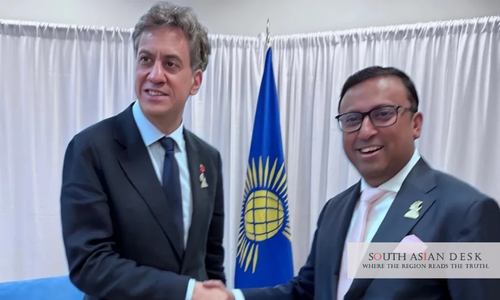
Bangladesh-UK bilateral relations were in focus on Monday, when Acting Foreign Minister Humaiun Kobir met UK Foreign Secretary Ed Miliband on the sidelines of the Commonwealth Heads of Government Meeting (CHOGM) in St John’s, Antigua and Barbuda. Both ministers expressed satisfaction with the direction of ties between Dhaka and London, according to a statement issued by Bangladesh’s Ministry of Foreign Affairs.
Strengthening Bangladesh-UK Bilateral Relations Through Trade and Investment
During the meeting, the two ministers noted that the relationship has grown steadily, marked by robust exports of Bangladeshi goods to the UK market and by British investment in Bangladesh. The statement did not give figures for either, but the emphasis on trade and investment reflects the economic weight of the partnership for both sides.
The ministers also discussed Bangladesh’s agreement to purchase Airbus aircraft for its national flag carrier, the Ministry of Foreign Affairs said. The reports available did not detail the size or value of the order or the role the UK might play in it, and the foreign ministry’s account described the topic as a matter of discussion rather than a new commitment.
Cooperation in Multilateral Forums
Beyond bilateral commerce, Mr Kobir and Mr Miliband agreed to extend reciprocal support in multilateral forums on a range of issues, including climate change, safe, orderly and regular migration, and humanitarian assistance. These are areas where the two governments have long engaged each other, and where coordinated positions can carry weight in international negotiations.
Climate cooperation has featured in recent exchanges at other levels. In May, Bangladesh’s Environment, Forest and Climate Change Minister Abdul Awal Mintoo met British Deputy High Commissioner James Goldman in Dhaka, where the two sides discussed renewable energy, carbon credit, climate financing, biodiversity conservation and protection of the Sundarbans, according to BSS.
British Support on the Rohingya Crisis
The Rohingya issue formed another important part of the discussion. The UK Foreign Secretary thanked Bangladesh for hosting around one million forcibly displaced Myanmar nationals and assured continued British humanitarian support for the Rohingya, the Ministry of Foreign Affairs said.
The assurance carries practical significance for Dhaka, which has repeatedly sought sustained international funding and political attention for the refugees in Cox’s Bazar. Earlier this year, Bangladesh’s foreign minister likewise appreciated the UK’s continued support for the Rohingya and urged London to maintain its leadership in international efforts to secure their safe, voluntary and dignified repatriation to Myanmar, according to Dhaka Tribune.
An Invitation to Visit Dhaka
The Business Standard reported that Mr Kobir also conveyed an invitation from Bangladesh’s prime minister to his British counterpart to visit Bangladesh at a mutually convenient time. No date has been announced. A prime ministerial visit would be a notable step in the relationship, particularly as both governments have spoken in recent months of deepening cooperation.
Background to the Latest Engagement
The meeting at CHOGM follows a series of diplomatic contacts in 2026. In March, British High Commissioner Sarah Cooke told reporters after a meeting at the foreign ministry in Dhaka that discussions had reaffirmed the strength and depth of the partnership, according to Observer. She also highlighted the UK’s Developing Countries Trading Scheme, which she said could help Bangladesh diversify its exports, and described the UK as one of the largest investors in the country.
In April, State Minister for Foreign Affairs Shama Obaed Islam met UK Trade Envoy Baroness Rosie Winterton at a dinner hosted by Ms Cooke, where both sides reiterated their commitment to strengthening the partnership, the Observer reported. In late June, Ms Cooke said a second Bangladesh-UK Joint Working Group meeting would be held in London on 7 and 8 July, with two agreements expected to be signed.
What the Meeting Signals
The talks in Antigua and Barbuda did not produce any headline agreement, and the ministry’s account focused on expressions of satisfaction, shared priorities and pledges of continued support. Even so, such sideline meetings serve to keep political channels open between capitals, and they allow ministers to follow up on commercial and humanitarian issues that are often handled by officials.
For Bangladesh, the combination of strong exports, British investment, the Airbus purchase and continued Rohingya assistance forms a broad agenda. How much of it translates into concrete outcomes may become clearer if the prime ministerial invitation is taken up and a visit to Dhaka is scheduled, which would give Bangladesh-UK bilateral relations a further boost.
Follow SouthAsianDesk on X, Instagram and Facebook for insights on business and current affairs from across South Asia.