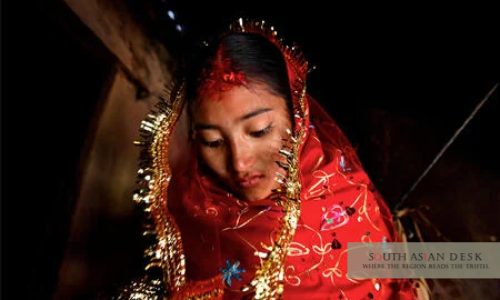
Child marriage in Bangladesh remains the highest in South Asia, with nearly half of young women wed before the age of 18, according to a report published by Dhaka Tribune drawing on international data. Although the national rate has fallen slightly in recent years, the overall situation has not changed significantly, and the country continues to top the regional rankings. The finding underlines how far Bangladesh still has to travel to meet its commitment to end the practice.
A Regional Burden With Bangladesh at the Top
South Asia carries a disproportionate share of the global problem. According to UNICEF, around 45 per cent of all child brides in the world live in the region, amounting to roughly 290 million women and girls. Within South Asia, Bangladesh records the highest prevalence. UNICEF’s 2023 analysis, which relied on the 2019 Multiple Indicator Cluster Survey, found that 51 per cent of young women in Bangladesh were married in childhood and ranked the country eighth in the world. Other datasets give slightly lower estimates. Girls Not Brides, for instance, places the under-18 rate at 47 per cent, well ahead of Nepal at 35 per cent, Afghanistan at 29 per cent and India at 23 per cent.
The gap between Bangladesh and its neighbours is notable because the country has performed better than many of them on other gender-related indicators. Arab News has reported that Bangladesh has one of the highest rates of girls’ enrolment in secondary school in the region, which suggests that schooling alone has not been enough to keep girls from early marriage.
Why Child Marriage in Bangladesh Persists
Experts describe the practice as more than a social custom. Dhaka Tribune’s report stresses that it is closely linked to poverty and gender inequality, which together shape decisions within households about the value and future of daughters. Families facing economic hardship may see marriage as a way to reduce financial pressure or to protect a girl’s perceived safety, even when the consequences for her health, education and independence are severe.
Shireen Pervin Huq, a founding member of the women’s rights organisation Naripokkho, spoke to the newspaper about why the practice remains entrenched in society. Other researchers have pointed to shocks that make families more vulnerable. UNICEF has noted that extreme weather events increase the risk to girls, and that droughts, floods and other climate stresses have prompted early marriages in Bangladesh. The pandemic years also disrupted schooling and incomes, and some experts warned at the time that the rate was rising.
Wide Gaps Within the Country
The prevalence of child marriage differs significantly from one part of Bangladesh to another, and survey data show that the risk is not the same for all girls. A UNICEF evidence profile on Bangladesh cited divisional rates of 63.7 per cent in Rajshahi, 57.7 per cent in Rangpur and 56 per cent in Barishal, all above the national average. The profile also found that inequalities in women’s education, household wealth and urban or rural residence contribute to uneven declines across the country. In practical terms, a girl from a poor rural household with limited schooling faces a far higher risk than a girl from a wealthier urban family.
Legal Framework Under Scrutiny
Bangladesh enacted the Child Marriage Restraint Act in 2017 to prevent the practice, setting the legal minimum age at 18 for women and 21 for men. Rights advocates, however, have long argued that enforcement is weak and that the legal framework contains exceptions. Girls Not Brides notes that, in Bangladesh, girls as young as 14 can be married with parental consent, and that the coexistence of civil, religious and customary laws often undermines girls’ ability to seek protection or remedy.
The pace of change is the central concern. A 2025 assessment by UNFPA stated that, if the current rate of decline continues, it could take more than two centuries to eliminate child marriage in Bangladesh. That projection is a stark reminder that gradual improvement will not be enough to reach the global target of ending the practice by 2030.
What Needs to Change
UNICEF has described the number of child brides in Bangladesh as staggering and has called for urgent and concerted action to keep girls in school and give them the chance to reach their full potential. Analysts say that sustained progress would require stronger enforcement of the law, targeted support for the divisions with the highest rates, and economic measures that reduce the pressure on poor families. Without such steps, the country is likely to remain at the top of the regional table for years to come.
Follow SouthAsianDesk on X, Instagram, and Facebook for insights on business and current affairs from across South Asia.
Read More: