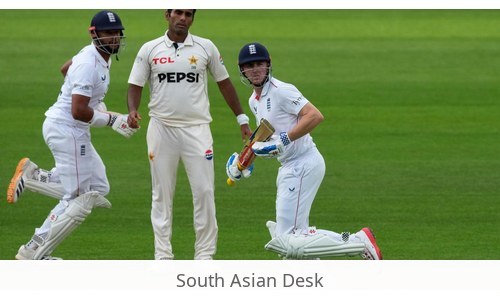
The England Pakistan Lord’s Test concluded on Sunday with a commanding 194-run win for the home side, sealing an unassailable 2-0 lead in the three-match series with one fixture still to be played. Chasing a daunting target of 389, Pakistan were bowled out for 194 on the fourth day, unable to build on an encouraging start to their innings despite a fighting effort from middle-order batter Saud Shakeel.
England Pakistan Lord’s Test – How the Chase Unfolded
Pakistan’s pursuit of 389 began poorly and never recovered. Opener Azan Awais was dismissed for six off 14 balls when Ollie Robinson trapped him leg before wicket in the fifth over, and Robinson struck again with the final delivery of the same over, bowling Abdullah Shafique without scoring. The damage deepened shortly afterward when Jofra Archer removed captain Babar Azam for six off eight balls, leaving Pakistan at 14 for 3 inside eight overs. Opener Imam-ul-Haq did not bat in the second innings after tearing his left calf earlier in the match, compounding an already difficult position for the tourists.
Some resistance followed in the second session, as Shakeel and Shan Masood added 97 runs for the fourth wicket to steady the innings temporarily. Shakeel went on to complete his eleventh Test half-century and continued to accumulate runs with control, eventually falling for 97 off 122 balls, an innings that included 13 fours and two sixes. It was the highest individual score of the match for either side, yet it proved insufficient once the rest of the batting order failed to offer sustained support. No other Pakistan batter passed fifty in either innings of the Test.
Ollie Robinson’s Eight Wickets Define the Match
Ollie Robinson’s eight wickets across the two innings were central to England’s victory and earned him the Player of the Match award. He finished with figures of 4 for 11 in Pakistan’s first innings, a spell that helped bowl the visitors out for just 110, and followed it with 4 for 24 in the second innings as Pakistan’s chase unravelled. His removal of Mohammad Rizwan for a duck, leg before wicket, left Pakistan struggling at 115 for 5 and effectively ended any realistic hope of an unlikely victory.
Josh Tongue offered valuable support in the closing stages, finishing with 3 for 46 in the second innings, including the final wicket of the match. Jofra Archer also contributed with the early breakthrough of Babar Azam and later removed Ali Usman after he had added 31 useful runs alongside Shakeel. Between them, England’s seam attack exploited home conditions with consistency across both innings, a pattern that has now defined the series.
Pakistan’s Struggles with the Bat
Pakistan’s batting was exposed for the majority of the Lord’s Test. Their first-innings total of 110 left them with a deficit too large to recover from, particularly once England, powered by Dan Lawrence’s unbeaten 54 amid rain interruptions on the third day, extended their advantage to a second-innings total of 208 all out. That gave England a lead of 388 runs, a mountain that no Pakistan side has scaled from such a position in recent memory.
Mohammad Abbas offered a rare highlight for the tourists with the ball, finishing with match figures of 9 for 130, including a five-wicket haul of 5 for 57 in England’s second innings. It was the second-best set of bowling figures recorded by a Pakistan bowler at Lord’s, behind only Yasir Shah’s 10 for 141 in 2016. Abbas, at 36, also made the honours board at the venue for the first time in his career, a personal milestone that stood in contrast to his side’s collective struggles.
England’s 2-0 Series Lead
The result confirms England’s 2-0 series lead, built on the back of an innings-and-103-run victory at Headingley in the opening Test. It marks a strong start for Joe Root in his second tenure as captain and represents England’s first series success since December 2024. The margin of victory at Lord’s, coming after Pakistan had never previously reached 200 in any of their three completed innings in the series, underlines the gap between the two sides across the opening two matches.
With the series already decided, attention will now turn to the third and final Test, where Pakistan will look to salvage some pride against an England attack that has bowled with control and discipline throughout. For the home side, the challenge will be maintaining the intensity that has delivered two convincing results, while Pakistan will hope for improved application with the bat if they are to avoid a series whitewash.
Published in SouthAsianDesk, August 31st, 2026
Follow SouthAsianDesk on X, Instagram and Facebook for insights on business and current affairs from across South Asia.