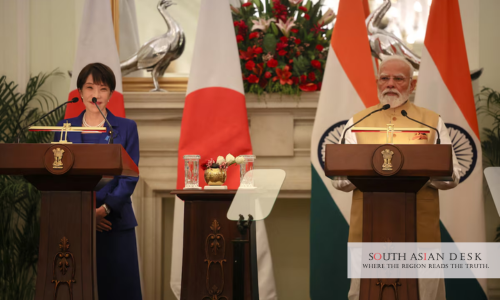
India-Japan AI cooperation has moved to the centre of a wider strategic push between New Delhi and Tokyo, after Indian Prime Minister Narendra Modi and Japanese Prime Minister Sanae Takaichi signed new agreements covering artificial intelligence, metals, energy resilience, defence and economic security.
The pacts were announced during Takaichi’s first official visit to India for the 16th India-Japan Annual Summit, where both sides sought to give their partnership a sharper economic and technological focus. The outcome reflects a broader effort by India and Japan to build more resilient supply chains, deepen strategic trust and expand cooperation in sectors that are increasingly tied to national security.
The two leaders adopted three major documents covering economic security, energy resilience and AI. India’s official list of summit outcomes said the artificial intelligence agreement would elevate the relationship into a strategic research and development partnership across the AI technology stack. This includes cooperation around safe, secure, trusted, inclusive and human-centric AI.
India-Japan AI cooperation becomes a strategic priority
The clearest signal from the summit was that India-Japan AI cooperation is no longer being treated as a narrow technology issue. Instead, it is now part of a wider strategic framework that includes semiconductors, clean energy, critical minerals, digital infrastructure and industrial resilience.
Modi said that Japan’s precision technology and India’s software capabilities could bring new momentum to global AI development. That formulation captures why the partnership matters. Japan brings strengths in advanced manufacturing, robotics, hardware systems and industrial precision. India brings a large technology workforce, software expertise, data-driven innovation and a fast-growing digital economy.
The new AI framework also builds on earlier India-Japan initiatives in emerging technology. Among the outcomes announced were institutional cooperation between IndiaAI Mission and Japan’s GENIAC initiative, support for business-to-business matchmaking, webinars on AI policy and possible joint projects with access to computing resources. Separate agreements also involved collaboration on large language models and foundation model development.
These outcomes show that the two countries are looking beyond general statements of intent. The aim is to create practical pathways for research, computing capacity, model development, policy exchange and commercial collaboration.
Modi Takaichi talks focus on economic security
The Modi Takaichi talks also produced an India-Japan Joint Declaration on Economic Security. The declaration is designed to promote project-based cooperation in semiconductors, critical minerals, information and communication technology, clean energy and pharmaceuticals.
That matters because economic security has become a central concern for major Asian economies. Supply chain disruptions, export restrictions and dependence on a limited number of sources for key minerals and technologies have pushed governments to rethink trade and industrial policy. India and Japan both want more diversified and reliable access to materials and components used in advanced manufacturing, clean energy and digital infrastructure.
Critical minerals cooperation was a major part of the summit’s economic agenda. These minerals are essential for batteries, electric vehicles, semiconductors, defence equipment, renewable energy systems and high-end electronics. The two sides also agreed to strengthen cooperation in geology and mineral exploration, including through the exchange of technical expertise in upstream exploration.
For India, such cooperation can support its ambition to expand domestic manufacturing and reduce dependence on imported inputs. For Japan, it strengthens access to alternative partners at a time when supply chain security has become closely linked to industrial competitiveness.
India Japan energy resilience pact adds depth to the partnership
The India Japan energy resilience agreement was another important outcome of the summit. The joint statement on energy resilience covers strategic stockpiling, reserve mechanisms for crude oil and petroleum products, and cooperation across the maritime energy transport value chain.
Both countries are major energy consumers and remain exposed to volatility in global energy markets. The summit statement specifically referred to the importance of uninterrupted freedom of navigation and the smooth flow of global commerce, including through the Strait of Hormuz. That reference is significant because maritime chokepoints remain central to Asian energy security.
The two sides also agreed to explore joint investments across the energy transport value chain. Cooperation on strategic petroleum reserves, technical exchanges and stockpiling practices could help both countries manage market shocks more effectively.
Clean energy cooperation was also part of the package. India and Japan announced a Cooperative Biogas for Growth initiative aimed at supporting India’s target of establishing 1,000 biogas and organic fertiliser plants. They also highlighted battery supply chains, clean ammonia, green hydrogen, solar PV technologies and nuclear energy as areas for future cooperation.
First India Japan defence pact adds strategic weight
Beyond AI and energy, the summit also carried a major defence component. Modi said the two countries had signed an agreement on their first defence co-development project. The project is linked to naval radio antenna systems, marking a new step in India Japan defence pact cooperation.
This is important because India and Japan have historically built strong economic ties, but their defence industrial cooperation has moved more cautiously. A first co-development project suggests that the relationship is entering a more operational phase, especially in maritime security and defence technology.
The joint statement also pointed to cooperation in maritime domain awareness, naval maintenance, repair and overhaul, and defence equipment and technology under the Make in India framework. This aligns with broader Indo-Pacific security concerns, where both countries favour a free, open and rules-based maritime order.
India and Japan are also members of the Quad, alongside the United States and Australia. While the summit was bilateral in form, its outcomes fit into a wider regional pattern of cooperation on supply chains, critical technologies, maritime security and energy resilience.
Japan investment in India remains a major pillar
The latest agreements build on an already substantial economic relationship. Bilateral trade between India and Japan reached $27.5 billion in the 2025-26 fiscal year, while Japanese investment in India stood at $3.2 billion between April and December 2025. Japan is also one of India’s major investors and has backed major infrastructure projects, including the Mumbai-Ahmedabad high-speed rail corridor.
Takaichi’s visit came with a large business delegation, underlining the commercial dimension of the summit. The technology and energy pacts are therefore not merely diplomatic statements. They are intended to support business linkages, research partnerships, investment flows and industrial collaboration.
Japanese companies have long been active in India’s manufacturing and infrastructure sectors. The new focus on AI, batteries, semiconductors, biogas, pharmaceuticals and critical minerals could expand that footprint into sectors central to the next phase of economic growth.
The summit also follows Modi’s visit to Tokyo last year, when Japan pledged to more than double its investment in India to over $61 billion over the next decade. That target gives the latest agreements a wider economic frame, connecting strategic cooperation with long-term investment planning.
Why the India Japan Annual Summit matters
The 16th India Japan Annual Summit shows how the relationship has evolved from traditional development and infrastructure cooperation into a more complex strategic partnership. The two countries are now linking trade, investment, defence, energy security, emerging technologies and supply chain resilience under one framework.
This approach reflects the changing global environment. Artificial intelligence is no longer just a commercial technology. Critical minerals are no longer just commodities. Energy transport is no longer just a logistics issue. Each of these areas now affects economic independence, industrial competitiveness and national security.
For India, closer cooperation with Japan can support its manufacturing ambitions, AI development, clean energy transition and critical minerals strategy. For Japan, India offers a large market, a growing technology base and a strategic partner in the Indo-Pacific.
The challenge will be implementation. The agreements announced in New Delhi will need to translate into research projects, financing structures, joint ventures, regulatory coordination and private sector participation. The real test will be whether the new framework produces tangible results in AI systems, mineral exploration, battery manufacturing, strategic reserves, clean energy projects and defence technology.
Still, the direction is clear. India-Japan AI cooperation has become the anchor for a wider strategic partnership that now spans technology, energy, metals, defence and economic security. In a world where supply chains and security concerns increasingly overlap, New Delhi and Tokyo are positioning their partnership as both commercially useful and strategically necessary.
Published in SouthAsianDesk, July 3, 2026
Follow SouthAsianDesk on X, Instagram and Facebook for insights on business and current affairs from across South Asia.