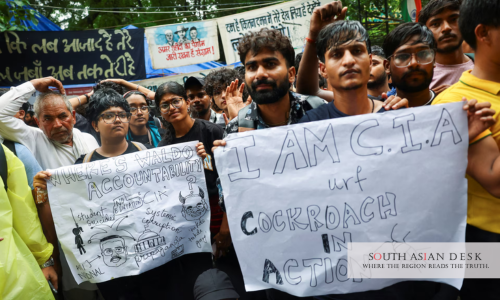
India youth protests continued in New Delhi as thousands of demonstrators returned to Jantar Mantar following violent clashes between supporters of the Cockroach Janta Party and security forces near Parliament.
More than 5,000 protesters gathered at the designated protest site on Tuesday, July 21, a day after a planned march towards Parliament was stopped by police using tear gas and batons. The demonstrators are demanding accountability over examination paper leaks, changes to India’s testing system and the resignation of Education Minister Dharmendra Pradhan.
Delhi Police said nearly 180 people were injured during the confrontation on Monday. The official figure included 118 police and security personnel and 60 protesters. Cockroach Janta Party founder Abhijeet Dipke separately claimed that more than 150 protesters were receiving hospital treatment. The competing figures have not been independently verified.
Police accused demonstrators of violating prohibitory orders and engaging in aggressive and violent conduct. Protest organisers, however, accused officers of using excessive force against participants, including women, as protesters attempted to advance towards Parliament during the opening of its monsoon session.
India youth protests persist despite government assurances
India youth protests have continued despite assurances that the government will punish those responsible for irregularities in the national medical entrance examination.
Prime Minister Narendra Modi told lawmakers from the governing alliance that strict action should be taken against those responsible and that a more reliable examination system must be established. Parliamentary Affairs Minister Kiren Rijiju said the government had acted after receiving information about the irregularities, arrested 13 people and successfully conducted a fresh examination.
The Cockroach Janta Party said it would maintain its protest campaign but would not immediately organise another march towards Parliament because of concerns that participants could face another police crackdown.
Education Minister Dharmendra Pradhan later said the government was committed to addressing students’ concerns and introducing examination reforms. However, neither the government nor the ruling Bharatiya Janata Party has accepted demands for his resignation.
The demonstrations began over the leak of question papers for a national medical entrance examination in May. The breach affected approximately two million candidates and intensified existing concerns about the security, transparency and fairness of highly competitive examinations in India.
For millions of Indian students, entrance tests provide access to medical colleges, government employment and opportunities for economic advancement. Paper leaks can force authorities to cancel or repeat examinations after candidates have spent months or years preparing.
Cockroach Janta Party protests grow beyond examination dispute
The Cockroach Janta Party protests began as an online satirical campaign before developing into a broader youth-led movement.
The group has used social media, political satire and the cockroach as a symbol of resilience. Its campaign has attracted young Indians frustrated by recurring examination controversies, limited employment opportunities and what they consider a lack of institutional accountability.
The movement expanded from online activity to demonstrations in cities and university campuses after Dipke returned to India and began organising street protests. The Jantar Mantar protest later grew from several hundred participants to gatherings of several thousand people.
Although the NEET-UG 2026 paper leak remains the immediate focus, the campaign now reflects wider dissatisfaction among young Indians over education, unemployment and confidence in public institutions.
Protesters are seeking Pradhan’s resignation, comprehensive examination reforms and compensation for the families of students reported to have died by suicide following the examination controversy. Local media reports cited by protest organisers have placed the number of such deaths at about a dozen, although the figure has not been independently confirmed.
The movement has demanded compensation of 10 million Indian rupees for each affected family.
Sonam Wangchuk hunger strike strengthens movement
The Sonam Wangchuk hunger strike has helped draw greater national attention to the campaign.
Wangchuk began fasting on June 28 in solidarity with the protesters. Police moved him to a hospital on July 18 after authorities said his health had deteriorated, prompting further anger among supporters of the movement.
His wife subsequently petitioned the Delhi High Court, alleging that he had been unlawfully detained and seeking permission for him to receive treatment at a private hospital. The court allowed the transfer on July 21.
Two government ministers later visited Wangchuk and urged him to end his hunger strike. Wangchuk said he would end the fast only after receiving assurances that participants would not face punitive or retaliatory legal action because of their involvement in the protests.
Opposition intensifies pressure over Delhi protest clashes
The Delhi protest clashes have also become a major political issue inside and outside Parliament.
Congress leaders Rahul Gandhi and Priyanka Gandhi Vadra joined a demonstration outside Modi’s residence on July 21. Police briefly detained them and several other opposition figures before releasing them.
Opposition lawmakers continued their campaign in Parliament the following day, gathering outside the building in support of the students and demanding Pradhan’s resignation. Protests and repeated interruptions forced the suspension of proceedings in both parliamentary chambers.
Rahul Gandhi called for action against officers accused of attacking students and demanded an apology from Modi. The government has not accepted the opposition’s demands.
Demonstrations have also spread beyond Delhi to cities including Mumbai, Bengaluru, Kolkata, Ahmedabad, Guwahati, Jammu and Thiruvananthapuram. Security remained tight in central Delhi, where 16 metro stations were temporarily closed before reopening on Wednesday evening.
Jantar Mantar protest sustained by nationwide support
The Jantar Mantar protest continued on July 22 despite intermittent monsoon rain and heavy security around the site.
The number of protesters reached approximately 5,000 by late afternoon. Volunteers distributed meals, bottled water, fruit and medical supplies sent by supporters from across India and overseas.
Volunteer doctors and medical students established a temporary medical facility to provide first aid and treatment for dizziness, nausea and injuries. Other participants managed food deliveries, cleared rubbish and helped maintain the encampment.
The support network has allowed the demonstrations to continue around the clock despite restrictions around the protest site. Organisers have presented the public donations as evidence that dissatisfaction over India examination paper leaks extends beyond the students directly affected.
The movement remains decentralised and largely dependent on social media rather than the organisational structure of a conventional political party. That independence has helped it appeal to students, professionals and families, although growing support from opposition parties has increased the likelihood that the dispute will become more politically contested.
The government’s promises of punishment, examination reforms and greater accountability have not yet ended the India youth protests. With demonstrators continuing to gather and opposition lawmakers raising the issue in Parliament, pressure is likely to remain on the Modi administration to provide specific reforms and a more detailed response to allegations of examination mismanagement and police violence.
Published in SouthAsianDesk, July 23, 2026
Follow SouthAsianDesk on X, Instagram and Facebook for insights on business and current affairs from across South Asia.