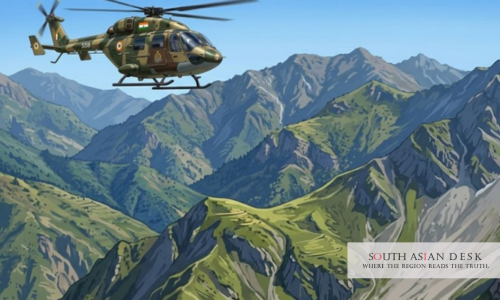
An Indian military helicopter committed an airspace violation over Nepal’s Darchula district on the morning of 10 June, flying without prior authorisation through the sovereign Nepali territory of Chhangru while transporting Shatrujeet Singh Kapoor, the director-general of India’s Indo-Tibetan Border Police, toward the disputed Kalapani region, according to Nepali district administration officials and security agencies who have verified the breach and initiated a formal request for explanation to Indian authorities.
The incident took place at approximately 10:00 am, when the helicopter bypassed the established border route along the Mahakali river, entered ward 1 of Byas Rural Municipality, and flew directly over Chhangru village before proceeding towards Kalapani. Weather conditions at the time were clear, and local officials confirmed there was no meteorological emergency or technical distress that could account for the departure from standard routing. The Armed Police Force company stationed at Chhangru observed the Indian military helicopter’s Nepal airspace violation immediately and relayed the report through the APF 44th Battalion Headquarters in Khalanga to the Ministry of Home Affairs in Kathmandu.
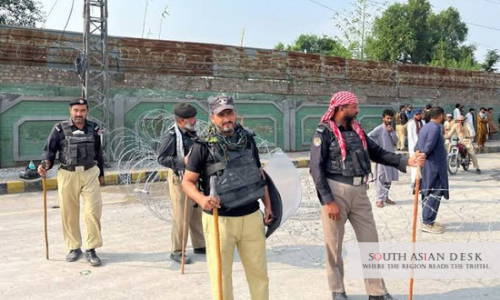
Residents of Chhangru Protest the Indian Military Helicopter’s Nepal Airspace Violation
The flight path drew an immediate and visible reaction from residents on the ground. A local youth who witnessed the incident told Kantipur that Indian helicopters routinely fly along the Mahakali river on their own side of the border and are rarely a cause for alarm. This time was different. “On Wednesday, the helicopter flew directly above our houses. It felt like an intrusion into our private lives. We all ran out of the house, shouting and protesting in anger,” he said.
Mohan Singh Dhami, the assistant chief district officer of Darchula, confirmed the breach to reporters. “We have verified that the Indian military helicopter entered Nepali airspace without the required prior permission from the government of Nepal,” he said. He noted that Kapoor was reportedly heading to inspect ITBP barracks at Gunji in the Kalapani area but that the absence of any adverse weather or technical emergency made the deviation from standard border routing difficult to justify. The local administration is writing to the office of the District Magistrate in Pithoragarh, India, requesting a formal clarification on why Nepali airspace was entered without communication.
Pattern of Violations and the Kalapani Dispute
The Indian military helicopter’s Nepal airspace violation is not without precedent. In 2021, Nepal’s Ministry of Foreign Affairs sent a formal diplomatic protest note to New Delhi after Indian military helicopters repeatedly violated Nepali airspace by flying over the Guru Gorakh Battalion Headquarters of the Nepali Army in Khalanga, the district headquarters of Darchula. Following that incident, the District Security Committee formally recommended that Kathmandu request India to respect its territorial borders.
The recurrence of such incidents is inseparable from the broader Kalapani dispute, which sits at the heart of one of South Asia’s most entrenched and historically documented territorial disagreements. Nepal regards the Kalapani, Lipulekh, and Limpiyadhura region as an integral part of its sovereign territory under historical treaties, but the area has been occupied by the Indian military, ITBP, and Sashastra Seema Bal for decades. In 2019, India published a new political map claiming these territories, prompting Nepal to issue its own revised political map incorporating them. That map was subsequently enshrined in a constitutional amendment unanimously endorsed by Nepal’s parliament on 13 June 2020.
In the years since, Nepal has taken practical security steps to reinforce its presence in the contested frontier. The APF company at Chhangru and a Border Outpost at Tinkar were both established in the wake of the 2020 constitutional amendment as visible assertions of Nepali administrative presence along the disputed boundary.
India’s Unilateral Infrastructure and the Pilgrimage Route
India, in the same period, has continued to assert its own position on the ground. Despite Nepal’s persistent diplomatic protests, New Delhi has unilaterally constructed a strategic road through Kalapani territory connecting to Mount Kailash and Mansarovar in Tibet. The road, which passes through Lipulekh, has been a central point of contention between the two governments.
Last month, Nepal’s Ministry of Foreign Affairs dispatched yet another diplomatic note after India and China agreed to expand bilateral trade through the Lipulekh pass, an arrangement that Nepal regards as further consolidating Indian administrative authority over territory it claims as its own.
The timing of the airspace incident carries additional significance. Just days before the helicopter flew over Chhangru, Indian Minister of State for External Affairs Pabitra Margherita formally flagged off the first batch of Indian pilgrims travelling to Mansarovar via the contested Lipulekh route, a high-profile administrative act that Nepal interprets as a deliberate assertion of Indian sovereignty over the passage.
Security Experts Call for Formal Government Response
Former Nepali Army Lieutenant General Sharad Giri said the entry of a foreign military helicopter into Nepal’s airspace must be treated as a serious matter regardless of whether it was deliberate or the result of a technical problem. “Whether it entered intentionally or due to a technical problem, the government must seek an explanation. Regardless of the circumstances, this cannot be taken as a normal incident,” he said.
Giri added that even if the aircraft had entered Nepali airspace due to a technical issue, the relevant Indian authorities were obligated to notify Nepal through appropriate diplomatic channels immediately. The absence of any such notification, he said, means the incident should be formally categorised and responded to as an airspace violation.
The combination of the Indian military helicopter Nepal airspace violation, the ongoing road and infrastructure assertions in Kalapani, and the Lipulekh pilgrimage route dispute creates a compounding pattern of friction that Nepal’s government faces pressure to address through sustained diplomatic engagement rather than individual protest notes, which have repeatedly failed to produce a lasting change in Indian conduct along the contested frontier.
Published in SouthAsianDesk, June 16, 2026
Follow SouthAsianDesk on X, Instagram and Facebook for insights on business and current affairs from across South Asia.