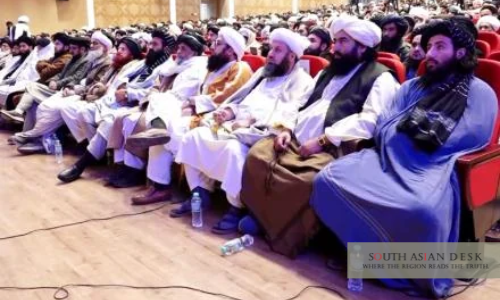
The Islamic Emirate leader, Sheikh Hibatullah Akhundzada, called for unity and solidarity among Afghans on Tuesday as he addressed a Kabul conference examining the effects of his decrees. He told the gathering that the presence of an Amir ensures the implementation of Islamic Sharia, and he urged people to become familiar with the true nature of the Islamic Emirate.
Akhundzada arrived in Kabul on the second day of the event, which is being held at Kabul University. The visit drew attention because the leader, who is based in Kandahar, rarely appears in the capital. Participants at the conference conferred on him the title of Sheikh-ul-Islam.
The Islamic Emirate Leader Addresses Scholars and Officials
The four-day gathering, which began on Monday, is formally titled a scientific and research conference on the impact of the leader’s decrees. It was organised by Wardak University under the Ministry of Higher Education, and Pajhwok reported that thousands of religious scholars, university lecturers, researchers and officials attended. The programme covers the religious, political, social, economic and cultural dimensions of the decrees.
In his speech, the Islamic Emirate leader posed a series of questions about the duties of the Amir al-Mu’minin and the rights that Muslims and their leader hold over one another. He said it was the responsibility of religious scholars to raise public awareness of these matters.
He also said that not an inch of Afghanistan’s territory was now under the control of others, and that the Islamic Emirate was established after the end of what he described as sedition. Afghanistan International reported, citing an audio recording attributed to the leader and broadcast by Taliban media, that he said his decrees were neither democratic nor a reflection of public opinion, and that retributive punishments could not be carried out without his orders.
A Message to Afghans Living Abroad
One of the most closely watched parts of the address was a direct appeal to Afghans living abroad. Akhundzada urged them to return home and to refrain from fighting to gain power. He said amnesty remained available to them and that they could resume their lives in the country.
He went further by suggesting that those who wished to hold government positions could be considered on merit. According to his remarks, anyone with the necessary qualifications and abilities would be given a post. Afghanistan International described the offer as the first time he had extended government posts to opponents in this way.
The appeal comes as Taliban officials continue to say that no armed opposition group maintains a physical presence inside Afghanistan, a claim that Tolo News has also reported in related coverage.
Officials Outline Achievements at the Kabul Conference
Other speakers at the Kabul conference reinforced the call for strict implementation of laws across society. Several participants argued that the success of the system depends on the satisfaction of both the people and God. Noor Ahmad Islamjar, the governor of Herat, said that without both forms of satisfaction, the administration would not enjoy genuine recognition and credibility, even if the whole world were to recognise it.
Noorul Haq Anwar, the Director General of Administrative Affairs, presented what he described as the achievements of the Islamic Emirate. These included preventing divisions, establishing a central administration, creating military courts to prevent oppression, and taking measures against injustice towards women while ensuring their access to rights under Sharia. He said that only those who have experienced hardship truly appreciate a blessing, recalling the situation before the Islamic Emirate came to power.
Claims about the treatment of women have been widely disputed by rights groups and several foreign governments, which have criticised restrictions imposed since 2021. The Islamic Emirate rejects that criticism and says its policies are rooted in Islamic law.
The Title of Sheikh-ul-Islam
The conferral of the title of Sheikh-ul-Islam was among the most notable developments of the event. The title has historically been used for prominent Islamic scholars and, in some periods, for senior religious officials. Taliban media reported that scholars attending the gathering bestowed it on the leader, who had previously been known by the titles Sheikh-ul-Hadith and Sheikh-ul-Quran.
Amu TV reported, citing sources among Kabul University professors, that participants had earlier been asked to state in forms whether they supported granting him the title. Those accounts have not been independently verified, and Taliban officials have presented the decision as the choice of the scholars present.
As the remaining sessions of the conference continue, attention will focus on whether the gathering produces recommendations on the implementation of the decrees, and how the leader’s invitation to opponents abroad is received.
Follow SouthAsianDesk on X, Instagram and Facebook for insights on business and current affairs from across South Asia.
Read More: