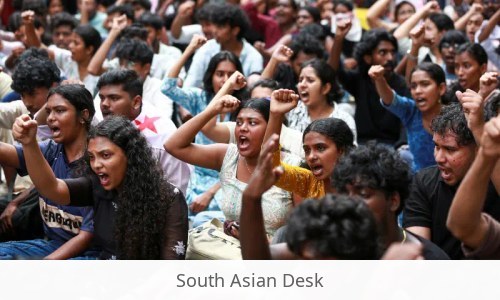
Jantar Mantar protest: The Cockroach Janta Party (CJP) continued its protest at Jantar Mantar, demanding the resignation of Education Minister Dharmendra Pradhan amid allegations of exam paper leaks. The government has agreed to hold talks with the CJP at a neutral venue today, signaling a potential turning point in the ongoing unrest.
Jantar Mantar Protest: Background of the Protests
The protests, which began in June, are part of a broader movement against corruption in India’s education sector. CJP founder Abhijeet Dipke has stated the protest will continue until Dharmendra Pradhan resigns, citing concerns over exam paper leaks. Nationwide demonstrations have erupted, with many protesters detained, emphasizing that the movement is about student rights rather than political affiliations.
Jantar Mantar, a historic site in Delhi, has long served as a focal point for public dissent in India. Its association with mass protests dates back decades, including movements against economic reforms in the 1990s and more recent campaigns for electoral transparency. This iteration of protests reflects a continuation of a pattern where students and educators leverage public spaces to demand accountability from institutions. The CJP’s focus on exam integrity aligns with broader concerns about systemic inequities in India’s education system, which has faced scrutiny for decades over issues like standardized testing irregularities, resource allocation, and bureaucratic inefficiencies.
Activists have highlighted systemic issues within the education system, including allegations of irregularities in standardized testing. The protests have drawn attention to long-standing grievances among students and educators, who argue that transparency and accountability are lacking in the administration of educational exams. These concerns are not new; similar allegations have surfaced in past years, particularly around high-stakes exams like the National Eligibility cum Entrance Test (NEET), which determines medical school admissions. The current unrest underscores a growing frustration with perceived failures in governance, particularly in sectors critical to India’s development trajectory.
Implications of Government Negotiations
The government’s willingness to engage in talks with the CJP marks a significant shift in addressing the protesters’ demands. Sonam Wangchuk, an activist who ended a 26-day hunger strike, emphasized the urgency of resolving the crisis to prevent potential violence. The negotiations may set a precedent for how the government addresses future protests and student demands.
Historically, Indian governments have often responded to mass protests with a mix of repression and selective concessions. The current approach—engaging in dialogue with the CJP—could signal a strategic pivot toward addressing underlying grievances rather than merely quelling dissent. If successful, the talks may lead to reforms in exam administration and greater transparency in the education sector. Such reforms could include the introduction of more rigorous oversight mechanisms, digital tracking of exam materials, and independent audits of testing processes.
The potential resolution could reshape student activism in India, influencing how educational policy is formulated and implemented. Past protests have occasionally led to incremental changes, such as the introduction of grievance redressal mechanisms or the establishment of oversight committees. However, the scale of this movement—spanning multiple states and involving sustained civil disobedience—suggests that any resolution may require more substantial policy adjustments. The government’s engagement with the CJP may also encourage other activist groups to pursue dialogue over confrontation, altering the dynamics of political engagement in the country.
The Jantar Mantar protest has become a symbol of the student rights movement, with activists linking it to broader issues of education sector corruption. The CJP government talks represent a critical juncture in this struggle, as Dharmendra Pradhan resignation remains a central demand. Meanwhile, the Sonam Wangchuk hunger strike has amplified pressure on authorities to act decisively.
Follow SouthAsianDesk on X, Instagram and Facebook for insights on business and current affairs from across South Asia.
Sources
- Jantar Mantar protest LIVE: Govt. has agreed to our request to hold talks today at neutral venue, says CJP – thehindu.com
- CJP Protest LIVE Updates: CJP, Union Ministers May Meet At 12.30 PM Today, Say Sources – ndtv.com
- ‘Not CJP or BJP, it’s about student rights’: Protests rage nationwide; many detained – indianexpress.com
- Indian activist Wangchuk ends 26-day hunger strike over exam paper leaks – aljazeera.com
- Two decades of mass protests in India – dawn.com
Image: i.dawn.com